







Question: Write a letter using a formal letter format to communicate your message. You are writing on behalf of the company to communicate a message. Please
- Write a letter using a formal letter format to communicate your message. You are writing on behalf of the company to communicate a message. Please refer to letter sample screenshot to help you create a professional letter. Using the you view is important in sharing the intent of your message. For this Review screenshot Cultivate a You View Remember to keep in mind the format and the audience for each piece of writing.
Scenario
Address of company:
Computers are Us
10 Binary Crescent
Dataville, O1O 010
Address of customer:
John Doe
52-7 Lilac Avenue
Winnipeg, Manitoba
R0R 0R0
Key Points to cover:
- This is a new computer store in the area
- Describe some of the services the store might offer
- There is also an internet cafe on site where you can use the computers while yours is getting repaired.
- Website will have more information (make up web address)
- Store open Monday to Friday, 9 am to 5 pm, closed on Sundays.
- Grand opening on (date and time); there will be some giveaways (you can make that up)
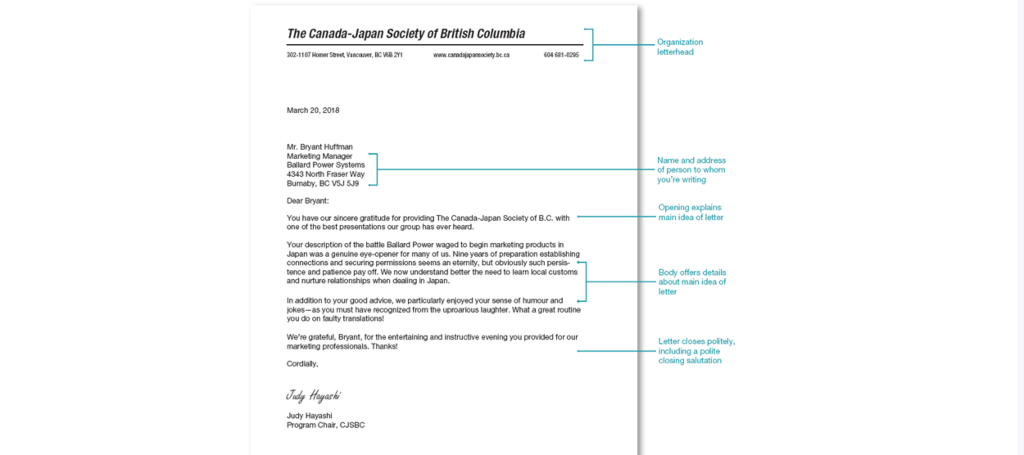
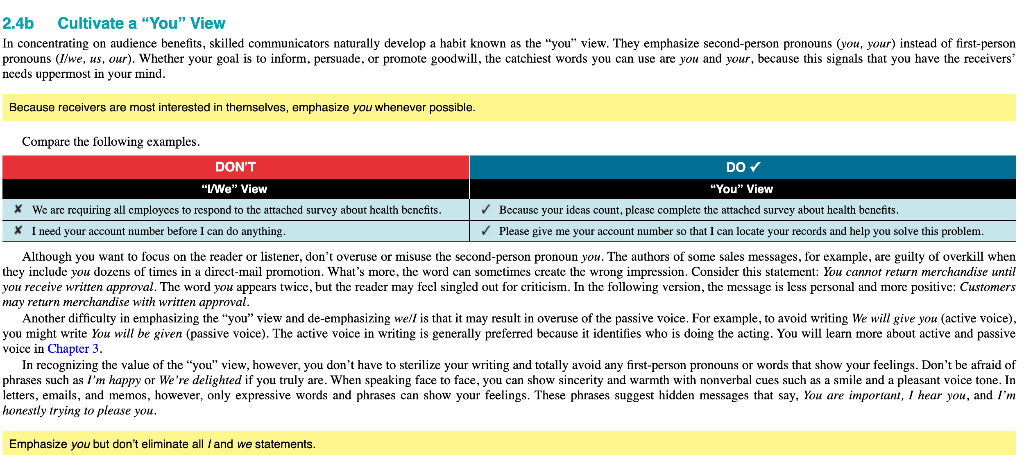
The Canada-Japan Society of British Columbia 302-1107 Homer Street, Vancouver, BC V8 271 www.canadajapansociety.be.ca 604 681-4295 March 20, 2018 Mr. Bryant Huffman Marketing Manager Ballard Power Systems 4343 North Fraser Way Burnaby, BC V5J 5J9 Dear Bryant: You have our sincere gratitude for providing The Canada-Japan Society of B.C. with one of the best presentations our group has ever heard. Your description of the battle Ballard Power waged to begin marketing products in Japan was a genuine eye-opener for many of us. Nine years of preparation establishing connections and securing permissions seems an eternity, but obviously such persis tence and patience pay off. We now understand better the need to learn local customs and nurture relationships when dealing in Japan. In addition to your good advice, we particularly enjoyed your sense of humour and jokes-as you must have recognized from the uproarious laughter. What a great routine you do on faulty translations! We're grateful, Bryant, for the entertaining and instructive evening you provided for our marketing professionals. Thanks! Cordially, Jody Hayashi Judy Hayashi Program Chair, CJSBC Organization letterhead Name and address - of person to whom you're writing Opening explains main idea of letter Body offers details about main idea of letter Letter closes politely, including a polite closing salutation 2.4b Cultivate a "You" View In concentrating on audience benefits, skilled communicators naturally develop a habit known as the "you" view. They emphasize second-person pronouns (you, your) instead of first-person pronouns (I/we, us, our). Whether your goal is to inform, persuade, or promote goodwill, the catchiest words you can use are you and your, because this signals that you have the receivers needs uppermost in your mind. Because receivers are most interested in themselves, emphasize you whenever possible. Compare the following examples. DON'T "I/We" View DO "You" View Because your ideas count, please complete the attached survey about health benefits. * We are requiring all employees to respond to the attached survey about health benefits. * I need your account number before I can do anything. Please give me your account number so that I can locate your records and help you solve this problem. Although you want to focus on the reader or listener, don't overuse or misuse the second-person pronoun you. The authors of some sales messages, for example, are guilty of overkill when they include you dozens of times in a direct-mail promotion. What's more, the word can sometimes create the wrong impression. Consider this statement: You cannot return merchandise until you receive written approval. The word you appears twice, but the reader may feel singled out for criticism. In the following version, the message is less personal and more positive: Customers may return merchandise with written approval. Another difficulty in emphasizing the "you" view and de-emphasizing well is that it may result in overuse of the passive voice. For example, to avoid writing We will give you (active voice), you might write You will be given (passive voice). The active voice in writing is generally preferred because it identifies who is doing the acting. You will learn more about active and passive voice in Chapter 3. In recognizing the value of the "you" view, however, you don't have to sterilize your writing and totally avoid any first-person pronouns or words that show your feelings. Don't be afraid of phrases such as I'm happy or We're delighted if you truly are. When speaking face to face, you can show sincerity and warmth with nonverbal cues such as a smile and a pleasant voice tone. In letters, emails, and memos, however, only expressive words and phrases can show your feelings. These phrases suggest hidden messages that say, You are important, I hear you, and I'm honestly trying to please you. Emphasize you but don't eliminate all and we statements
Step by Step Solution
There are 3 Steps involved in it
1 Expert Approved Answer
Step: 1 Unlock

Question Has Been Solved by an Expert!
Get step-by-step solutions from verified subject matter experts
Step: 2 Unlock
Step: 3 Unlock
 Study Help