







Question: Write a program that reads in two hexadecimal numbers from a file, hex.dat, and prints out the sum of the two numbers in hexadecimal. (As
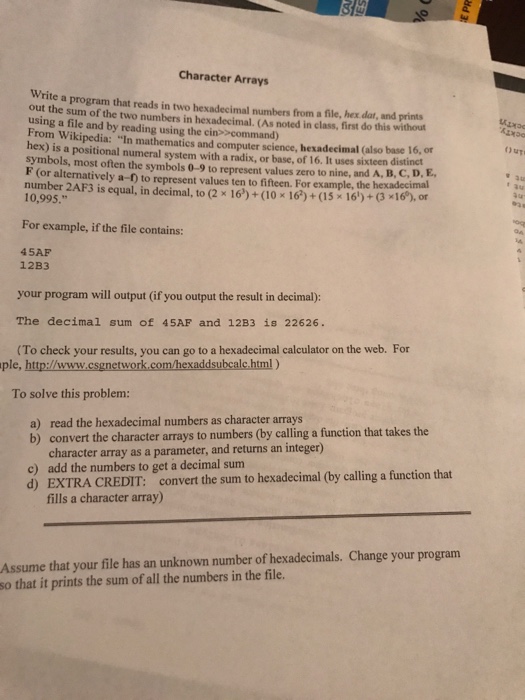
Write a program that reads in two hexadecimal numbers from a file, hex.dat, and prints out the sum of the two numbers in hexadecimal. (As noted in class, first do this without using a file and by reading using the cin > > command) From Wikipedia: "In mathematics and computer science, hexadecimal (also base 16, or hex) is a positional numeral system with a radix, or base, of 16. It uses sixteen distinct symbols, most often the symbols 0-9 to represent values zero to nine, and A, B, C, D, E, F (or alternatively a-f) to represent values ten to fifteen. For example, the hexadecimal number 2AF3 is equal, in decimal, to (2 times 16^3) + (10 times 16^2) + (15 times 16^1) +(3 times 16^0) or 10, 995." For example, if the file contains: 45AF 12B3 your program will output (if you output the result in decimal): The decimal sum of 45AF and 12B3 is 22626. (To check your results, you can go to a hexadecimal calculator on the web. For Example, http: //www.csgnetwork.com/hexaddsubcale.html) a) To solve this problem: read the hexadecimal numbers as character arrays b) convert the character arrays to numbers (by calling a function that takes the character array as a parameter, and returns an integer) c) add the numbers to get a decimal sum d) EXTRA CREDIT: convert the sum to hexadecimal (by calling a function that fills a character array) Assume that your file has an unknown number of hexadecimals. Change your program so that it prints the sum of all the numbers in the file. Write a program that reads in two hexadecimal numbers from a file, hex.dat, and prints out the sum of the two numbers in hexadecimal. (As noted in class, first do this without using a file and by reading using the cin > > command) From Wikipedia: "In mathematics and computer science, hexadecimal (also base 16, or hex) is a positional numeral system with a radix, or base, of 16. It uses sixteen distinct symbols, most often the symbols 0-9 to represent values zero to nine, and A, B, C, D, E, F (or alternatively a-f) to represent values ten to fifteen. For example, the hexadecimal number 2AF3 is equal, in decimal, to (2 times 16^3) + (10 times 16^2) + (15 times 16^1) +(3 times 16^0) or 10, 995." For example, if the file contains: 45AF 12B3 your program will output (if you output the result in decimal): The decimal sum of 45AF and 12B3 is 22626. (To check your results, you can go to a hexadecimal calculator on the web. For Example, http: //www.csgnetwork.com/hexaddsubcale.html) a) To solve this problem: read the hexadecimal numbers as character arrays b) convert the character arrays to numbers (by calling a function that takes the character array as a parameter, and returns an integer) c) add the numbers to get a decimal sum d) EXTRA CREDIT: convert the sum to hexadecimal (by calling a function that fills a character array) Assume that your file has an unknown number of hexadecimals. Change your program so that it prints the sum of all the numbers in the file
Step by Step Solution
There are 3 Steps involved in it

Get step-by-step solutions from verified subject matter experts
 Study Help