







Question: Write a recursive method that prints the binary form of a given non-negative integer, with the following specification: public class NPrint { public static void
Write a recursive method that prints the binary form of a given non-negative integer, with the following specification:
public class NPrint {
public static void binaryPrint(int n) {
// your implementation
}
}
The method prints the value of n as a BINARY number. If n is zero, then a single zero is printed; otherwise no leading zeros are printed in the output. Examples:
n=0 Output:0
n=4 Output:100
n=27 Output:11011
Hint: How to convert an int to its binary form? A very intuitive way is to divide the number by 2 in each recursion. In each recursive call, you print either '0' (unless it is a leading zero) if 2 divides n, or '1' otherwise.
Implement a concrete ArrayStack class that extends the Stack interface as we discussed in the class (any other different Stack class implementation, even if it is implemented by yourself, will not receive any credit).
Write a method that evaluates an arithmatic expression, which is given by a string.
public class Evaluate {
public static int expression(String str) {
// return the value
}
}
Your implementation is required to use the Stack interface we discussed in the class.
Write a necessary test program to verify the result. For example,
14-3*4+2*5-6*2 (should return 0)
You may want to test all possible corner conditions to make sure your implement is inclusive.
Your implementation only considers +, - and * operators and does not need to consider parentheses.
Bonus: extra 10 points will be awarded if you implementation supports parentheses. For examples:
14-3*(4+2*(5-6))*2 (should return 2)
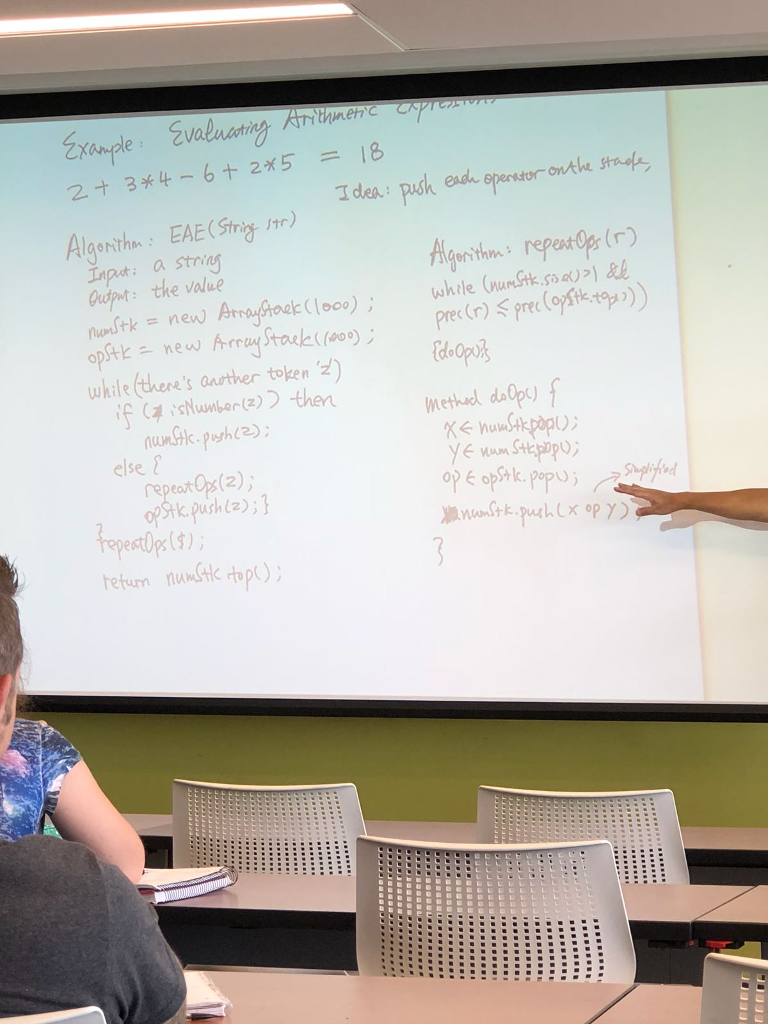 make the program similar to this class notes
Files Needed:
NPrint.java, Evaluate.java, Stack.java and ArrayStack.java.
Step by Step Solution
There are 3 Steps involved in it

Get step-by-step solutions from verified subject matter experts
 Study Help