Question: *****Write a short summary of the authors' viewpoint. How does he connect executive compensation to toilet paper hoarding? (Minimum 280 words) ETHICS! ETHICS AND THE
*****Write a short summary of the authors' viewpoint.
How does he connect executive compensation to toilet paper hoarding? (Minimum 280 words)
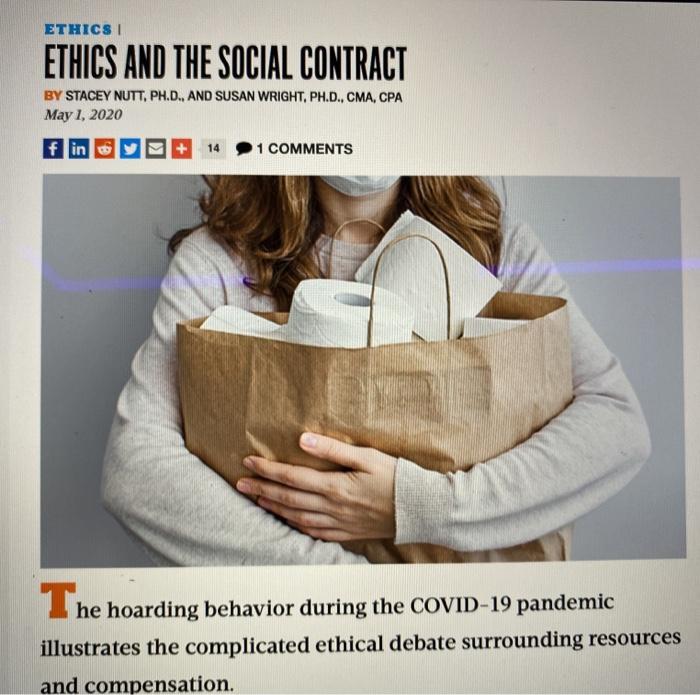
ETHICS! ETHICS AND THE SOCIAL CONTRACT BY STACEY NUTT, PH.D., AND SUSAN WRIGHT, PH.D., CMA, CPA May 1, 2020 14 1 COMMENTS The hoarding behavior during the COVID-19 pandemic illustrates the complicated ethical debate surrounding resources and compensation. In terms of both lives and wealth, the losses around the world due to COVID-19 are immense. When looking at how people reacted to this tragedy, let's hope the history books don't focus on those who decided to hoard cleaning supplies, toilet paper, and other resources, creating shortages for others. Such unfortunate behavior can also provide some insight into a more enduring ethical quandary in capitalist economies: the challenge of balancing competitive executive compensation with increasing income inequality and demands for equitable pay and fair distribution of resources. Executive compensation and income disparities are serious and difficult subjects that have been covered exhaustively by academics, politicians, and social commentators. Prescribed solutions often fit into the mold of either economic conservatism (i.e., "That's how capitalism works") or egalitarianism (i.e., "Share so that it's fair"). Politics aside, following the principle of fairness would help to resolve the ethical issues related to income inequality THE SOCIAL CONTRACT In the abstract, most agree that "hoarding" in its simplest form can be viewed as a social ill. Maybe it isn't the simple act of hoarding-whether toilet paper or compensation that's the issue. Perhaps it's a perceived violation of a sense of fairness or an implied social contract that incites public anger. When members of a society are perceived to violate such an agreement, like taking more than one's fair share of the toilet paper, the rest of society looks for quick and decisive action. When such behavior is exhibited by leaders of society through outsized executive compensation and conspicuous consumption, it isn't surprising that society might react even more aggressively with a backlash. Examples of compensation hoarding abound. In 2019, Adam Neumann, cofounder and ex-CEO of The We Company (WeWork's parent), walked away from a corporate implosion of his own making with a separation package in excess of $1.5 billion. And Jeff Bezos, founder and CEO of Amazon, has been publicly "comp shamed" over the fact that his company doesn't pay federal taxes as well as his recent inflexibility regarding employee sick pay during the height of the pandemic. He's personally worth in excess of $130 billion while many Amazon employees make $15 per hour. The executives aren't alone in this, either- compensation committees of public companies' boards of directors help to perpetuate the issue of income inequality. They have an ethical responsibility to establish a more equitable pay structure. Business of Despite what extremists might believe, reasonable arguments support both sides of the issues. Some argue that, similar to a minimum wage, there should be a maximum wage or a limit to what the CEO can earn as a multiple of the company's lowest-paid employee or median salary. Others are adamant that there should be no limits to rein in compensation, as is currently the case in the United States. Consequently, there's a disconnect between the respective views of the public and some business leaders regarding high earners' obligations under our implied social contract. From an ethical perspective, how much pay is too much? There are multiple go-to responses to this disconnect in attitudes, but most emphasize a simple solution that satisfies the public's desire for fairness. The most common of these is a regulatory approach whereby government attempts to modify behavior through regulation. Rules banning price gouging during natural disasters or regulating executive compensation are intended to correct or prevent violations of an implied social contract. Another approach is to make public declarations of corporate social responsibility, for example, high earners promising outsized portions of their wealth to charitable causes or a CEO declaring that the company's purpose is to benefit all stakeholders, not just shareholders. These approaches acknowledge the need to conform to an implicit social contract-and that excess hoarding violates that social contract through selfish, acquisitive behavior when many others are deprived of resources. Unfortunately, many proposed solutions, such as increasing taxation of the wealthy to provide a universal basic income to the lower and middle classes, fail to draw all parties toward a shared view of their respective obligations under our unwritten collective social contract. The socially minded expect leaders to resist the impulse to put their own wants above the needs of the poor and underserved-even if they have the means and the legal right to do otherwise-and want to castigate those they feel are violating this implied social and ethical obligation to share resources and distribute compensation more fairly. LONG-TERM SOLUTION Sustainable progress on the related issues of outsized executive compensation and income inequality can only come through early, repeated, and thorough training in principled leadership-in short, a service-based approach that teaches future corporate executives that true leaders "don't hoard all the toilet paper," figuratively speaking. Such lessons are an integral part of cadet training at The Citadel, the military college where we teach. The theme of putting the collective above the individual moves beyond the classroom into every aspect of our students' lives. They're continually reminded that principled leaders lead with humility, develop and value people, share resources, and serve others before themselves. The all-encompassing and repetitive nature of military training serves to create buy-in and a sense of ownership around the social and ethical obligations of a principled leader. A social contract conveys a moral imperative to act as a principled leader. Such ethical principles carry a responsibility to share the toilet paper- and the wealth-with all levels of society, both during the current pandemic and in the future









 Study Help