Question: write a thoughtful discussion post about the reading--at least 2-3 paragraphs. What did you learn about the particularity of the Piraha language? What do you
write a thoughtful discussion post about the reading--at least 2-3 paragraphs. What did you learn about the particularity of the Piraha language? What do you learn that is special about it--its features and performance? What do you think Daniel Everett is trying to tell us about the fundamental relationship between culture and language?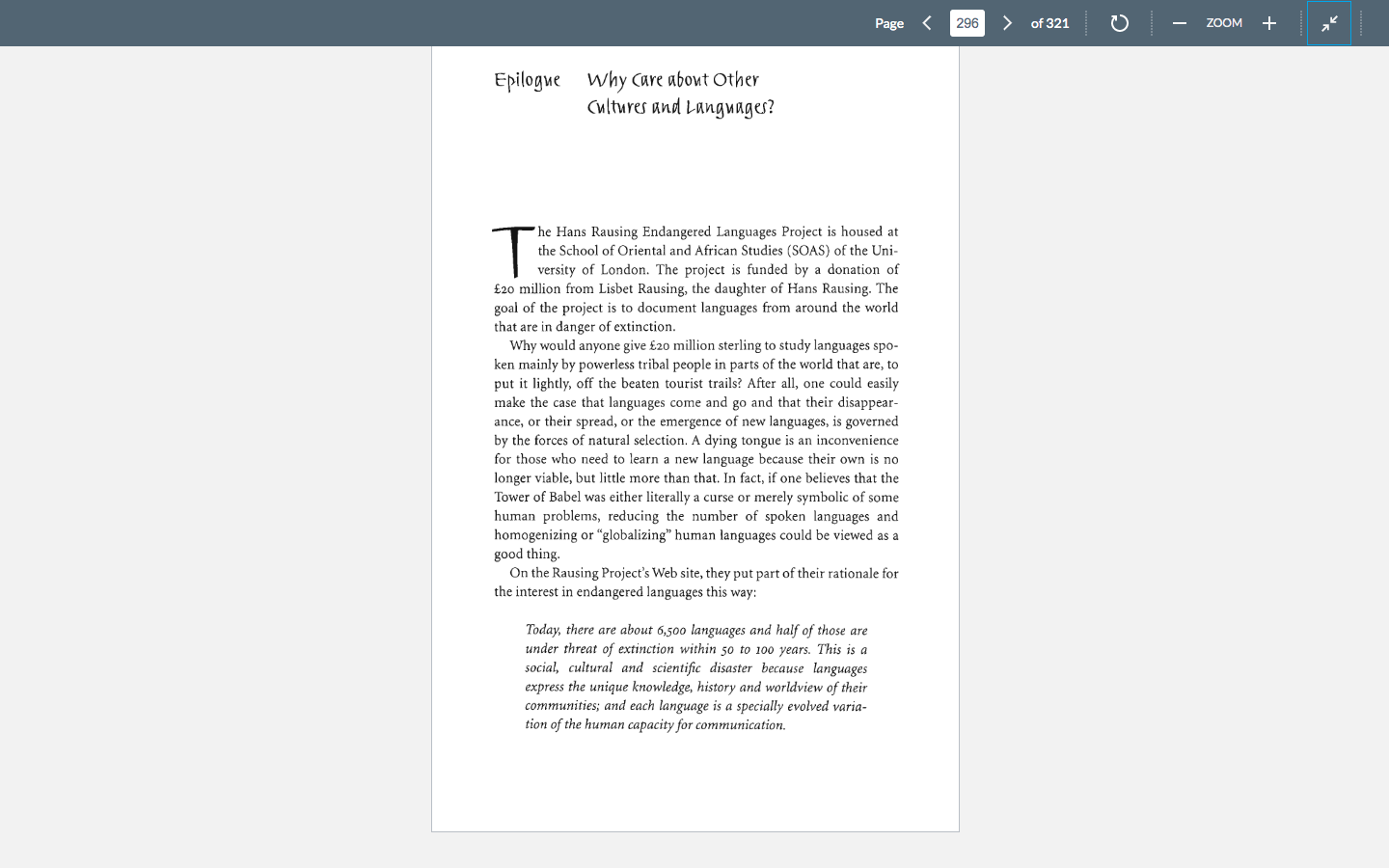
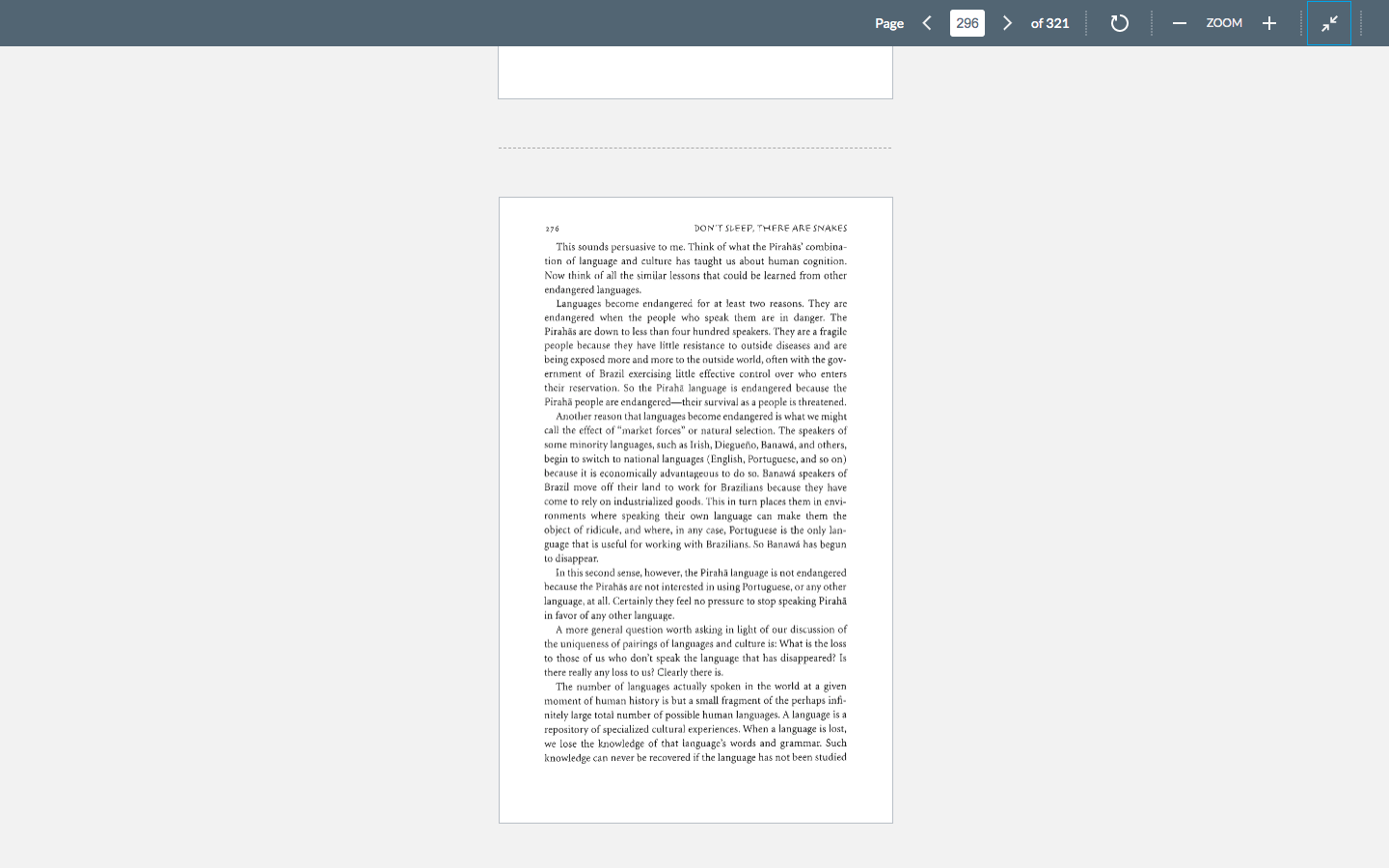
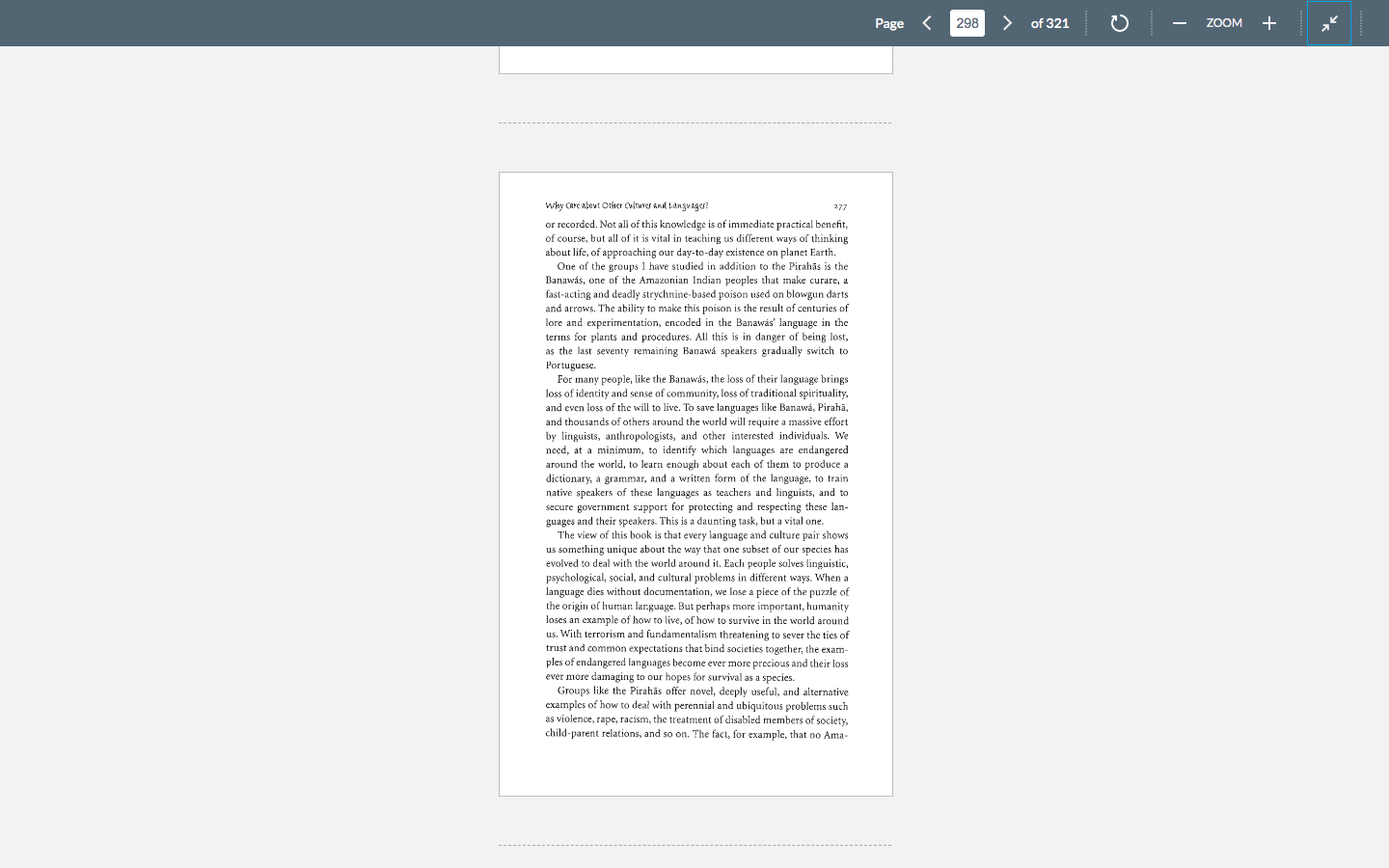
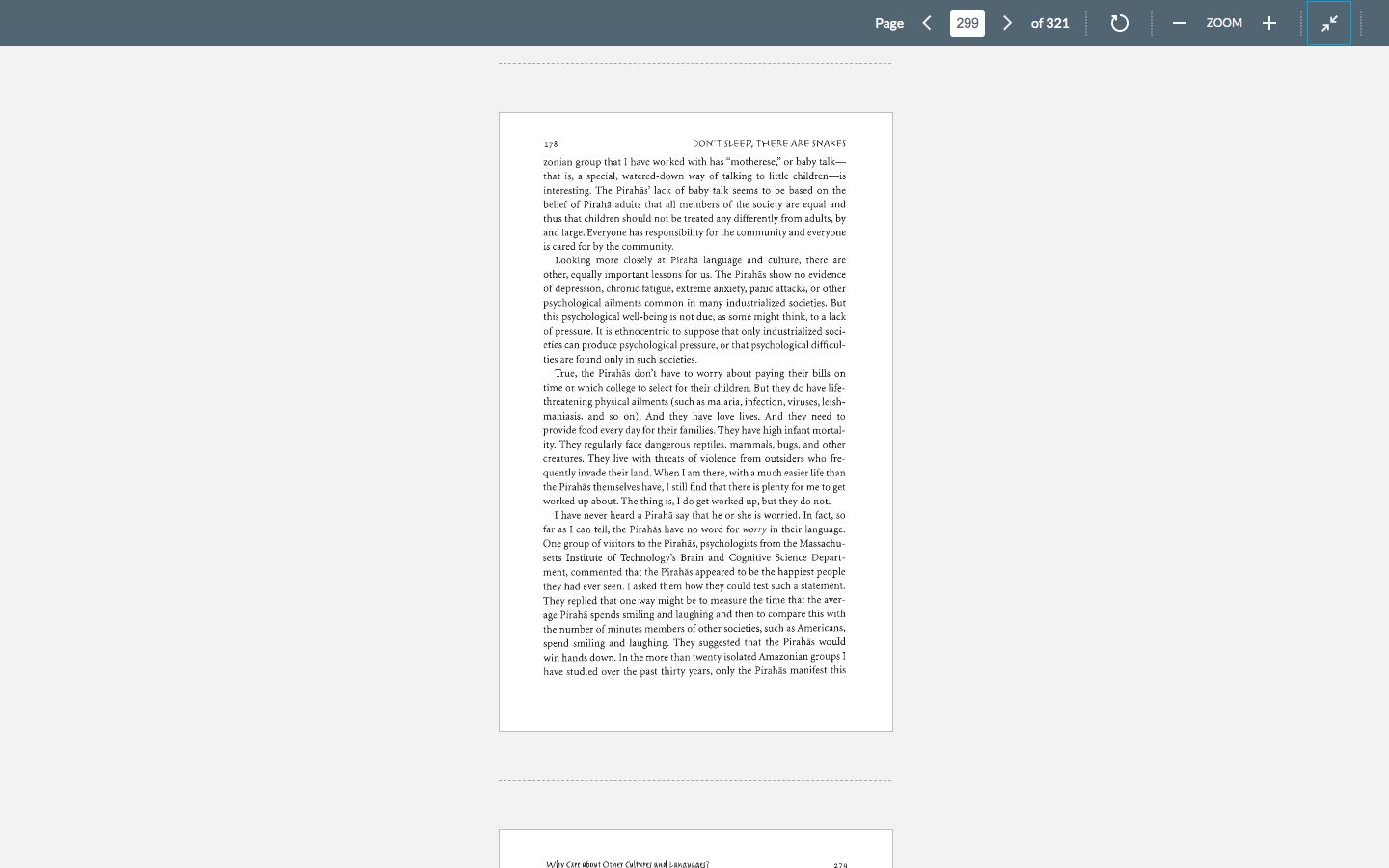
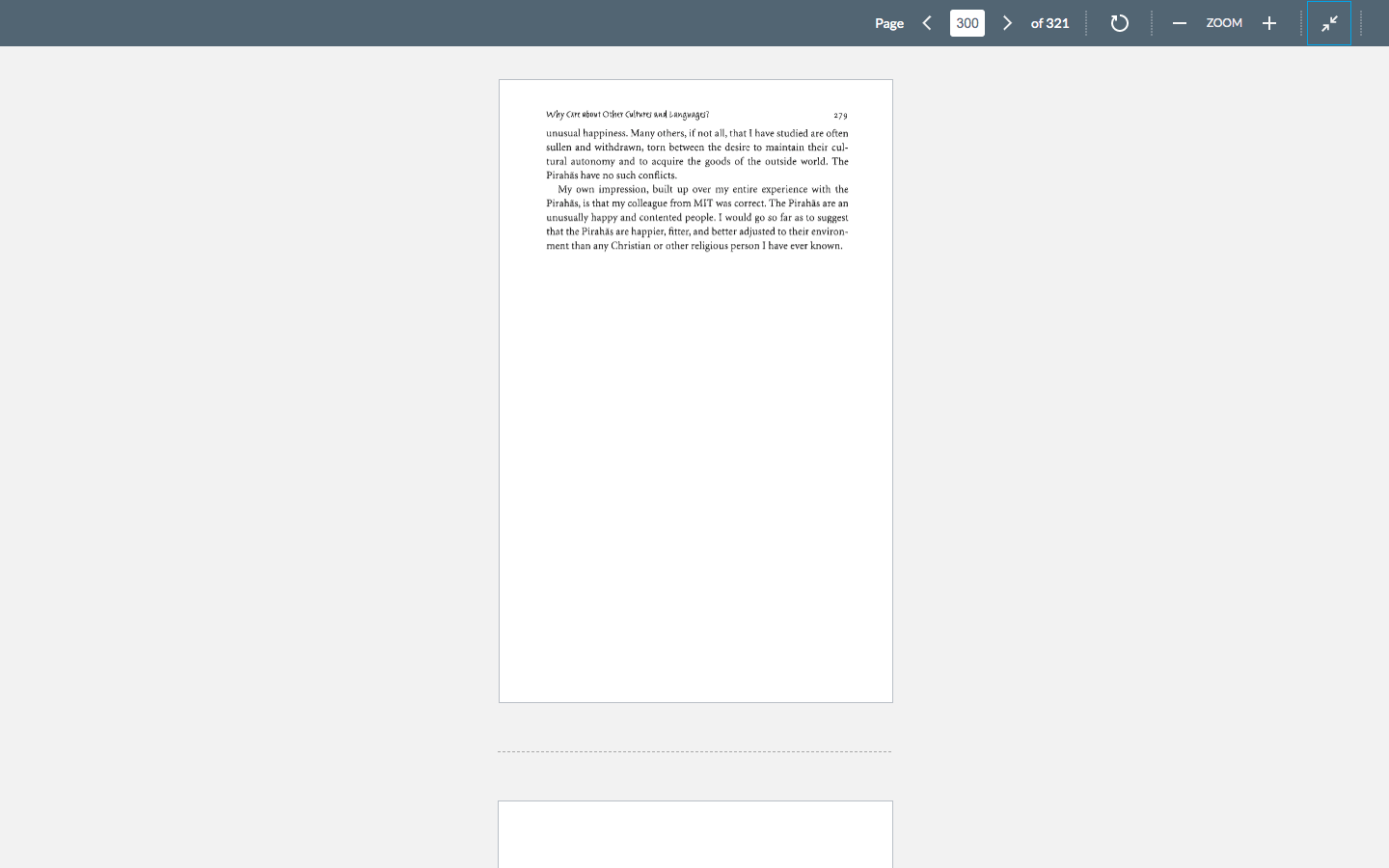
Page 296 of 321 ZOOM + Epilogue Why care about Other Cultures and Languages? To "he Hans Rausing Endangered Languages Project is housed at the School of Oriental and African Studies (SOAS) of the Uni- 20 million from Lisbet Rausing, the daughter of Hans Rausing. The goal of the project is to document languages from around the world that are in danger of extinction. Why would anyone give 20 million sterling to study languages spo- ken mainly by powerless tribal people in parts of the world that are, to put it lightly, off the beaten tourist trails? After all, one could easily make the case that languages come and go and that their disappear- ance, or their spread, or the emergence of new languages, is governed by the forces of natural selection. A dying tongue is an inconvenience for those who need to learn a new language because their own is no longer viable, but little more than that. In fact, if one believes that the Tower of Babel was either literally a curse or merely symbolic of some human problems, reducing the number of spoken languages and homogenizing or "globalizing human languages could be viewed as a good thing. On the Rausing Project's Web site, they put part of their rationale for the interest in endangered languages this way: Today, there are about 6,500 languages and half of those are under threat of extinction within 50 to 100 years. This is a social, cultural and scientific disaster because languages express the unique knowledge, history and worldview of their communities; and each language is a specially evolved varia- tion of the human capacity for communication. Page 296 of 321 ZOOM + 276 DON'T SLEEP, THERE ARE SNAKES This sounds persuasive to me. Think of what the Pirahas' combina- tion of language and culture has taught us about human cognition. Now think of all the similar lessons that could be learned from other endangered languages. Languages become endangered for at least two reasons. They are endangered when the people who speak them are in danger. The Pirahas are down to less than four hundred speakers. They are a fragile people because they have little resistance to outside diseases and are being exposed more and more to the outside world, often with the gov- ernment of Brazil exercising little effective control over who enters their reservation. So the Piraha language is endangered because the Pirah people are endangeredtheir survival as a people is threatened. Another reason that languages become endangered is what we might call the effect of "market forces" or natural selection. The speakers of some minority langua such as Irish, Diegueno, Banawd, and others, begin to switch to national languages (English, Portuguese, and so on) because it is economically advantageous to do so. Banawa speakers of Brazil move off their land to work for Brazilians because they have come to rely on industrialized goods. This in turn places them in envi- ronments where speaking their own language can make them the object of ridicule, and where, in any case, Portuguese is the only lan guage that is uscful for working with Brazilians. So Banawa has begun to disappear In this second sense, however, the Piraha language is not endangered because the Pirahas are not interested in using Portuguese, or any other language, at all. Certainly they feel no pressure to stop speaking Piraha in favor of any other language. A more general question worth asking in light of our discussion of the uniqueness of pairings of languages and culture is: What is the loss to those of us who don't speak the language that has disappeared? Is there really any loss to us? Clearly there is. The number of languages actually spoken in the world at a given moment of human history is but a small fragment of the perhaps inti- nitely large total number of possible human languages. A language is a repository of specialized cultural experiences. When a language is lost, we lose the knowledge of that language's words and grammar. Such knowledge can never be recovered if the language has not been studied Page 298 of 321 ZOOM + 277 Why care about other culture and Languager? or recorded. Not all of this knowledge is of immediate practical benefit, of course, but all of it is vital in teaching us different ways of thinking about life, of approaching our day-to-day existence on planet Earth. One of the groups I have studied in addition to the Pitahs is the Banawas, one of the Amazonian Indian peoples that make curare, a fast-acting and deadly strychnine-based poison used on blowgun darts and arrows. The ability to make this poison is the result of centuries lore and experimentation, encoded in the Banawas" language in the terms for plants and procedures. All this is in danger of being lost, as the last seventy remaining Banawa speakers gradually switch to Portuguese. For many people, like the Banawas, the loss of their language brings loss of identity and sense of community, loss of traditional spirituality, and even loss of the will to live. To save languages like Banaw, Pirah, and thousands of others around the world will require a massive effort by linguists, anthropologists, and other interested individuals. We need, at a minimum, to identify which languages are endangered around the world, to learn enough about each of them to produce a dictionary, a grammar, and a written form of the language, to train native speakers of these languages as teachers and linguists, and secure government support for protecting and respecting these lan- guages and their speakers. This is a daunting task, but a vital one. The view of this book is that every language and culture pair shows us something unique about the way that one subset of our species has evolved to deal with the world around it. Each people solves linguistic, psychological, social, and cultural problems in different ways. When a language dies without documentation, we lose a piece of the puzzle of the origin of human larguage. But perhaps more important, humanity loses an example of how to live, of how to survive in the world around us. With terrorism and fundamentalism threatening to sever the tics of trust and common expectations that bind societies together, the exam- ples of endangered languages become ever more precious and their loss ever more damaging to our hopes for survival as a species. Groups like the Pirahs offer novel, deeply useful, and alternative examples of how to deal with perennial and ubiquitous problems such as violence, rape, racism, the treatment of disabled members of society, child-parent relations, and so on. The fact, for example, that no Ama- Page 299 of 321 ZOOM + 278 DON'T SLEEP, THERE ARE SNAKES zonian group that I have worked with has "motherese," or baby talk- that is, a special, watered-down way of talking to little childrenis interesting. The Pirahas' lack of baby talk seems to be based on the belief of Piraha adults that all members of the society are equal and thus that children should not be treated any differently from adults, by and large. Everyone has responsibility for the community and everyone is cared for by the community Looking more closely at Piraha language and culture, there are other, equally important lessons for us. The Pirahas show no evidence of depression, chronic fatigue, extreme anxiety, panic attacks, or other psychological ailments common in many industrialized societies. But this psychological well-being is not due, as some might think, to a lack of pressure. It is ethnocentric to suppose that only industrialized soci- eties can produce psychological pressure, or that psychological difficul- ties are found only in such societies. True, the Pirahs don't have to worry about paying their bills on time or which college to select for their children. But they do have life threatening physical ailments (such as malaria, infection, viruses, leish- maniasis, and so on. And they have love lives. And they need to provide food every day for their families. They have high infant mortal- ity. They regularly face dangerous reptiles, mammals, bugs, and other creatures. They live with threats of violence from outsiders who fre- quently invade their land. When I am there, with a much easier life than the Pirahas themselves have, I still find that there is plenty for me to get worked up about. The thing is, I do get worked up, but they do not. I have never heard a Pirah say that he or she is worried. In fact, so far as I can tell, the Pirahas have no word for worry in their language. One group of visitors to the Pirans, psychologists from the Massachu- setts Institute of Technology's Brain and Cognitive Science Depart- ment, commented that the Pirahas appeared to be the happiest people they had ever seen. I asked them how they could test such a statement. They replied that one way might be to measure the time that the aver- age Piraha spends smiling and laughing and then to compare this with the number of minutes members of other societies, such as Americans, spend smiling and laughing. They suggested that the Pirahs would win hands down. In the more than twenty isolated Amazonian groups 1 have studied over the past thirty years, only the Pirahs manifest this Why care about the stron GMA Page 300 of 321 ZOOM + 279 Why care about other cultures and Language? unusual happiness. Many others, if not all, that I have studied are often sullen and withdrawn, torn between the desire to maintain their cul- tural autonomy and to acquire the goods of the outside world. The Pirahas have no such conflicts. My own impression, built up over my entire experience with the Pirahs, is that my colleague from MIT was correct. The Pirahs are an unusually happy and contented people. I would go so far as to suggest that the Pirahas are happier, fitter, and better adjusted to their environ- ment than any Christian or other religious person I have ever known









 Study Help