







Question: Write a WinMIPS64 code to determine whether a given number is an Armstrong number. The n -digit numbers equal to sum of n th powers
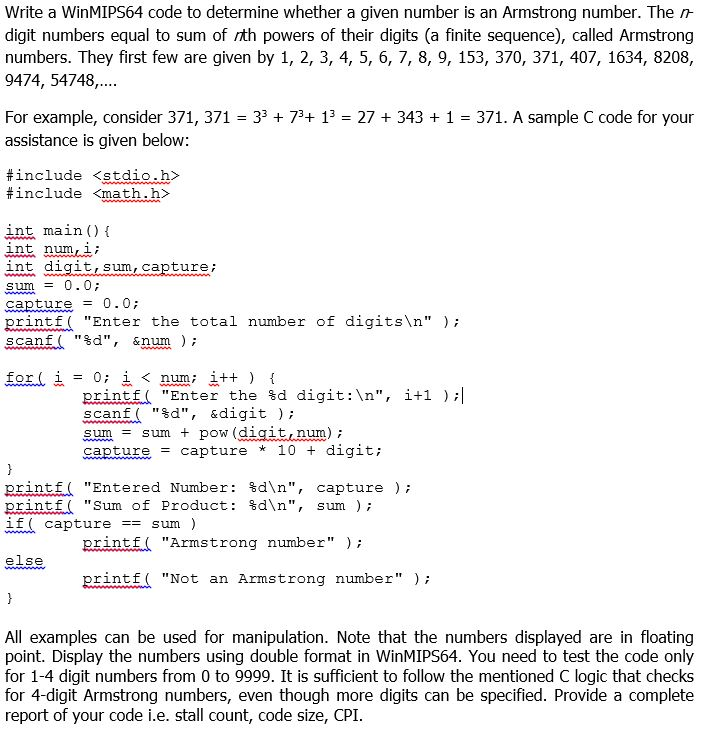
Write a WinMIPS64 code to determine whether a given number is an Armstrong number. The n-digit numbers equal to sum of nth powers of their digits (a finite sequence), called Armstrong numbers. They first few are given by 1, 2, 3, 4, 5, 6, 7, 8, 9, 153, 370, 371, 407, 1634, 8208, 9474, 54748,.
For example, consider 371, 371 = 33 + 73+ 13 = 27 + 343 + 1 = 371. A sample C code for your assistance is given below:
#include
#include
int main(){
int num,i;
int digit,sum,capture;
sum = 0.0;
capture = 0.0;
printf( "Enter the total number of digits " );
scanf( "%d", &num );
for( i = 0; i
printf( "Enter the %d digit: ", i+1 );
scanf( "%d", &digit );
sum = sum + pow(digit,num);
capture = capture * 10 + digit;
}
printf( "Entered Number: %d ", capture );
printf( "Sum of Product: %d ", sum );
if( capture == sum )
printf( "Armstrong number" );
else
printf( "Not an Armstrong number" );
}
All examples can be used for manipulation. Note that the numbers displayed are in floating point. Display the numbers using double format in WinMIPS64. You need to test the code only for 1-4 digit numbers from 0 to 9999. It is sufficient to follow the mentioned C logic that checks for 4-digit Armstrong numbers, even though more digits can be specified. Provide a complete report of your code i.e. stall count, code size, CPI.
Write a WinMIPS64 code to determine whether a given number is an Armstrong number. The digit numbers equal to sum of nth powers of their digits (a finite sequence), called Armstrong numbers. They first few are given by 1, 2, 3, 4, 5, 6, 7, 8, 9, 153, 370, 371, 407, 1634, 8208, 9474, 54748,.... For example, consider 371, 371 33 73+ 13 27 343 1 371. A sample C code for your assistance is given below: include
Step by Step Solution
There are 3 Steps involved in it

Get step-by-step solutions from verified subject matter experts
 Study Help