







Question: write c program to: include the code asked for and the screenshot outputs for all 5 cases (a through e) Problem Use the bisection method
write c program to:
include the code asked for and the screenshot outputs for all 5 cases (a through e)
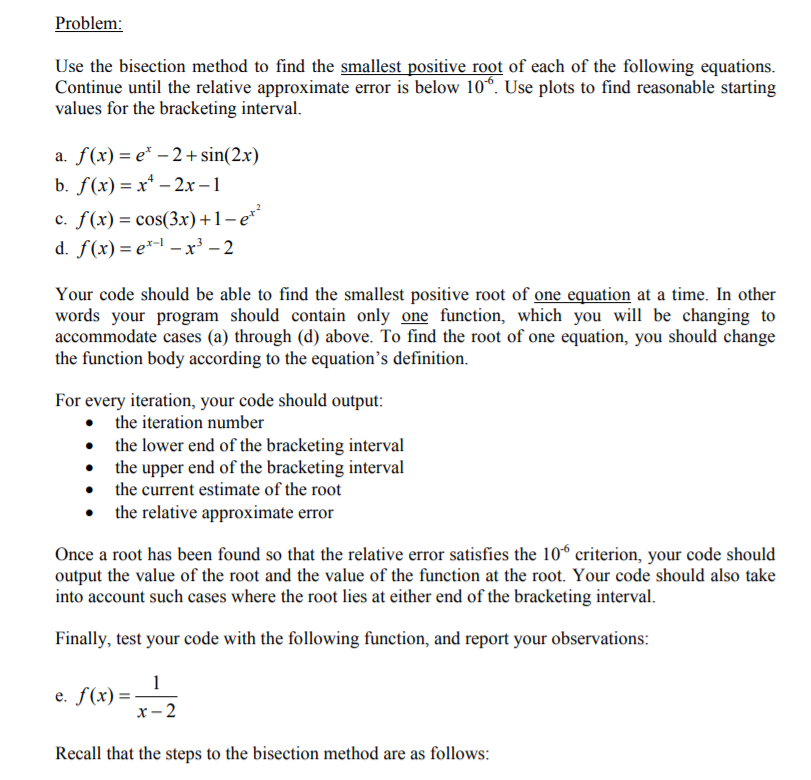
Problem Use the bisection method to find the smallest positive root of each of the following equations Continue until the relative approximate error is below 106. Use plots to find reasonable starting values for the bracketing interval a. f(x)-e -2+sin(2x) (x)- cos(3x) +1- e d. f(x)-e-1-x3-2 Your code should be able to find the smallest positive root of one equation at a time. In other words your program should contain only one function, which you will be changing to accommodate cases (a) through (d) above. To find the root of one equation, you should change the function body according to the equation's definition. For every iteration, your code should output: e the iteration number e the lower end of the bracketing interval e the upper end of the bracketing interval e the current estimate of the root the relative approximate error Once a root has been found so that the relative error satisfies the 106 criterion, your code should output the value of the root and the value of the function at the root. Your code should also take into account such cases where the root lies at either end of the bracketing interval Finally, test your code with the following function, and report your observations e. f(x)=-1 Recall that the steps to the bisection method are as follows
Step by Step Solution
There are 3 Steps involved in it

Get step-by-step solutions from verified subject matter experts
 Study Help