







Question: write code with java language Part 1: 1.1 Investigate the characteristics of the object orientated paradigm, including inheritance, encapsulation, polymorphism, constructors, abstract, interface, collections, static,
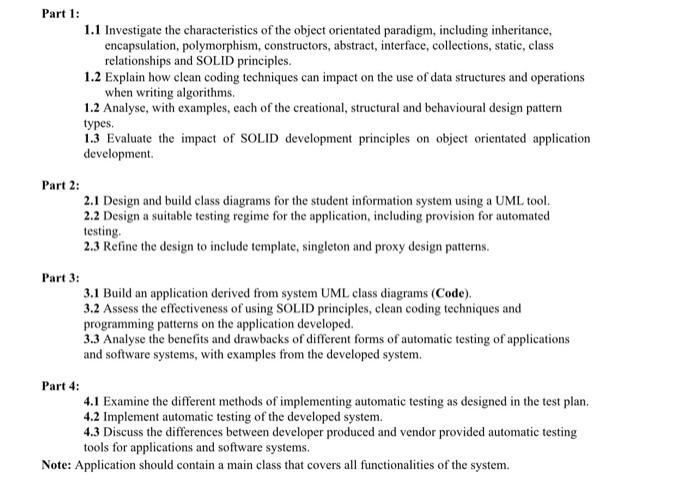
Part 1: 1.1 Investigate the characteristics of the object orientated paradigm, including inheritance, encapsulation, polymorphism, constructors, abstract, interface, collections, static, class relationships and SOLID principles. 1.2 Explain how clean coding techniques can impact on the use of data structures and operations when writing algorithms. 1.2 Analyse, with examples, each of the creational, structural and behavioural design pattern types. 1.3 Evaluate the impact of SOLID development principles on object orientated application development. Part 2: 2.1 Design and build class diagrams for the student information system using a UML tool. 2.2 Design a suitable testing regime for the application, including provision for automated testing. 2.3 Refine the design to include template, singleton and proxy design patterns. Part 3: 3.1 Build an application derived from system UML class diagrams (Code). 3.2 Assess the effectiveness of using SOLID principles, clean coding techniques and programming patterns on the application developed. 3.3 Analyse the benefits and drawbacks of different forms of automatic testing of applications and software systems, with examples from the developed system. Part 4: 4.1 Examine the different methods of implementing automatic testing as designed in the test plan. 4.2 Implement automatic testing of the developed system. 4.3 Discuss the differences between developer produced and vendor provided automatic testing tools for applications and software systems. Note: Application should contain a main class that covers all functionalities of the system
Step by Step Solution
There are 3 Steps involved in it

Get step-by-step solutions from verified subject matter experts
 Study Help