







Question: Write down the case study answers TRATION FOR PECK EXPERIENCE Case Study The Experts Georg Tacke is the co-CEO of Simon Kucher & Partners. He
Write down the case study answers 
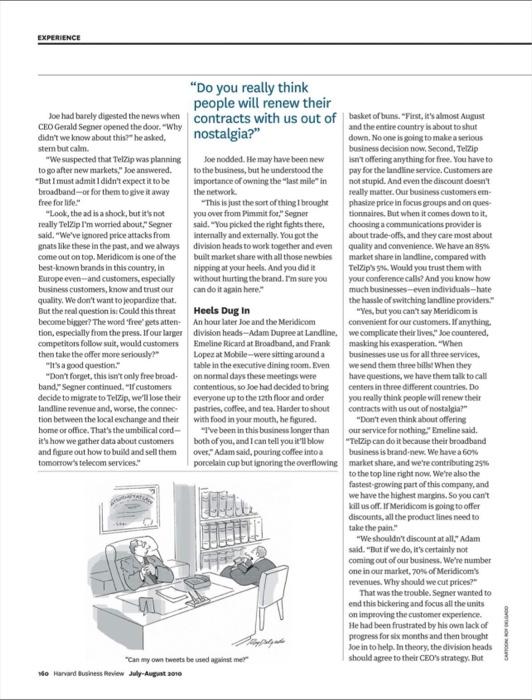
TRATION FOR PECK EXPERIENCE Case Study The Experts Georg Tacke is the co-CEO of Simon Kucher & Partners. He is based in Bonn, Germany Anne Gro Gulla is the group branding director for Telenor Group in Oslo, HER's fictional cases present dilemmas faced by real leaders and offer solutions from experts. HBR.ORG Marco Bertini is an assistant professor of marketing at London Business School. Nirmalya Kumar is a professor of marketing and codirector of the Aditya Birla India Centre at London Business School What do you do when one of your small competitors pulls out its big gun? by Marco Bertini and Nirmalya Kumar The Upstart's Assault oseph Ulan spent his first few his lips narrow. "Free broadband forever with TelZipt Save at least C450 a year when you switch from Meridicom!" minutes in the office on Wednesday Googling the weather in Sardinia. He, Ana, and the boys were set to fly there on Saturday, and although he wasn't looking forward to the Alitalia flight, the prospect of two weeks on the beach seemed heavenly. No questions from his CEO about why the new customer initia- tives were behind schedule. No excuses from the landline, mobile, and broadband division heads about why their respec tive service centers and billing systems couldn't be integrated. No meetings to run, no presentations to prepare. He couldn't wait to step out of his chief marketing officer suit and into his Daddy sandals and swim trunks. TelZip, a small mobile network opera tor eager to break into new markets, had decided to offer free broadband service to business customers who were willing to leave their current provider and enter into a long-term contract. As the oldest and largest telecommunications player in the country, Meridicom was accustomed to seeing both old and new competitors- bigger mobile companies, cable TV opera- toes, and internet providers-undercut its prices on all types of services by the usual 10% Meridicom was the industry price leader, so when it published rates, every- one else reacted predictably. But TelZip was now changing the game-not only giving away a high-growth, high-margin product but attacking Meridicom head-on. Only 72 more hours, Joe thought, smil- ing as he opened that morning's Financial Times. But the ad spanning page 3 made July-August 2010 Harvard Business Review 159 EXPERIENCE Joe had barely digested the news when CEO Gerald Segner opened the door. "Why didn't we know about this?" he asked, stem but calm. "We suspected that TelZip was planning to go after new markets," Joe answered. "But I must admit I didn't expect it to be broadband-or for them to give it away free for life." "Look, the ad is a shock, but it's not really TelZip I'm worried about." Segner said. "We've ignored price attacks from gnats like these in the past, and we always come out on top. Meridicom is one of the best-known brands in this country, in Europe even-and customers, especially business customers, know and trust our quality. We don't want to jeopardize that. But the real question is: Could this threat become bigger? The word 'free' gets atten- tion, especially from the press. If our larger competitors follow suit, would customers then take the offer more seriously?" "It's a good question." "Don't forget, this isn't only free broad- band," Segner continued. "If customers decide to migrate to TelZip, we'll lose their landline revenue and, worse, the connec tion between the local exchange and their home or office. That's the umbilical cord- it's how we gather data about customers and figure out how to build and sell them tomorrow's telecom services." 160 Harvard Business Review July-August 2010 Harvard Business Review "Do you really think people will renew their contracts with us out of nostalgia?" Joe nodded. He may have been new to the business, but he understood the importance of owning the last mile" in the network. "This is just the sort of thing I brought you over from Pimmit for," Segner said. "You picked the right fights there, internally and externally. You got the division heads to work together and even built market share with all those newbies nipping at your heels. And you did it without hurting the brand. I'm sure you can do it again here." Heels Dug In An hour later Joe and the Meridicom division heads-Adam Dupree at Landline, Emeline Ricard at Broadband, and Frank Lopez at Mobile-were sitting around a table in the executive dining room. Even on normal days these meetings were contentious, so Joe had decided to bring everyone up to the 12th floor and order pastries, coffee, and tea. Harder to shout with food in your mouth, he figured. "I've been in this business longer than both of you, and I can tell you it'll blow over," Adam said, pouring coffee into a porcelain cup but ignoring the overflowing "Can my own tweets be used against me basket of buns. "First, it's almost August and the entire country is about to shut down. No one is going to make a serious business decision now. Second, Telip isn't offering anything for free. You have to pay for the landline service. Customers are not stupid. And even the discount doesn't really matter. Our business customers em- phasize price in focus groups and on ques tionnaires. But when it comes down to it, choosing a communications provider is about trade-offs, and they care most about quality and convenience. We have an 85% market share in landline, compared with TelZip's 5%. Would you trust them with your conference calls? And you know how much businesses-even individuals-hate the hassle of switching landline providers." "Yes, but you can't say Meridicom is convenient for our customers. If anything. we complicate their lives," Joe countered, masking his exasperation. "When businesses use us for all three services, we send them three bills! When they have questions, we have them talk to call centers in three different countries. Do you really think people will renew their contracts with us out of nostalgia?" "Don't even think about offering our service for nothing." Emeline said. "TelZip can do it because their broadband business is brand-new. We have a 60% market share, and we're contributing 25% to the top line right now. We're also the fastest growing part of this company, and we have the highest margins. So you can't kill us off. If Meridicom is going to offer discounts, all the product lines need to take the pain." "We shouldn't discount at all," Adam said. "But if we do, it's certainly not coming out of our business. We're number one in our market, 70% of Meridicom's revenues. Why should we cut prices?" That was the trouble. Segner wanted to end this bickering and focus all the units on improving the customer experience. He had been frustrated by his own lack of progress for six months and then brought Joe in to help. In theory, the division heads should agree to their CEO's strategy. But GOVERN HBR.ORG The truth was Joe hadn't decided. Doing nothing, as Adam had advised, might make sense. Tellip wasn't a large competitor, and Segner cared more about pricing power and margins than about small dips in market share. But perhaps Charles was right to advocate for a direct response. Meridicom was large enough to make "free forever" credible, maybe even turn this challenge into an opportunity. The question was how-and, given the dif ficulty Joe had already faced in getting the divisions to work together, how quickly. Should Joe ignore or respond to TelZip's bold move? the fastest way to expand your business knowledge with the world's largest book summary company Books pling up on your desk or nightcand? No time to read! You're not alone. For years. successful executives have been relying on getAbstract to summarize the most critical business books and deliver them in a flash. Now you can too! Our subscriptions give you access to more than 5.000 business book summaries, including the latest books from Harvard Business Press-summarized exchiely by getAbstract We provide various formats for your computer Phone BlackBerry and Kinde, including audio Nowhere else you find such breadth and depth. Nowhere. Subscriptions range from $89 (30 summaries) to $299 (unlimited access) Sign up now and see why hundreds of thousands of business professionals use gebstract www.getabstract.com/harvard 100% GUARANTEED Corporate Solutions works dcty with cops to ride o gns for the argention Leading compon Meng Merant, n getAbstract ed at the ingres Tell us what you'd do if you were in Joe's shoes Go to Mr.org Ahm when it came down to it, they cared more about protecting their turf than working together. They were quasi-independent operators, still remunerated based on the performance of their own units. And because all three continued to make money for the company, it would be hard to move them away from the status quo. Frank had been quietly sipping tea and taking notes in his Moleskine. Adam and Emeline, whose divisions were several times the size of his, called him "the doo- dler" behind his back. But Joe considered him to be the most thoughtful of the three. "Adam," Frank said, "I think you're ignoring that TelZip is a serious player in the mobile phone market now. They have a 25% share, compared with our 5%, and a lot of name recognition. The only way we're going to catch up to them and others in that business is by offering something more compelling. Sure, customers care about both service and price, especially nowadays. But they also want predict ability about what their costs will be each month, and mobile is the biggest and most variable component of that. Broadband is less of a worry because it's a fixed charge. Still, if you're looking for reliable rates, free forever' is about as good as it gets Joe sighed. Yes, free forever was pretty hard to beat. Fire and Wine Joe was standing outside the little wine shop around the corner from his office, trying to remember whether his wife wanted red or white for the dinner party that night, when he heard a shout from behind him. "Joe, I'm so glad I ran into you." It was Charles DeGraff, Meridicom's head of sales. "Has this Tellip thing driven you to drink?" "It's been rough. But, no, my wife asked me to pick up some wine, and I know this guy always ducks out before 7 "You should try the one down the street-open until 11 and 10% off when you buy six bottles. Anyway, while I have you, I want to say that this TelZip thing is a huge opportunity for us. We should match them-full-page ad in tomorrow's FT. Show all these little guys who's boss. Sure, margins might suffer for a while. But we'll kill everyone else off and keep even boost-our market share." "You really think we should fight fire with fire?" "Look, all I hear from our major busi- ness customers is that we're too expensive. They tell me: "How can we run a success- ful company when we're paying so much to you? Segner wants us to focus on the customer, right? Well, the customer wants us to acknowledge the competition in our market and give them a better deal Sit Tight or Stand Up? Joe had missed his kids bedtime and was on track to be late with the wine for the dinner party when Segner stopped by on his way out of the building. "Just checking in about TelZip. What's the plan?" Conquer Biz Bestsellers in a Flash TRATION FOR PECK EXPERIENCE Case Study The Experts Georg Tacke is the co-CEO of Simon Kucher & Partners. He is based in Bonn, Germany Anne Gro Gulla is the group branding director for Telenor Group in Oslo, HER's fictional cases present dilemmas faced by real leaders and offer solutions from experts. HBR.ORG Marco Bertini is an assistant professor of marketing at London Business School. Nirmalya Kumar is a professor of marketing and codirector of the Aditya Birla India Centre at London Business School What do you do when one of your small competitors pulls out its big gun? by Marco Bertini and Nirmalya Kumar The Upstart's Assault oseph Ulan spent his first few his lips narrow. "Free broadband forever with TelZipt Save at least C450 a year when you switch from Meridicom!" minutes in the office on Wednesday Googling the weather in Sardinia. He, Ana, and the boys were set to fly there on Saturday, and although he wasn't looking forward to the Alitalia flight, the prospect of two weeks on the beach seemed heavenly. No questions from his CEO about why the new customer initia- tives were behind schedule. No excuses from the landline, mobile, and broadband division heads about why their respec tive service centers and billing systems couldn't be integrated. No meetings to run, no presentations to prepare. He couldn't wait to step out of his chief marketing officer suit and into his Daddy sandals and swim trunks. TelZip, a small mobile network opera tor eager to break into new markets, had decided to offer free broadband service to business customers who were willing to leave their current provider and enter into a long-term contract. As the oldest and largest telecommunications player in the country, Meridicom was accustomed to seeing both old and new competitors- bigger mobile companies, cable TV opera- toes, and internet providers-undercut its prices on all types of services by the usual 10% Meridicom was the industry price leader, so when it published rates, every- one else reacted predictably. But TelZip was now changing the game-not only giving away a high-growth, high-margin product but attacking Meridicom head-on. Only 72 more hours, Joe thought, smil- ing as he opened that morning's Financial Times. But the ad spanning page 3 made July-August 2010 Harvard Business Review 159 EXPERIENCE Joe had barely digested the news when CEO Gerald Segner opened the door. "Why didn't we know about this?" he asked, stem but calm. "We suspected that TelZip was planning to go after new markets," Joe answered. "But I must admit I didn't expect it to be broadband-or for them to give it away free for life." "Look, the ad is a shock, but it's not really TelZip I'm worried about." Segner said. "We've ignored price attacks from gnats like these in the past, and we always come out on top. Meridicom is one of the best-known brands in this country, in Europe even-and customers, especially business customers, know and trust our quality. We don't want to jeopardize that. But the real question is: Could this threat become bigger? The word 'free' gets atten- tion, especially from the press. If our larger competitors follow suit, would customers then take the offer more seriously?" "It's a good question." "Don't forget, this isn't only free broad- band," Segner continued. "If customers decide to migrate to TelZip, we'll lose their landline revenue and, worse, the connec tion between the local exchange and their home or office. That's the umbilical cord- it's how we gather data about customers and figure out how to build and sell them tomorrow's telecom services." 160 Harvard Business Review July-August 2010 Harvard Business Review "Do you really think people will renew their contracts with us out of nostalgia?" Joe nodded. He may have been new to the business, but he understood the importance of owning the last mile" in the network. "This is just the sort of thing I brought you over from Pimmit for," Segner said. "You picked the right fights there, internally and externally. You got the division heads to work together and even built market share with all those newbies nipping at your heels. And you did it without hurting the brand. I'm sure you can do it again here." Heels Dug In An hour later Joe and the Meridicom division heads-Adam Dupree at Landline, Emeline Ricard at Broadband, and Frank Lopez at Mobile-were sitting around a table in the executive dining room. Even on normal days these meetings were contentious, so Joe had decided to bring everyone up to the 12th floor and order pastries, coffee, and tea. Harder to shout with food in your mouth, he figured. "I've been in this business longer than both of you, and I can tell you it'll blow over," Adam said, pouring coffee into a porcelain cup but ignoring the overflowing "Can my own tweets be used against me basket of buns. "First, it's almost August and the entire country is about to shut down. No one is going to make a serious business decision now. Second, Telip isn't offering anything for free. You have to pay for the landline service. Customers are not stupid. And even the discount doesn't really matter. Our business customers em- phasize price in focus groups and on ques tionnaires. But when it comes down to it, choosing a communications provider is about trade-offs, and they care most about quality and convenience. We have an 85% market share in landline, compared with TelZip's 5%. Would you trust them with your conference calls? And you know how much businesses-even individuals-hate the hassle of switching landline providers." "Yes, but you can't say Meridicom is convenient for our customers. If anything. we complicate their lives," Joe countered, masking his exasperation. "When businesses use us for all three services, we send them three bills! When they have questions, we have them talk to call centers in three different countries. Do you really think people will renew their contracts with us out of nostalgia?" "Don't even think about offering our service for nothing." Emeline said. "TelZip can do it because their broadband business is brand-new. We have a 60% market share, and we're contributing 25% to the top line right now. We're also the fastest growing part of this company, and we have the highest margins. So you can't kill us off. If Meridicom is going to offer discounts, all the product lines need to take the pain." "We shouldn't discount at all," Adam said. "But if we do, it's certainly not coming out of our business. We're number one in our market, 70% of Meridicom's revenues. Why should we cut prices?" That was the trouble. Segner wanted to end this bickering and focus all the units on improving the customer experience. He had been frustrated by his own lack of progress for six months and then brought Joe in to help. In theory, the division heads should agree to their CEO's strategy. But GOVERN HBR.ORG The truth was Joe hadn't decided. Doing nothing, as Adam had advised, might make sense. Tellip wasn't a large competitor, and Segner cared more about pricing power and margins than about small dips in market share. But perhaps Charles was right to advocate for a direct response. Meridicom was large enough to make "free forever" credible, maybe even turn this challenge into an opportunity. The question was how-and, given the dif ficulty Joe had already faced in getting the divisions to work together, how quickly. Should Joe ignore or respond to TelZip's bold move? the fastest way to expand your business knowledge with the world's largest book summary company Books pling up on your desk or nightcand? No time to read! You're not alone. For years. successful executives have been relying on getAbstract to summarize the most critical business books and deliver them in a flash. Now you can too! Our subscriptions give you access to more than 5.000 business book summaries, including the latest books from Harvard Business Press-summarized exchiely by getAbstract We provide various formats for your computer Phone BlackBerry and Kinde, including audio Nowhere else you find such breadth and depth. Nowhere. Subscriptions range from $89 (30 summaries) to $299 (unlimited access) Sign up now and see why hundreds of thousands of business professionals use gebstract www.getabstract.com/harvard 100% GUARANTEED Corporate Solutions works dcty with cops to ride o gns for the argention Leading compon Meng Merant, n getAbstract ed at the ingres Tell us what you'd do if you were in Joe's shoes Go to Mr.org Ahm when it came down to it, they cared more about protecting their turf than working together. They were quasi-independent operators, still remunerated based on the performance of their own units. And because all three continued to make money for the company, it would be hard to move them away from the status quo. Frank had been quietly sipping tea and taking notes in his Moleskine. Adam and Emeline, whose divisions were several times the size of his, called him "the doo- dler" behind his back. But Joe considered him to be the most thoughtful of the three. "Adam," Frank said, "I think you're ignoring that TelZip is a serious player in the mobile phone market now. They have a 25% share, compared with our 5%, and a lot of name recognition. The only way we're going to catch up to them and others in that business is by offering something more compelling. Sure, customers care about both service and price, especially nowadays. But they also want predict ability about what their costs will be each month, and mobile is the biggest and most variable component of that. Broadband is less of a worry because it's a fixed charge. Still, if you're looking for reliable rates, free forever' is about as good as it gets Joe sighed. Yes, free forever was pretty hard to beat. Fire and Wine Joe was standing outside the little wine shop around the corner from his office, trying to remember whether his wife wanted red or white for the dinner party that night, when he heard a shout from behind him. "Joe, I'm so glad I ran into you." It was Charles DeGraff, Meridicom's head of sales. "Has this Tellip thing driven you to drink?" "It's been rough. But, no, my wife asked me to pick up some wine, and I know this guy always ducks out before 7 "You should try the one down the street-open until 11 and 10% off when you buy six bottles. Anyway, while I have you, I want to say that this TelZip thing is a huge opportunity for us. We should match them-full-page ad in tomorrow's FT. Show all these little guys who's boss. Sure, margins might suffer for a while. But we'll kill everyone else off and keep even boost-our market share." "You really think we should fight fire with fire?" "Look, all I hear from our major busi- ness customers is that we're too expensive. They tell me: "How can we run a success- ful company when we're paying so much to you? Segner wants us to focus on the customer, right? Well, the customer wants us to acknowledge the competition in our market and give them a better deal Sit Tight or Stand Up? Joe had missed his kids bedtime and was on track to be late with the wine for the dinner party when Segner stopped by on his way out of the building. "Just checking in about TelZip. What's the plan?" Conquer Biz Bestsellers in a Flash Step by Step Solution
There are 3 Steps involved in it
1 Expert Approved Answer
Step: 1 Unlock

Question Has Been Solved by an Expert!
Get step-by-step solutions from verified subject matter experts
Step: 2 Unlock
Step: 3 Unlock
 Study Help