







Question: Write executive summary (One sample T test) of given below articles. ( The use and misuse of statistics) Introduction and Background null hypothesis alternative hypothesis
Write executive summary (One sample T test) of given below articles. ( The use and misuse of statistics)
- Introduction and Background
- null hypothesis
- alternative hypothesis
- Include P-value
- conclusion/ Decision
- Recommendation
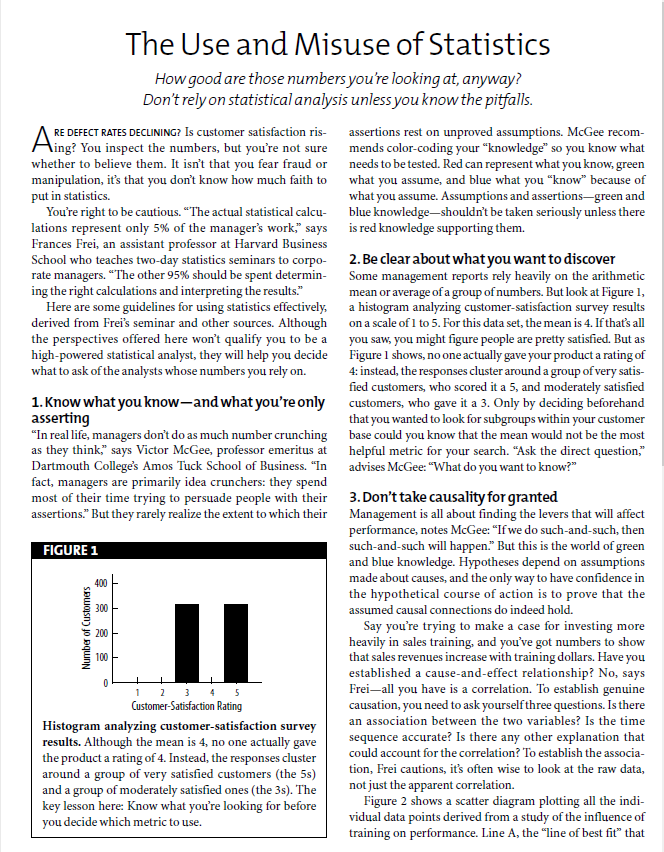
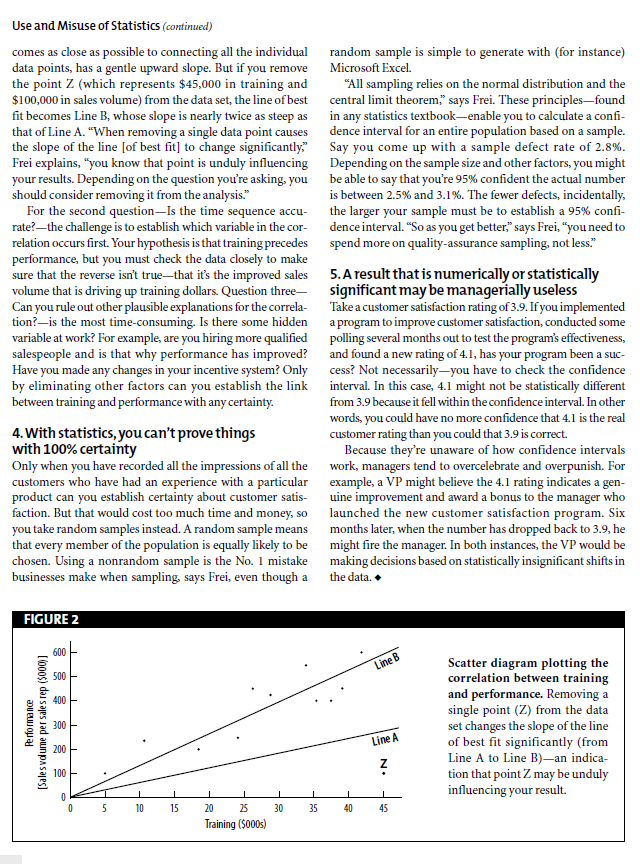
The Use and Misuse of Statistics How good are those numbers you're looking at, anyway? Don't rely on statistical analysis unless you know the pitfalls. RE DEFECT RATES DECLINING? Is customer satisfaction ris- assertions rest on unproved assumptions. McGee recom- Aing? You inspect the numbers, but you're not sure mends color-coding your "knowledge" so you know what whether to believe them. It isn't that you fear fraud or needs to be tested. Red can represent what you know, green manipulation, it's that you don't know how much faith to what you assume, and blue what you "know" because of put in statistics. what you assume. Assumptions and assertions-green and You're right to be cautious. "The actual statistical calcu- blue knowledge-shouldn't be taken seriously unless there lations represent only 5% of the manager's work, says is red knowledge supporting them. Frances Frei, an assistant professor at Harvard Business School who teaches two-day statistics seminars to corpo- 2. Be clear about what you want to discover rate managers. "The other 95% should be spent determin- Some management reports rely heavily on the arithmetic ing the right calculations and interpreting the results." mean or average of a group of numbers. But look at Figure 1, Here are some guidelines for using statistics effectively, a histogram analyzing customer-satisfaction survey results derived from Frei's seminar and other sources. Although on a scale of 1 to 5. For this data set, the mean is 4. If that's all the perspectives offered here won't qualify you to be a you saw, you might figure people are pretty satisfied. But as high-powered statistical analyst, they will help you decide Figure I shows, no one actually gave your product a rating of what to ask of the analysts whose numbers you rely on. 4: instead, the responses cluster around a group of very satis- fed customers, who scored it a 5, and moderately satisfied 1. Know what you know-and what you're only customers, who gave it a 3. Only by deciding beforehand asserting that you wanted to look for subgroups within your customer "In real life, managers don't do as much number crunching base could you know that the mean would not be the most as they think," says Victor McGee, professor emeritus at helpful metric for your search. "Ask the direct question," Dartmouth College's Amos Tuck School of Business. "In advises McGee: "What do you want to know?" fact, managers are primarily idea crunchers: they spend most of their time trying to persuade people with their 3. Don't take causality for granted assertions." But they rarely realize the extent to which their Management is all about finding the levers that will affect performance, notes McGee: "If we do such-and-such, then FIGURE 1 such-and-such will happen." But this is the world of green and blue knowledge. Hypotheses depend on assumptions 400 made about causes, and the only way to have confidence in the hypothetical course of action is to prove that the 300 assumed causal connections do indeed hold. Number of Customers 200 Say you're trying to make a case for investing more heavily in sales training, and you've got numbers to show 100 that sales revenues increase with training dollars. Have you established a cause-and-effect relationship? No, says 1 1 3 4 5 Frei-all you have is a correlation. To establish genuine Customer-Satisfaction Rating causation, you need to ask yourself three questions. Is there Histogram analyzing customer-satisfaction survey an association between the two variables? Is the time results. Although the mean is 4, no one actually gave sequence accurate? Is there any other explanation that the product a rating of 4. Instead, the responses cluster could account for the correlation? To establish the associa- around a group of very satisfied customers (the 5s) tion, Frei cautions, it's often wise to look at the raw data, and a group of moderately satisfied ones (the 3s). The not just the apparent correlation. key lesson here: Know what you're looking for before Figure 2 shows a scatter diagram plotting all the indi- you decide which metric to use. vidual data points derived from a study of the influence of training on performance. Line A, the "line of best fit" thatUse and Misuse of Statistics (continued) comes as close as possible to connecting all the individual random sample is simple to generate with (for instance) data points, has a gentle upward slope. But if you remove Microsoft Excel. the point Z (which represents $45,000 in training and "All sampling relies on the normal distribution and the $100,000 in sales volume) from the data set, the line of best central limit theorem, says Frei. These principles-found fit becomes Line B, whose slope is nearly twice as steep as in any statistics textbook-enable you to calculate a confi- that of Line A. "When removing a single data point causes dence interval for an entire population based on a sample. the slope of the line [of best fit] to change significantly," Say you come up with a sample defect rate of 2.8%. Frei explains, "you know that point is unduly influencing Depending on the sample size and other factors, you might your results. Depending on the question you're asking, you be able to say that you're 95% confident the actual number should consider removing it from the analysis." is between 2.5% and 3.1%. The fewer defects, incidentally, For the second question-Is the time sequence accu- the larger your sample must be to establish a 95% confi- rate?-the challenge is to establish which variable in the cor- dence interval. "So as you get better," says Frei, "you need to relation occurs first. Your hypothesis is that training precedes spend more on quality-assurance sampling, not less." performance, but you must check the data closely to make sure that the reverse isn't true-that it's the improved sales 5. A result that is numerically or statistically volume that is driving up training dollars. Question three- significant may be managerially useless Can you rule out other plausible explanations for the correla- Take a customer satisfaction rating of 3.9. If you implemented tion?-is the most time-consuming. Is there some hidden a program to improve customer satisfaction, conducted some variable at work? For example, are you hiring more qualified polling several months out to test the program's effectiveness, salespeople and is that why performance has improved? and found a new rating of 4.1, has your program been a suc- Have you made any changes in your incentive system? Only cess? Not necessarily-you have to check the confidence by eliminating other factors can you establish the link interval. In this case, 4.1 might not be statistically different between training and performance with any certainty. from 3.9 because it fell within the confidence interval. In other words, you could have no more confidence that 4.1 is the real 4. With statistics, you can't prove things customer rating than you could that 3.9 is correct. with 100% certainty Because they're unaware of how confidence intervals Only when you have recorded all the impressions of all the work, managers tend to overcelebrate and overpunish. For customers who have had an experience with a particular example, a VP might believe the 4.1 rating indicates a gen- product can you establish certainty about customer satis- wine improvement and award a bonus to the manager who faction. But that would cost too much time and money, so launched the new customer satisfaction program. Six you take random samples instead. A random sample means months later, when the number has dropped back to 3.9, he that every member of the population is equally likely to be might fire the manager. In both instances, the VP would be chosen. Using a nonrandom sample is the No. 1 mistake making decisions based on statistically insignificant shifts in businesses make when sampling, says Frei, even though a the data. + FIGURE 2 600 Line B Scatter diagram plotting the 500 correlation between training 400 and performance. Removing a single point (Z) from the data Performance [Salesvolume per sales rep (5000) ] set changes the slope of the line Line A 200 of best fit significantly (from Line A to Line B)-an indica- 100 tion that point Z may be unduly influencing your result. 5 10 15 20 25 30 35 40 45 Training ($000s)
Step by Step Solution
There are 3 Steps involved in it

Get step-by-step solutions from verified subject matter experts
 Study Help