







Question: Write MIPS instruction sequences to perform the following operations. Do not use pseudoinstructions. ( That means no LI , MOVE, etc. ) In addition to
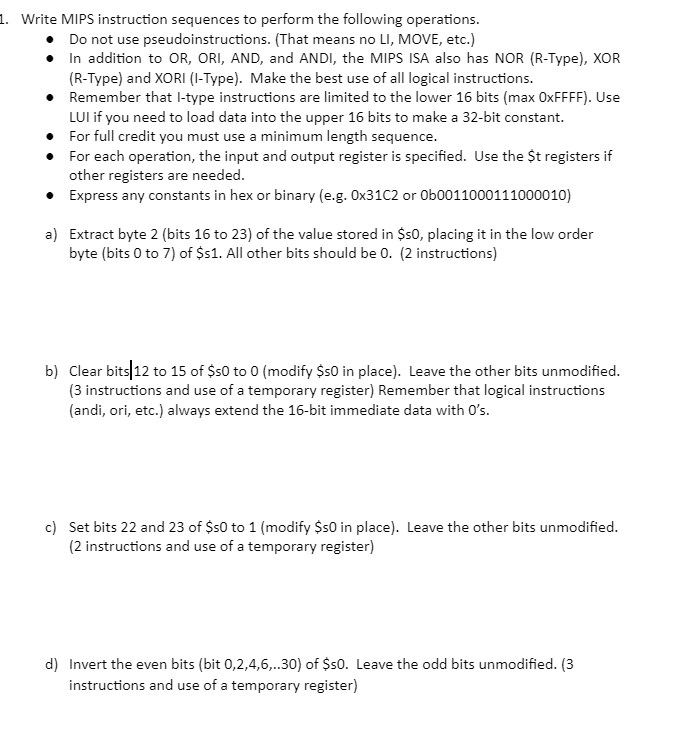
Write MIPS instruction sequences to perform the following operations.
Do not use pseudoinstructions. That means no LI MOVE, etc.
In addition to OR ORI, AND, and ANDI, the MIPS ISA also has NOR RType XOR
RType and XORI IType Make the best use of all logical instructions.
Remember that Itype instructions are limited to the lower bits max xFFFF Use
LUI if you need to load data into the upper bits to make a bit constant.
For full credit you must use a minimum length sequence.
For each operation, the input and output register is specified. Use the $t registers if
other registers are needed.
Express any constants in hex or binary egxC or b
a Extract byte bits to of the value stored in $ placing it in the low order
byte bits to of $ All other bits should be instructions
b Clear bits to of $ to modify $ in place Leave the other bits unmodified.
instructions and use of a temporary register Remember that logical instructions
andi ori, etc. always extend the bit immediate data with s
c Set bits and of $ to modify $ in place Leave the other bits unmodified.
instructions and use of a temporary register
d Invert the even bits bit of $ s Leave the odd bits unmodified.
instructions and use of a temporary register
Step by Step Solution
There are 3 Steps involved in it
1 Expert Approved Answer
Step: 1 Unlock

Question Has Been Solved by an Expert!
Get step-by-step solutions from verified subject matter experts
Step: 2 Unlock
Step: 3 Unlock
 Study Help