







Question: Write the algorithm i. Write a code in Octave that implements Newton's method (commenting throughout your code to briefly explain what is being done)
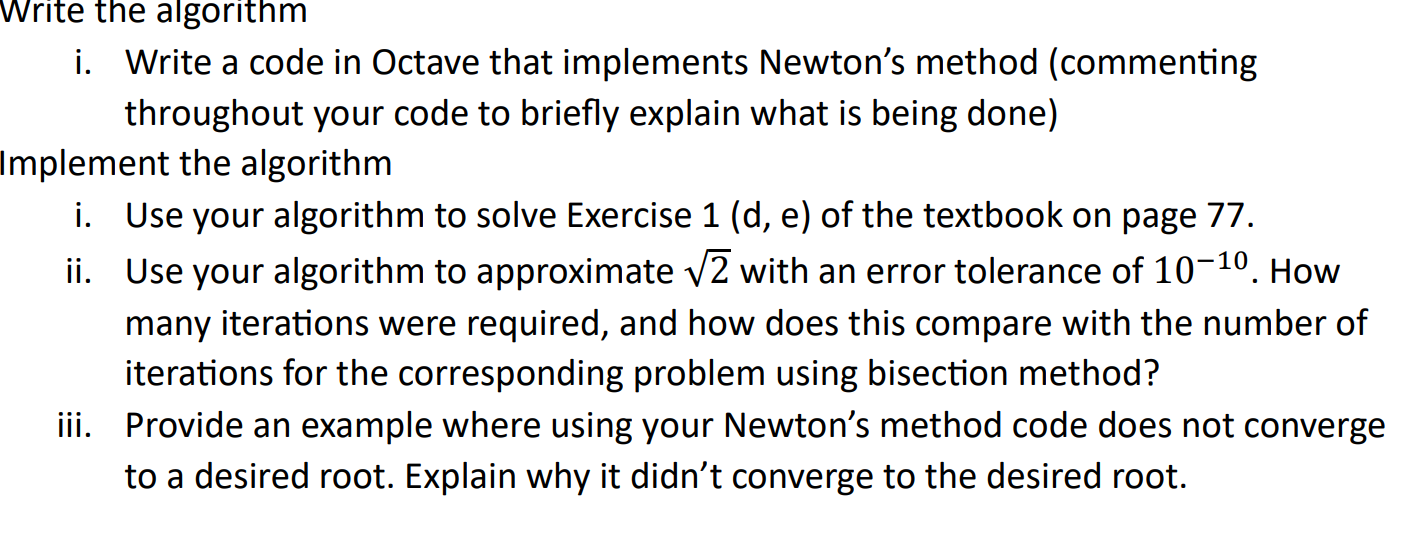
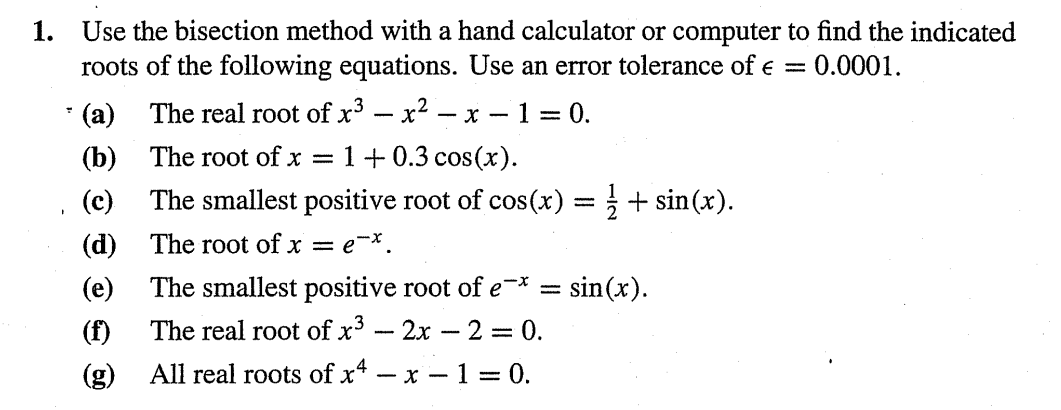
Write the algorithm i. Write a code in Octave that implements Newton's method (commenting throughout your code to briefly explain what is being done) Implement the algorithm ii. i. Use your algorithm to solve Exercise 1 (d, e) of the textbook on page 77. Use your algorithm to approximate 2 with an error tolerance of 10-10. How many iterations were required, and how does this compare with the number of iterations for the corresponding problem using bisection method? iii. Provide an example where using your Newton's method code does not converge to a desired root. Explain why it didn't converge to the desired root. 1. Use the bisection method with a hand calculator or computer to find the indicated roots of the following equations. Use an error tolerance of = 0.0001. (a) The real root of x - x - x - 1 = 0. (b) (c) (d) (e) (f) The root of x = 1+0.3 cos(x). The smallest positive root of cos(x) The root of x = e-*. The smallest positive root of e-* = The real root of x - 2x - 2 = 0. All real roots of x-x-1=0. + sin(x). = sin(x).
Step by Step Solution
3.36 Rating (149 Votes )
There are 3 Steps involved in it
Certainly heres an algorithm for implementing Newtons method in Octave octave Newtons method implementation function root iterations newtonsmethodf df x0 tol maxiter f Function for which we want to fi... View full answer

Get step-by-step solutions from verified subject matter experts
 Study Help