





Question: WRITE the code assuming the DDT data set is called exactly DDT_2_ instead. Task 1 When conducting testing the NULL hypothesis is usually always FALSE

WRITE the code assuming the DDT data set is called exactly DDT_2_ instead.
WRITE the code assuming the DDT data set is
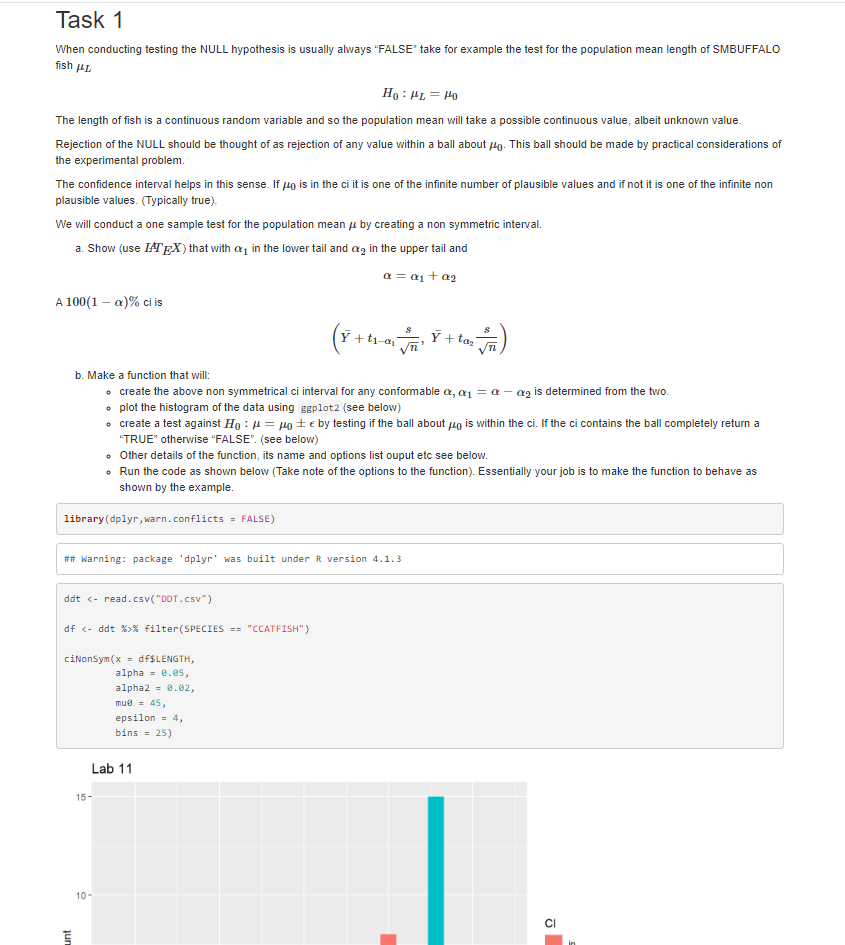
Task 1 When conducting testing the NULL hypothesis is usually always "FALSE" take for example the test for the population mean length of SMBUFFALO fish PL Ho : HL = Ho The length of fish is a continuous random variable and so the population mean will take a possible continuous value, albeit unknown value. Rejection of the NULL should be thought of as rejection of any value within a ball about /p. This ball should be made by practical considerations of the experimental problem The confidence interval helps in this sense. If pig is in the ci it is one of the infinite number of plausible values and if not it is one of the infinite non plausible values. (Typically true). We will conduct a one sample test for the population mean / by creating a non symmetric interval. a. Show (use ITgX) that with on in the lower tail and @2 in the upper tail and a = 01+ 02 A 100(1 - 4)% ci is b. Make a function that will: . create the above non symmetrical ci interval for any conformable o, aj = o - 02 is determined from the two. . plot the histogram of the data using ggplotz (see below) . create a test against Ho : / = po + e by testing if the ball about up is within the ci. If the ci contains the ball completely return a "TRUE" otherwise "FALSE". (see below) . Other details of the function, its name and options list ouput etc see below. Run the code as shown below (Take note of the options to the function). Essentially your job is to make the function to behave as shown by the example. library(dplyr, warn. conflicts = FALSE) "# Warning: package 'dplyr' was built under R version 4.1.3 ddt % filter(SPECIES == "CCATFISH") ciNonSym (x = df$LENGTH, alpha = 0.05, alpha2 = 0.02, mud = 45, epsilon = 4, bins = 25) Lab 11 15- 10- CI

Step by Step Solution

There are 3 Steps involved in it

1 Expert Approved Answer
Step: 1 Unlock blur-text-image

Question Has Been Solved by an Expert!

Get step-by-step solutions from verified subject matter experts

Step: 2 Unlock
Step: 3 Unlock

Students Have Also Explored These Related Mathematics Questions!