







Question: write the proper code that satisfys the conditions in the picture this is to be done in java . Not too specific because its giving
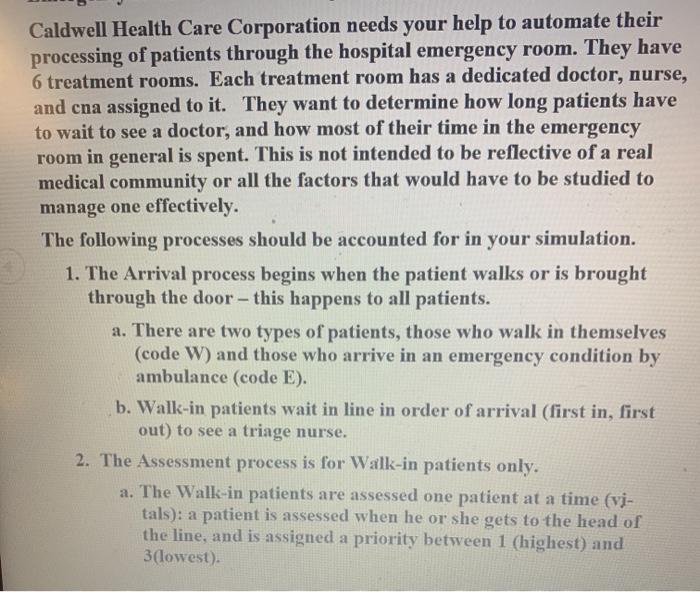
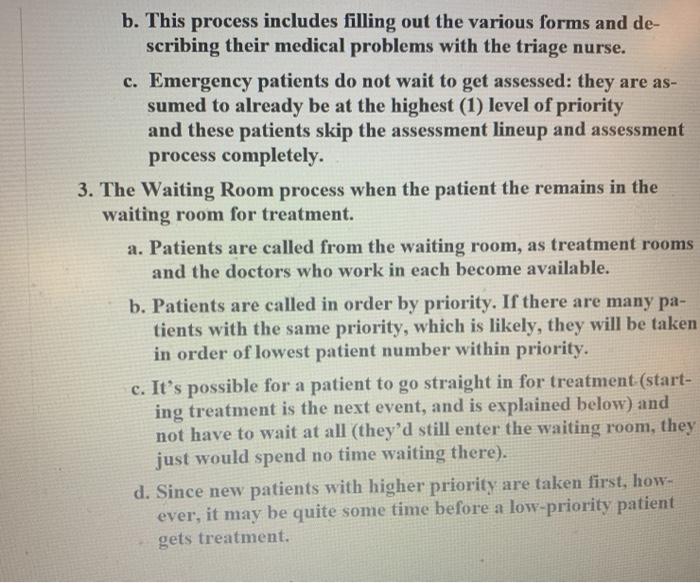
Caldwell Health Care Corporation needs your help to automate their processing of patients through the hospital emergency room. They have 6 treatment rooms. Each treatment room has a dedicated doctor, nurse, and cna assigned to it. They want to determine how long patients have to wait to see a doctor, and how most of their time in the emergency room in general is spent. This is not intended to be reflective of a real medical community or all the factors that would have to be studied to manage one effectively. The following processes should be accounted for in your simulation. 1. The Arrival process begins when the patient walks or is brought through the door - this happens to all patients. a. There are two types of patients, those who walk in themselves (code W) and those who arrive in an emergency condition by ambulance (code E). b. Walk-in patients wait in line in order of arrival (first in, first out) to see a triage nurse. 2. The Assessment process is for Walk-in patients only. a. The Walk-in patients are assessed one patient at a time (vi- tals): a patient is assessed when he or she gets to the head of the line, and is assigned a priority between 1 (highest) and 3(lowest). b. This process includes filling out the various forms and de- scribing their medical problems with the triage nurse. c. Emergency patients do not wait to get assessed: they are as- sumed to already be at the highest (1) level of priority and these patients skip the assessment lineup and assessment process completely. 3. The Waiting Room process when the patient the remains in the waiting room for treatment. a. Patients are called from the waiting room, as treatment rooms and the doctors who work in each become available. b. Patients are called in order by priority. If there are many pa- tients with the same priority, which is likely, they will be taken in order of lowest patient number within priority. c. It's possible for a patient to go straight in for treatment (start- ing treatment is the next event, and is explained below) and not have to wait at all (they'd still enter the waiting room, they just would spend no time waiting there). d. Since new patients with higher priority are taken first, how- ever, it may be quite some time before a low-priority patient gets treatment. Caldwell Health Care Corporation needs your help to automate their processing of patients through the hospital emergency room. They have 6 treatment rooms. Each treatment room has a dedicated doctor, nurse, and cna assigned to it. They want to determine how long patients have to wait to see a doctor, and how most of their time in the emergency room in general is spent. This is not intended to be reflective of a real medical community or all the factors that would have to be studied to manage one effectively. The following processes should be accounted for in your simulation. 1. The Arrival process begins when the patient walks or is brought through the door - this happens to all patients. a. There are two types of patients, those who walk in themselves (code W) and those who arrive in an emergency condition by ambulance (code E). b. Walk-in patients wait in line in order of arrival (first in, first out) to see a triage nurse. 2. The Assessment process is for Walk-in patients only. a. The Walk-in patients are assessed one patient at a time (vi- tals): a patient is assessed when he or she gets to the head of the line, and is assigned a priority between 1 (highest) and 3(lowest). b. This process includes filling out the various forms and de- scribing their medical problems with the triage nurse. c. Emergency patients do not wait to get assessed: they are as- sumed to already be at the highest (1) level of priority and these patients skip the assessment lineup and assessment process completely. 3. The Waiting Room process when the patient the remains in the waiting room for treatment. a. Patients are called from the waiting room, as treatment rooms and the doctors who work in each become available. b. Patients are called in order by priority. If there are many pa- tients with the same priority, which is likely, they will be taken in order of lowest patient number within priority. c. It's possible for a patient to go straight in for treatment (start- ing treatment is the next event, and is explained below) and not have to wait at all (they'd still enter the waiting room, they just would spend no time waiting there). d. Since new patients with higher priority are taken first, how- ever, it may be quite some time before a low-priority patient gets treatment
Step by Step Solution
There are 3 Steps involved in it

Get step-by-step solutions from verified subject matter experts
 Study Help