







Question: . Write TRUE if the statement is correct and FALSE if the statement is wrong. A. Total fixed costs do not change in response to
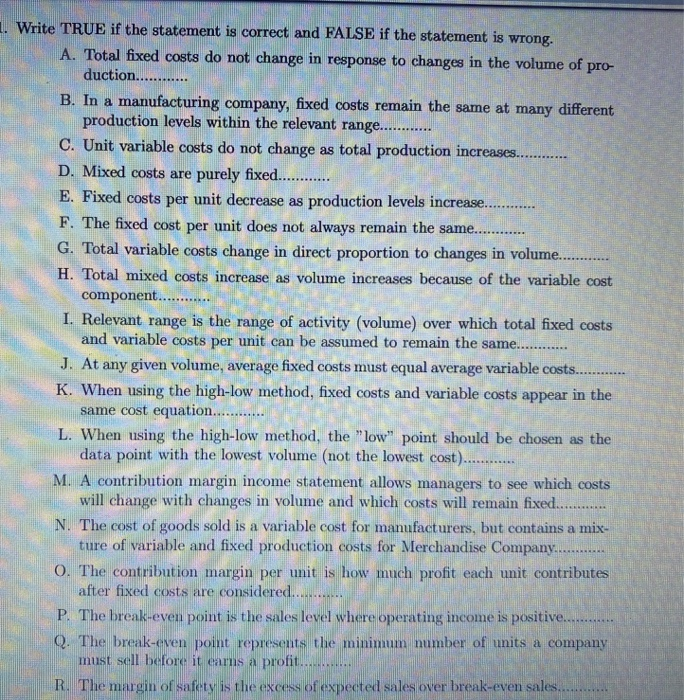
. Write TRUE if the statement is correct and FALSE if the statement is wrong. A. Total fixed costs do not change in response to changes in the volume of pro- duction....... B. In a manufacturing company, fixed costs remain the same at many different production levels within the relevant range............ C. Unit variable costs do not change as total production increases..... D. Mixed costs are purely fixed......... E. Fixed costs per unit decrease as production levels increase... F. The fixed cost per unit does not always remain the same..... G. Total variable costs change in direct proportion to changes in volume. H. Total mixed costs increase as volume increases because of the variable cost component......... I. Relevant range is the range of activity (volume) over which total fixed costs and variable costs per unit can be assumed to remain the same............ J. At any given volume, average fixed costs must equal average variable costs..... K. When using the high-low method, fixed costs and variable costs appear in the same cost equation... L. When using the high-low method, the "low point should be chosen as the data point with the lowest volume (not the lowest cost)............ M. A contribution margin income statement allows managers to see which costs will change with changes in volume and which costs will remain fixed............ N. The cost of goods sold is a variable cost for manufacturers, but contains a mix. ture of variable and fixed production costs for Merchandise Company..... 0. The contribution margin per unit is how much profit each unit contributes after fixed costs are considered............ P. The break-even point is the sales level where operating income is positive........... Q. The break-even point represents the minimum number of units a company must sell before it earns a profit............ R. The margin of safety is the excess of expected sales over break-even sales
Step by Step Solution
There are 3 Steps involved in it

Get step-by-step solutions from verified subject matter experts
 Study Help