Question: Write two paragraphs for chapter 17 (at least five grammatically correct complete sentences in each paragraph). One summarizing the chapter and one what you learned
Writetwo paragraphs for chapter 17 (at least five grammatically correct complete sentences in each paragraph). One summarizing the chapter and one what you learned in each chapter. It should be your reflection of the material you read. Which new concepts did you learn, what surprised you the most and how will you apply these new concepts in your personal and work life.
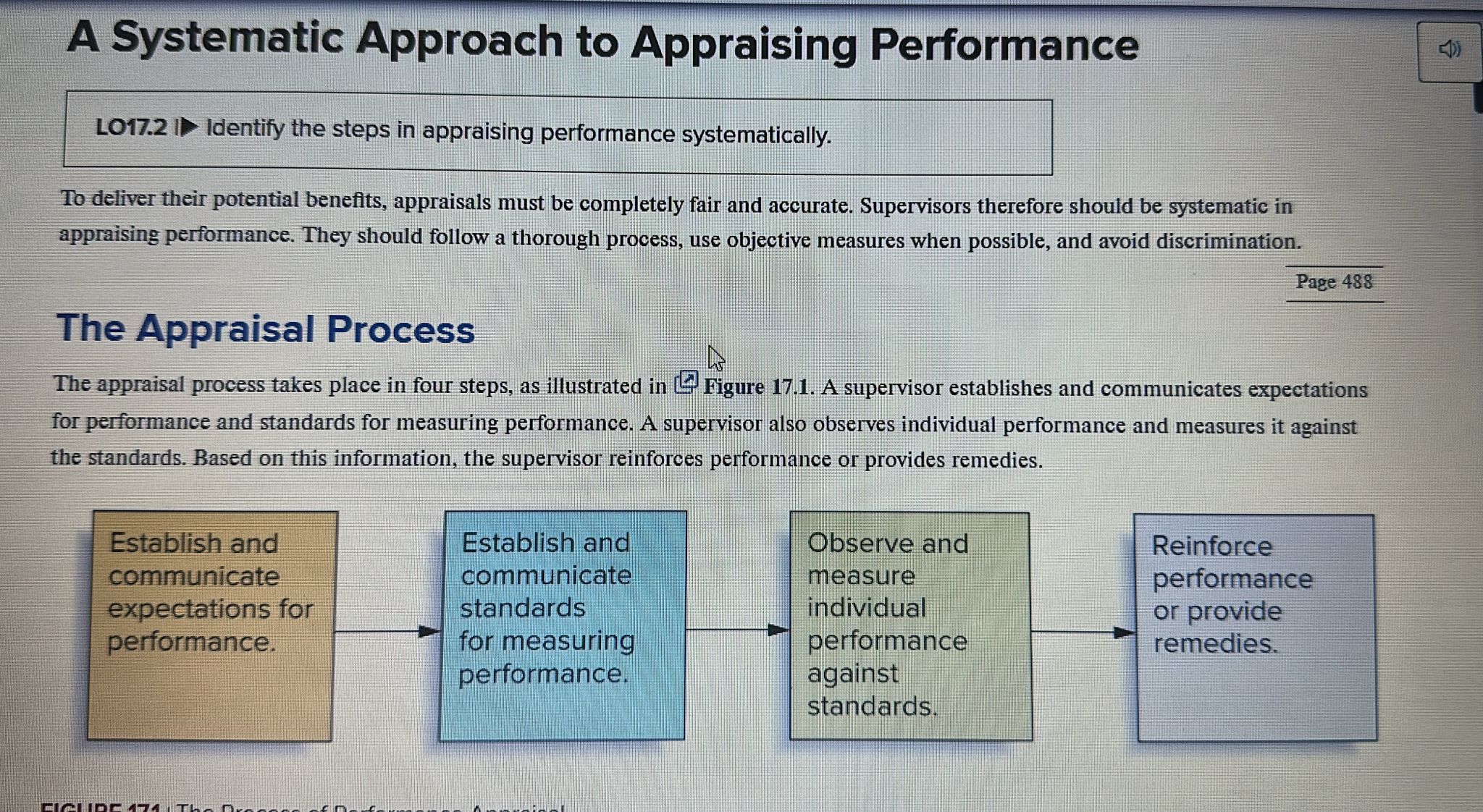
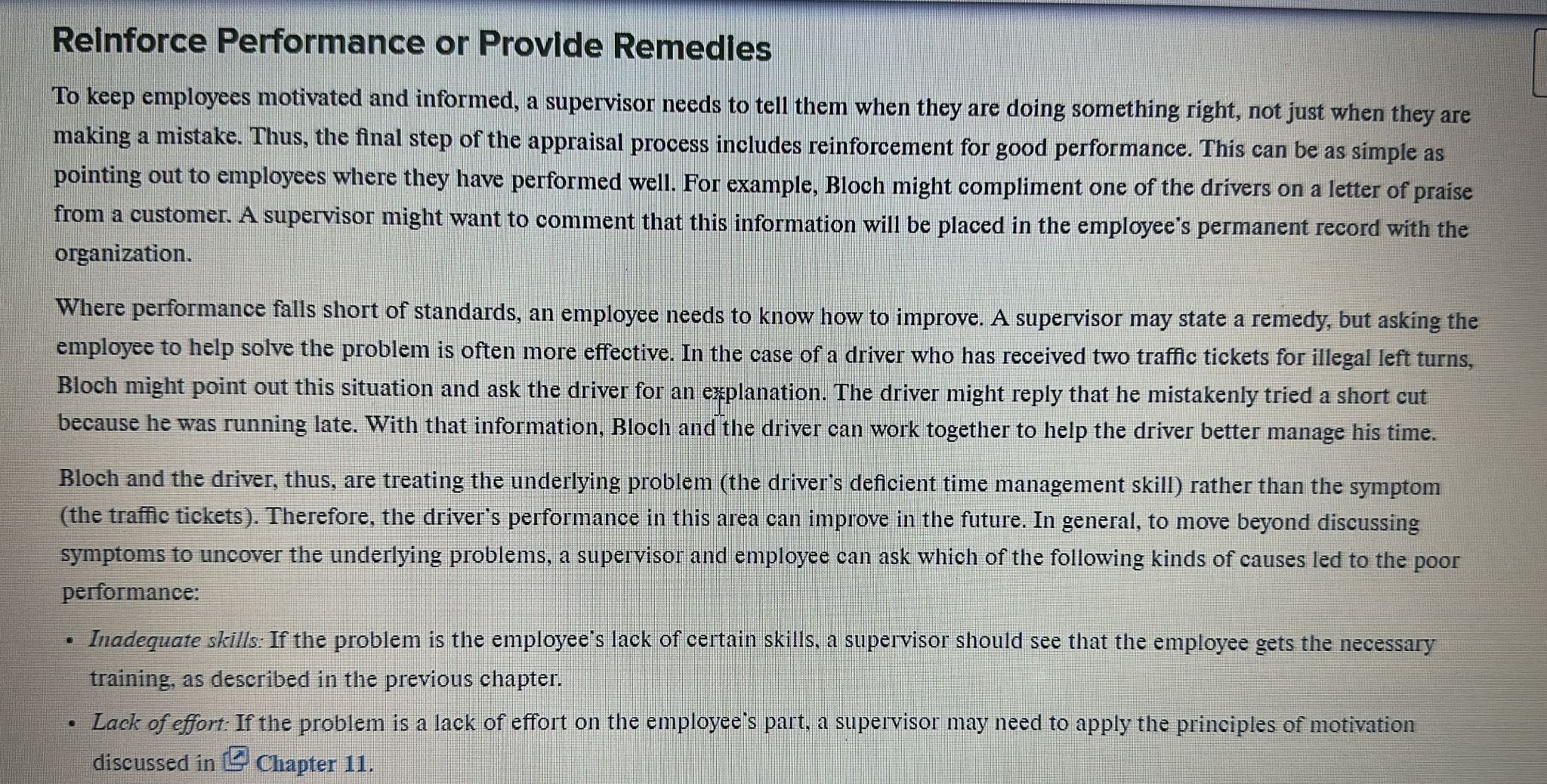
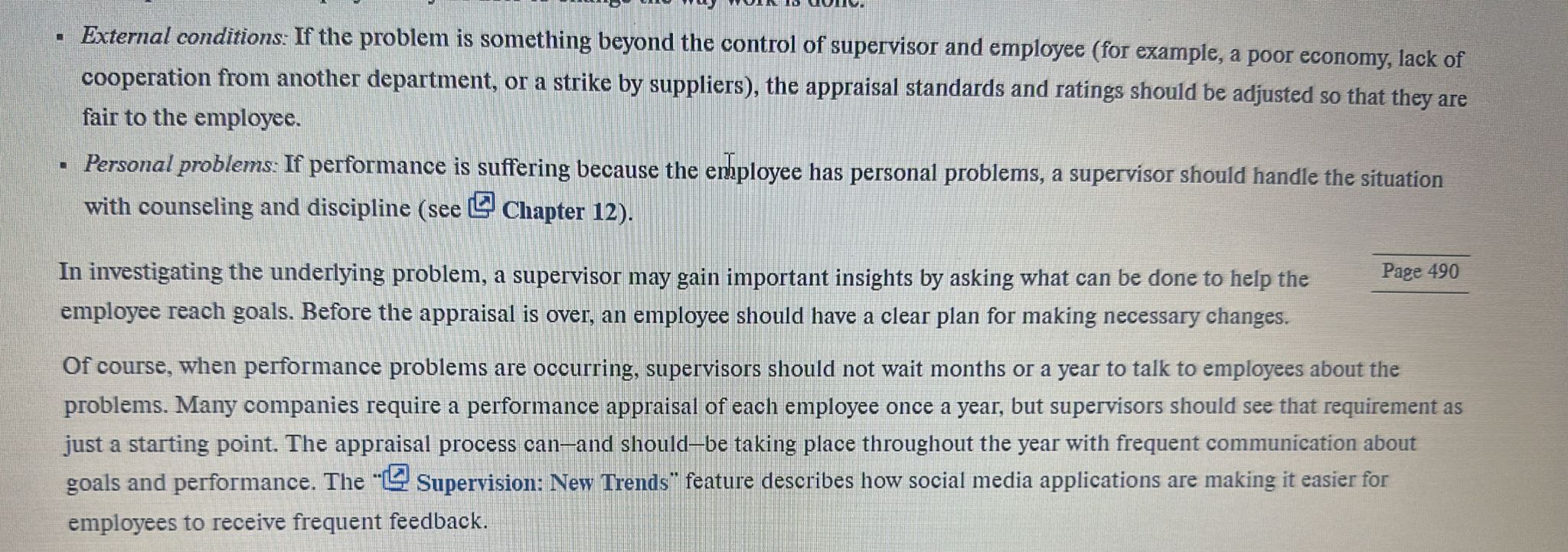
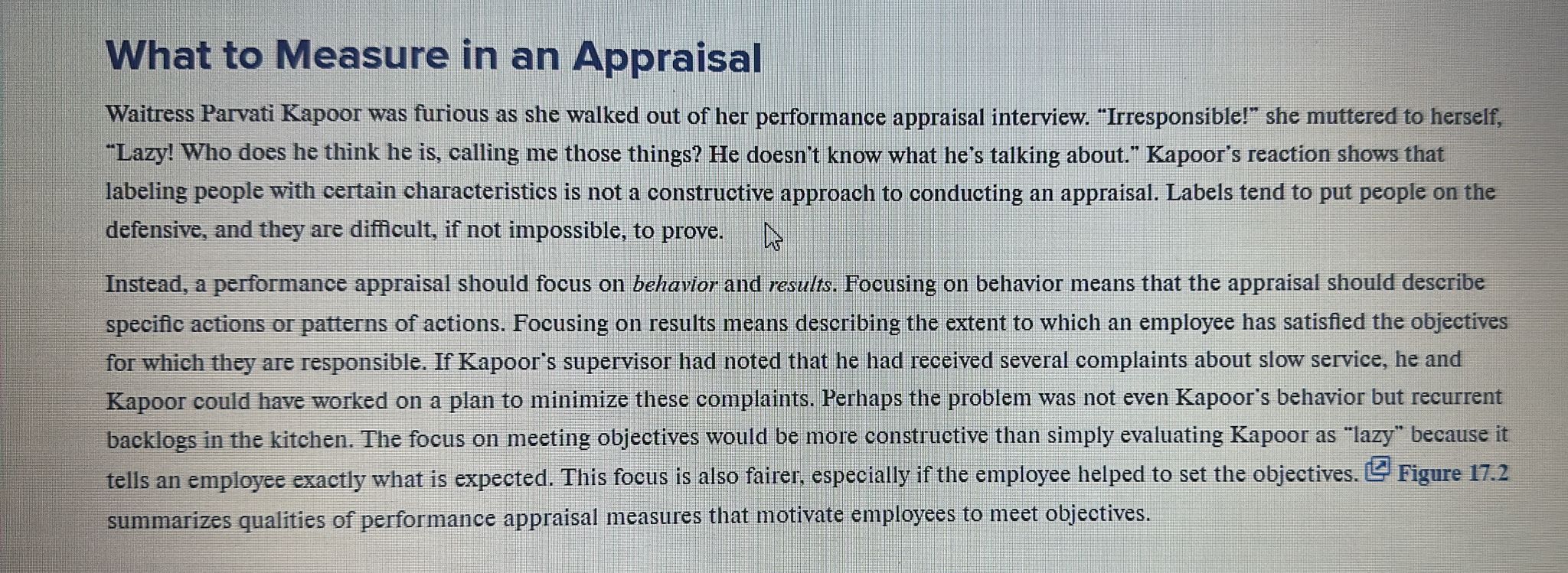
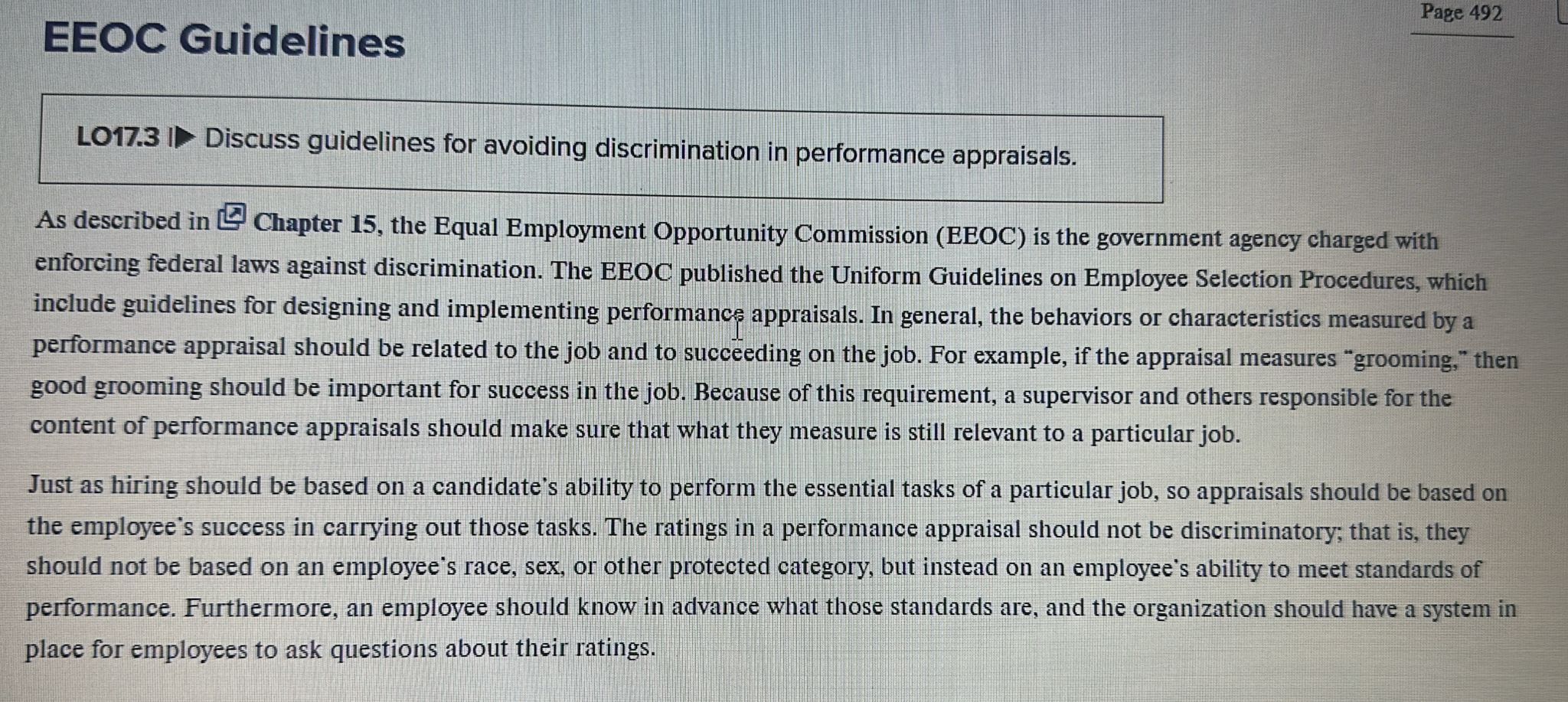
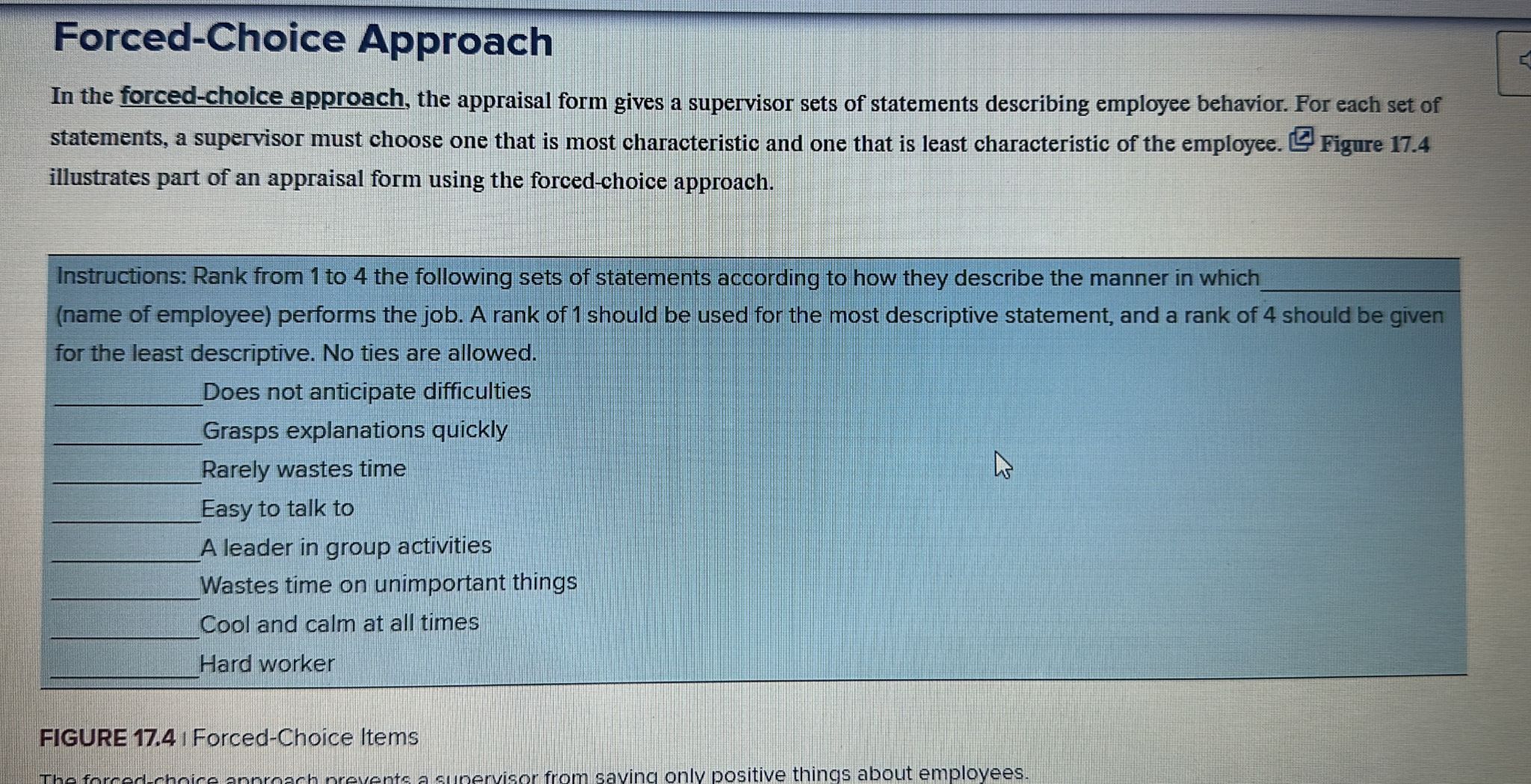
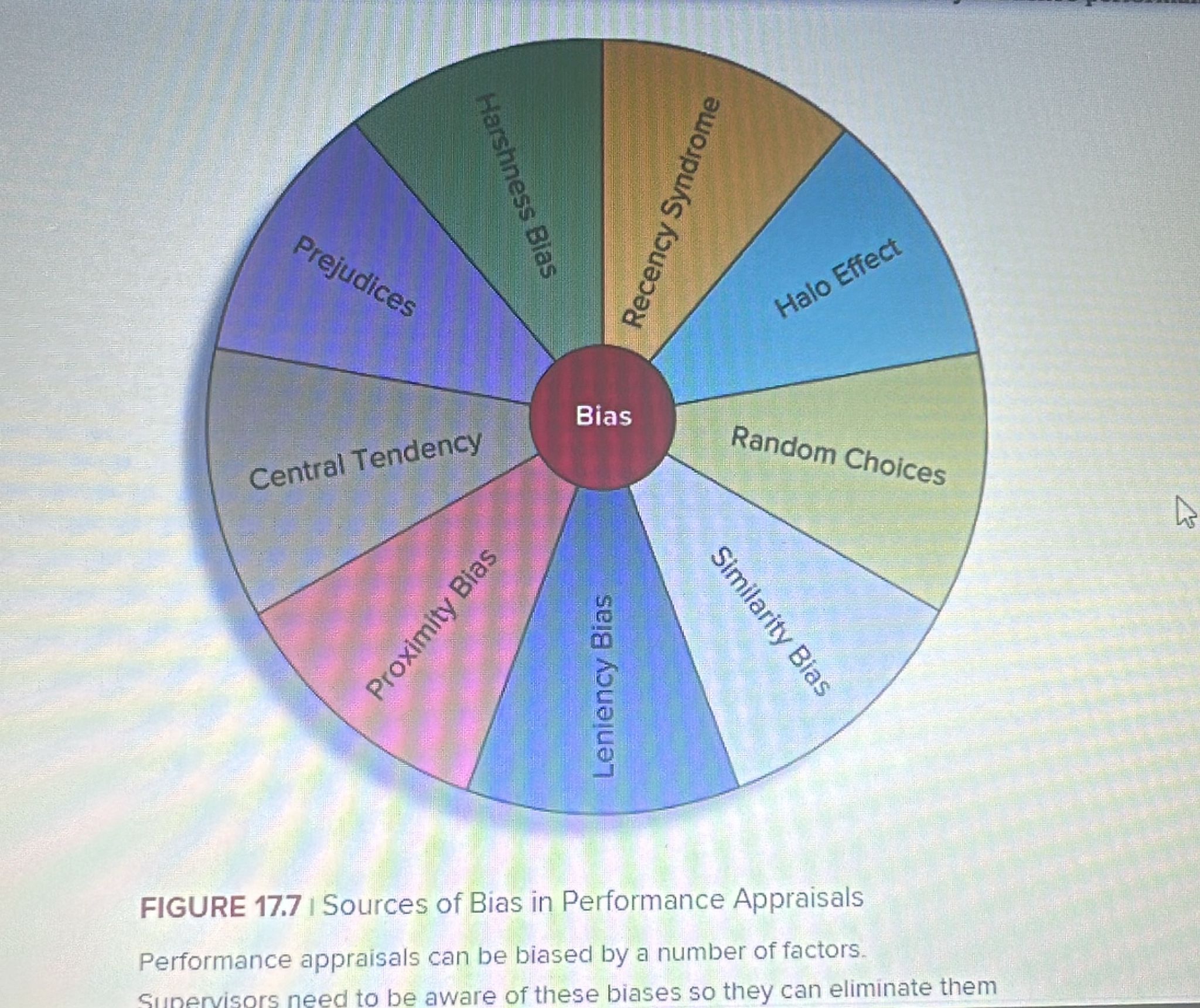
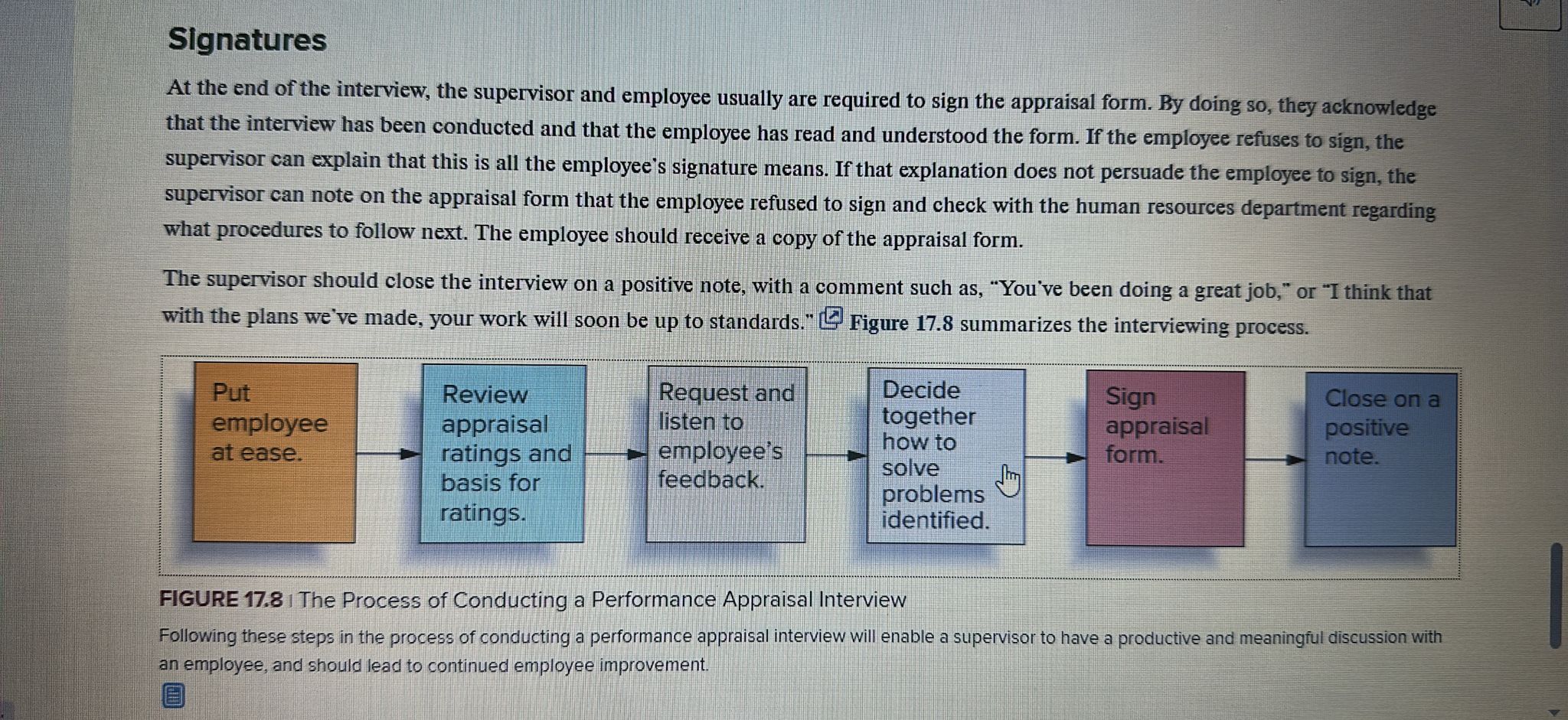
Purposes of Performance Appraisal LO17.1 1 Summarize the benefits of conducting performance appraisals. Performance appraisals provide the information needed by employees to improve the quality of their work. To improve, employees need to hear how they are doing. As described in [ Chapters 7 and 4 10, a supervisor should provide frequent feedback. Performance appraisals supplement this informal information with a more thought-out, formal evaluation. (Employees who get enough informal feedback probably will not be surprised by the results of the appraisal.) A formal performance appraisal ensures that feedback to an employee covers all important aspects of the employee's performance. Based on this information, the employee and supervisor can plan how to improve weak areas. In this way, performance Page 487 appraisals support the practice of coaching, described in - Chapter 16. For instance, Harriet Cohen, a Ventura, California, consultant, advises her clients to include personalized goals that match up with each employee's ambitions. So if a supervisor has an employee who hopes to move into management someday, the appraisal could include progress on goals related to handling greater responsibility. For another employee with different ambitions, the coaching could focus on becoming an expert at a particular activity. An appraisal also can help motivate employees. Most people appreciate the time their supervisor spends discussing their work, as well as praise for good performance; just hearing the supervisor's viewpoint can be motivating. Steve Miranda, an executive leader in human resources and business strategy, says that after an effective appraisal, employees "feel energized that the boss appreciates their strengths, values their contribution, and sees their potential." Employees also tend to put forth the greatest effort in the areas that get appraised.A Systematic Approach to Appraising Performance LO17.2 1> Identify the steps in appraising performance systematically. To deliver their potential benefits, appraisals must be completely fair and accurate. Supervisors therefore should be systematic in appraising performance. They should follow a thorough process, use objective measures when possible, and avoid discrimination. Page 488 The Appraisal Process The appraisal process takes place in four steps, as illustrated in Figure 17.1. A supervisor establishes and communicates expectations for performance and standards for measuring performance. A supervisor also observes individual performance and measures it against the standards. Based on this information, the supervisor reinforces performance or provides remedies. Establish and Establish and Observe and Reinforce communicate communicate measure performance expectations for standards individual or provide performance. for measuring performance remedies. performance. against standards.Establish and Communicate Expectations for Performance During the planning process, a supervisor determines what the department or work group should accomplish (see [ Chapter 6). Through action plans, a supervisor spells out who is to do what to accomplish those objectives. From this information, it is relatively easy to specify what each employee must do to help the department or work group meet its objectives. One approach is to list the three to five major responsibilities of each position; the appraisal then focuses on these responsibilities. For example, suppose Francine Bloch supervises the delivery team for a chain of appliance stores in Dallas. Each driver is expected to operate the vehicle safely, deliver every appliance without damaging anything, and be polite to customers. A supervisor must make sure employees know and understand what is expected of them. To do this, the supervisor should make sure that objectives for the employees are clear and should communicate them effectively (see [ Chapter 10). Employees are most likely to understand and be committed to objectives when they have a say in developing them. More and more firms now require that supervisors and employees together set mutually acceptable performance goals. At the United States Agency for International Development (USAID ), the foreign service officers whose performance was being evaluated every year were recently asked to help senior managers devise a new review system. The goal was to refocus on employee development, by separating performance appraisal from the process of selecting candidates for promotion. As a personnel psychologist for USAID said of the old system, "Many supervisors tried to maintain a focus on employee development, including holding employees accountable for poor performance, but our human resources systems provided little support for their efforts. With too few people and too much work to do, it was just too easy for meaningful conversations between employees and supervisors to get sidelined or postponed indefinitely." As at many organizations, the new system, implemented in 2018 and 2019, replaces annual reviews with more frequent conversations-quarterly in this case-and now provides every foreign service officer with both skill development and performanceEstablish and Communicate Standards for Measuring Performance Because expectations for performance are objectives, each expectation should be measurable (see [ Chapter 6). In appraising performance, a supervisor's task includes deciding how to measure employees' performance and then making sure employees know what will be measured. For instance, if the supervisor is looking for effective teamwork, this performance might be defined in terms of attendance (on time) at team meetings, ideas offered to meet the team's challenges, and communication to the team about the progress the person is making on team assignments." For Bloch's employees, the standards would include delivering all appliances without damage, having zero accidents or traffic tickets, and receiving no complaints from customers about service. Page 489 Observe and Measure Individual Performance against Standards Through the control process, a supervisor should continuously gather information about each employee's performance. This is an ongoing activity, not something the supervisor saves to do when filling out appraisal forms. Ways to gather information include keeping regular performance records (such as a work team's output or the customer calls handled by each employee), saving customer notes of complaint or praise, writing a summary whenever an employee is observed doing something exceptional, and encouraging employees to keep track of their accomplishments. This record keeping may seem time-consuming, but it is essential. Some companies ease the burden by installing performance appraisal software. At Shippo, a shipping platform that helps e-commerce companies, appraisals are automated using software called Lattice. Using this system, supervisors conduct two reviews a year, a light check-in and a comprehensive 360-degree review. As a result, employees receive evaluations that are more unbiased and holistic, which helps them develop their careers and enhance working relationships. The appraisal software has made reviews quick and easy to administer and enables supervisors to track the progress of performance reviews."Reinforce Performance or Provide Remedies To keep employees motivated and informed, a supervisor needs to tell them when they are doing something right, not just when they are making a mistake. Thus, the final step of the appraisal process includes reinforcement for good performance. This can be as simple as pointing out to employees where they have performed well. For example, Bloch might compliment one of the drivers on a letter of praise from a customer. A supervisor might want to comment that this information will be placed in the employee's permanent record with the organization. Where performance falls short of standards, an employee needs to know how to improve. A supervisor may state a remedy, but asking the employee to help solve the problem is often more effective. In the case of a driver who has received two traffic tickets for illegal left turns, Bloch might point out this situation and ask the driver for an explanation. The driver might reply that he mistakenly tried a short cut because he was running late. With that information, Bloch and the driver can work together to help the driver better manage his time. Bloch and the driver, thus, are treating the underlying problem (the driver's deficient time management skill) rather than the symptom (the traffic tickets). Therefore, the driver's performance in this area can improve in the future. In general, to move beyond discussing symptoms to uncover the underlying problems, a supervisor and employee can ask which of the following kinds of causes led to the poor performance: . Inadequate skills: If the problem is the employee's lack of certain skills, a supervisor should see that the employee gets the necessary training, as described in the previous chapter. . Lack of effort: If the problem is a lack of effort on the employee's part, a supervisor may need to apply the principles of motivation discussed in L Chapter 11.. External conditions: If the problem is something beyond the control of supervisor and employee (for example, a poor economy, lack of cooperation from another department, or a strike by suppliers), the appraisal standards and ratings should be adjusted so that they are fair to the employee. - Personal problems: If performance is suffering because the employee has personal problems, a supervisor should handle the situation with counseling and discipline (see [ Chapter 12). In investigating the underlying problem, a supervisor may gain important insights by asking what can be done to help the Page 490 employee reach goals. Before the appraisal is over, an employee should have a clear plan for making necessary changes. Of course, when performance problems are occurring, supervisors should not wait months or a year to talk to employees about the problems. Many companies require a performance appraisal of each employee once a year, but supervisors should see that requirement as just a starting point. The appraisal process can-and should-be taking place throughout the year with frequent communication about goals and performance. The "[ Supervision: New Trends" feature describes how social media applications are making it easier for employees to receive frequent feedback.What to Measure in an Appraisal Waitress Parvati Kapoor was furious as she walked out of her performance appraisal interview. "Irresponsible!" she muttered to herself, "Lazy! Who does he think he is, calling me those things? He doesn't know what he's talking about." Kapoor's reaction shows that labeling people with certain characteristics is not a constructive approach to conducting an appraisal. Labels tend to put people on the defensive, and they are difficult, if not impossible, to prove. Instead, a performance appraisal should focus on behavior and results. Focusing on behavior means that the appraisal should describe specific actions or patterns of actions. Focusing on results means describing the extent to which an employee has satisfied the objectives for which they are responsible. If Kapoor's supervisor had noted that he had received several complaints about slow service, he and Kapoor could have worked on a plan to minimize these complaints. Perhaps the problem was not even Kapoor's behavior but recurrent backlogs in the kitchen. The focus on meeting objectives would be more constructive than simply evaluating Kapoor as "lazy" because it tells an employee exactly what is expected. This focus is also fairer, especially if the employee helped to set the objectives. Figure 17.2 summarizes qualities of performance appraisal measures that motivate employees to meet objectives.Page 492 EEOC Guidelines LO17.3 1 Discuss guidelines for avoiding discrimination in performance appraisals. As described in [ Chapter 15, the Equal Employment Opportunity Commission (EEOC) is the government agency charged with enforcing federal laws against discrimination. The EEOC published the Uniform Guidelines on Employee Selection Procedures, which include guidelines for designing and implementing performance appraisals. In general, the behaviors or characteristics measured by a performance appraisal should be related to the job and to succeeding on the job. For example, if the appraisal measures "grooming," then good grooming should be important for success in the job. Because of this requirement, a supervisor and others responsible for the content of performance appraisals should make sure that what they measure is still relevant to a particular job. Just as hiring should be based on a candidate's ability to perform the essential tasks of a particular job, so appraisals should be based on the employee's success in carrying out those tasks. The ratings in a performance appraisal should not be discriminatory; that is, they should not be based on an employee's race, sex, or other protected category, but instead on an employee's ability to meet standards of performance. Furthermore, an employee should know in advance what those standards are, and the organization should have a system in place for employees to ask questions about their ratings.Performance Appraisals and Pay Reviews Many organizations review an employee's wage or salary level at the time of the performance appraisal. This reinforces the link the company makes between performance and pay increases. An employee with an excellent rating would be eligible to receive the largest allowable increase, whereas someone rated as a poor worker might not get any raise or only a cost-of-living increase. However, reviewing pay and performance at the same time presents a potentially serious drawback. Employees may focus on the issue of money, so a supervisor has more difficulty using the performance evaluation as an opportunity for motivating and coaching. A majority of companies (68 percent in a study by Development Dimensions International ) direct their managers to separate performance appraisals from discussions of pay." In those organizations, especially when performance reviews are quarterly or ongoing rather than annual, a supervisor can more readily keep the appraisal focused on the employee's performance. At other organizations, a supervisor who must review pay rates at the same time as performance should make an extra effort to emphasize performance, and it is especially important to provide coaching and feedback about performance throughout the year.Types of Appraisals LO17.4 1> Compare types of appraisals. Many techniques have been developed for appraising performance. The human resources department or higher-level management usually dictates which type the supervisor will use. An organization that has all its supervisors use the same approach establishes a way to keep records showing performance over time, especially when an employee reports to more than one supervisor during their employment. Although a supervisor has to use the appraisal format selected for the whole organization, they may be able to supplement it with other helpful information. A supervisor can use the "Comments" section of a preprinted form or attach additional information to it. Page 493 Graphic Rating Scales The most commonly used type of appraisal is the graphic rating scale, which rates the degree to which an employee has achieved various characteristics, such as job knowledge or punctuality. The rating is often scored from 1 to 5, for example, with 5 representing excellent performance and I representing poor performance. Some appraisal forms include space for comments so that a supervisor can provide support for the ratings. L Figure 17.3 is a sample appraisal form using a graphic rating scale.The main advantage of a graphic rating scale is that it is relatively easy to use. In addition, the scores provide a basis for deciding whether an employee has improved in various areas. However, the ratings themselves are subjective; what one supervisor considers "excellent" may be only "average" to another. Also, many supervisors tend to rate everyone at least a little above average. Some appraisal forms attempt to overcome these problems by containing descriptions of excellent or poor behavior in each area. Other rating scales pose a different problem by labeling performance in terms of how well an employee "meets requirements." Presumably, the supervisor wants all employees to meet the requirements of the job, but if the scale rates everyone at the top, it is less useful for coaching and rewarding employees. For example, the U.S. Merit Systems Protection Board (MSPB), an agency that protects federal workers from political Page 494 partisanship and management abuses, recently conducted a survey of performance appraisals at federal agencies. The MSPB found that "even in [rating] systems with only three levels, where the top rating should be reserved for the top performers, almost half were rated at the top level." Neither the employees who responded to the survey nor their supervisors found their appraisal systems helpful for managing performance, development, or promotions or for coping with challenging employees. The City of Fort Worth Equipment Services Department decided its rankings would be based on the collection of hard data, such as the time an employee takes to complete particular repairs. The information about time spent on each project is compared against industry standards to see whether the employee is more or less productive than those standards. The data show whether the employee should be rated a five or something less on the agency's five-point scale. 12 After reviewing their performance practices, some companies have decided to keep their performance ratings with a few changes. For example, at Facebook, about 87 percent of employees wanted to keep their rating system. As a result, the company kept the system because it enhanced fairness, transparency, and development. According to Facebook managers, the ratings help employees see how the company views their contributions. The ratings are tied to compensation. 13Paired-Comparison Approach The paired-comparison approach measures the relative performance of employees in a group. A supervisor lists the employees in the group and then ranks them. One method is to compare the performance of the first two employees on the list. A supervisor places a checkmark next to the name of the employee whose performance is better, then repeats the process, comparing the first employee's performance with that of other employees. Next, the supervisor compares the second employee on the list with all the others, and so on, until each pair of employees has been compared. The employee with the most check marks is considered the most valuable. A supervisor also can compare employees in terms of several criteria, such as work quantity and quality. For each criterion, a supervisor ranks the employees from best to worst, assigning a I to the lowest-ranked employee and the highest score to the best employee in that category. Then all the scores for each employee are totaled to see who has the highest total score. The paired-comparison approach is appropriate when a supervisor needs to find one outstanding employee in a group. It can be used to identify the best candidate for a promotion or special assignment. However, paired comparisons make some employees look good at the expense of others, which can make it ineffective for motivating team performance or coaching employees. In recent years, more companies have used paired comparisons as a way to help them reduce their workforce. These companies must weigh the advantages of identifying the least productive workers against the possible harm to morale and teamwork among the remaining employees. 14Forced-Choice Approach In the forced-choice approach, the appraisal form gives a supervisor sets of statements describing employee behavior. For each set of statements, a supervisor must choose one that is most characteristic and one that is least characteristic of the employee. Figure 17.4 illustrates part of an appraisal form using the forced-choice approach. Instructions: Rank from 1 to 4 the following sets of statements according to how they describe the manner in which (name of employee) performs the job. A rank of 1 should be used for the most descriptive statement, and a rank of 4 should be given for the least descriptive. No ties are allowed. Does not anticipate difficulties Grasps explanations quickly Rarely wastes time Easy to talk to A leader in group activities Wastes time on unimportant things Cool and calm at all times Hard worker FIGURE 17.4 | Forced-Choice Items bervisor from saving only positive things about employeesEssay Appraisal Sometimes, a supervisor must write a description of the employee's performance, answering questions such as "What are the major strengths of this employee?" or "In what areas does this employee need improvement?" Essay appraisals often are used along with other types of appraisals, notably graphic rating scales. They provide an opportunity for a supervisor to describe aspects of performance that are not thoroughly covered by an appraisal questionnaire. The main drawback of essay appraisals is that their quality depends on a supervisor's writing skills. Behaviorally Anchored Rating Scales Some organizations pay behavioral scientists or organizational psychologists to create behaviorally anchored rating scales (BARS) These scales rate employee performance in several areas, such as work quantity and quality, using a series of statements that describe effective and ineffective performance in each area. In each area, a supervisor selects the statement that best describes how an employee performs. The statements in the rating scales are different for each job title in the organization. ( Figure 17.5 (see page 496) shows a behaviorally anchored rating scale measuring the performance area of teaching competence.Page 497 Critical-Incident Appraisal To conduct a critical-incident appraisal, a supervisor keeps a written record of incidents that show positive and negative ways an employee has acted. The record should include dates, people involved, actions taken, and any other relevant details. At the time of the appraisal, a supervisor reviews the record to reach an overall evaluation of an employee's behavior. During the appraisal interview, a supervisor should give an employee a chance to offer their own views of each incident recorded. This technique has the advantage of focusing on actual behaviors. However, keeping records of critical incidents can be time-consuming, and even if a supervisor is diligent, important incidents could be overlooked. Also, supervisors tend to record negative events more than positive ones, resulting in an overly harsh appraisal. A diligent supervisor can, however, use critical-incident appraisals as a tool for motivating and developing employees. For example, as an adviser to plumbing and mechanical contractors, Paul Ridilla has found that companies can improve performance by identifying and recording the kinds of behavior that add value to the organization: suggesting innovations, working extra hours, training coworkers, and providing the superior service that leads customers to send thank-you notes. Ridilla advises that supervisors keep track of these and other positive behaviors-and recognize and reward them.Work-Standards Approach To use the work-standards approach, a supervisor tries to establish objective measures of performance. A typical work standard would be the quantity produced by an assembly-line worker. This amount should reflect what a person normally could produce. A supervisor then compares an employee's actual performance with the standards. Although the work-standards approach has been applied largely to production workers, the principle of objectively measuring outcomes makes sense for a variety of jobs. For example, speed of service is an important metric for Jack in the Box, the fast-food chain with 2,200 restaurants, mostly in the western United States. The company uses an outside consulting clampany to make weekly "mystery shopper" visits to each store and time customer transactions with a stopwatch, since the automatic timers installed at the drive-thru windows can be manipulated. Jenna Onofre, Jack in the Box's senior manager of guest experience, says the mystery shoppers' objectivity is a big asset to the firm's efforts to get consistent feedback on employee performance. "When it comes to standards," she says, "that's huge."Management by Objectives L Chapter 6 introduced management by objectives (MBO) as a planning tool. In an organization that uses MBO, a supervisor will also use this approach for appraising performance. A supervisor compares each employee's accomplishments with the objectives for that employee. If the employee has met or exceeded their objectives, the appraisal will be favorable. The main advantages of this system are that an employee knows what is expected and a supervisor focuses on results rather than more subjective criteria. Computer systems can readily link a variety of departmental performance measures, such as sales or production levels or customer satisfaction surveys, to performance appraisals. This makes the use of MBO even more practical for today's organizations. In New York, the North Shore-LIJ Health System, now known as Northwell Health, switched from a paper-based system of performance appraisal to a computer-based system. The older system had required supervisors to fill out 10-page forms asking them to rate each employee on subjective factors such as "leadership" and "respectfulness." The new system ties ratings to achievement of measurable goals. Maria Giraldo, nurse manager in the intensive care unit of one of the system's hospitals, appreciates the clarity about what is expected of her. Appraisal interviews can move beyond deciding whether she did a good job to more helpful conversations about how to keep improving. Giraldo and other supervisors and employees can get the most out of an MBO-based appraisal system by actively participating when objectives are set and regularly reviewing the objectives with their supervisor to ensure they are still relevant and up-to-date."Page 498 Assessments by Someone Other Than the Supervisor Supervisors cannot know how an employee behaves at all times or in all situations. Nor can supervisors always appreciate the full impact of an employee's behavior on people inside and outside the organization. To supplement what supervisors do know, other people might offer insights into an employee's behavior. For this reason, supervisors may combine their appraisals with self-assessments by the employee or appraisals by peers and customers. Appraisals of supervisors and other managers also may come from their subordinates. Combining several sources of appraisals is called 360-degree feedback." About 90 percent of the Fortune 500 companies use some form of 360-degree feedback, including appraisal information from customers or peers. Several police departments have improved the performance of their officers by using 360-degree feedback as the basis of coaching. 2 These departments use computer systems into which supervisors, the officers themselves, and others who worked with the officers enter evaluations of how well they handled specific incidents or their jobs over a period of time. The officers' supervisors review the ratings and discuss with the employees how to bring the ratings higher. Knowing that others are watching their performance, the employees focus on the behaviors that will make a difference, and then their ratings generally improve. An increasing number of the nation's 18,000 law- enforcement departments-estimated at about half-have adopted body-camera programs to improve accountability to the public and reduce complaints. Many of these departments assign body cameras to patrol officers, and sometimes to higher-ranking officials as well.24 To use self-assessments, a supervisor can ask each employee to complete an assessment before the appraisal interview. Then the supervisor and employee compare the employee's evaluation of their own behavior with the supervisor's evaluation. This can stimulate discussion and insights, especially in areas where the two are in disagreement.25FIGURE 177 | Sources of Bias in Performance Appraisals Performance appraisals can be biased by a number of factors. Explain the purpose of conducting performance appraisal interviews. The purpose of holding an appraisal interview is to communicate information about an employee's performance. Once a supervisor has evaluated an employee's performance, the supervisor needs to convey his or her thoughts to the employee. An interview is an appropriate setting for doing so because it sets aside time to focus on and discuss the appraisal in private. The interview is also an opportunity for upward communication from the employee. By contributing viewpoints and ideas, an employee can work with the supervisor on devising ways to improve performance. The purpose of an appraisal interview is more difficult to achieve when cultural differences between the supervisor and employee cause misunderstandings. The "(Supervision and Diversity" feature identifies some cross-cultural challenges of appraisal interviews and suggests ways to meet the challenges.Preparing for the Interview LO17.7 1 Tell how supervisors should prepare for a performance appraisal interview. Before the appraisal interview, a supervisor should allow plenty of time for completing the appraisal form. The form should be completed carefully and thoughtfully, not in a rush during the hour before the interview. In addition to filling out the form, the supervisor should think about the employee's likely reactions to the appraisal and plan how to handle them. A supervisor also should be ready with some ideas for correcting problems noted in the appraisal. Page 503Conducting the Interview LO17.8 > Describe guidelines for conducting the interview. At the beginning of the interview, a supervisor should try to put an employee at ease. Employees are often uncomfortable at the prospect of discussing their performance. An offer of coffee and a little small talk may help to break the ice. The supervisor can begin by reviewing the employee's self-appraisal, if one was completed, with the employee, asking them to give reasons for the various ratings. Then a supervisor describes their rating of the employee and how it was arrived at. A supervisor can start by describing overall impressions and then explain the contents of the appraisal form. The supervisor should explain the basis for the ratings, using specific examples of the employee's behavior and results. Most employees are waiting for the "bad news," so it is probably most effective to describe areas for improvement first, followed by the employee's strengths. People need to know what they are doing well so that they will continue on that course, realizing that their efforts are appreciated. After describing the evaluation of the employee's performance, a supervisor should give the employee time to offer feedback. Page 504 The employee should be able to agree or disagree with the supervisor's conclusions, as well as ask questions. This is an important time for the supervisor to keep an open mind and apply the listening skills discussed in ( Chapter 10. Hearing the employee's reactions is the first step toward resolving any problems described in the appraisal.Problem Solving and Coaching When the supervisor and employee understand each other's point of view, they should reach a decision on how to solve problems described in the appraisal. Together they can come up with a number of alternatives and select the solutions that seem most promising. Sometimes, the best solution is for the employee to make behavioral changes; at other times, the supervisor may need to make changes, such as keeping the employee better informed or improving work processes. Proponents of quality management have criticized performance appraisals for connecting rewards mainly to individual performance. The problem, they say, is that the quality of employees' performance depends mainly on the organization's systems, which give each employee the necessary information, authority, and materials. Some organizations address this shortcoming by using appraisal interviews as an opportunity to identify organizational factors that are standing in the way of success. For example, WD-40 Company starts with the belief that employees and their supervisors need to cooperate in order for the company to succeed. WD-40 employees contribute to defining their job requirements, and supervisors are expected to coach employees throughout the year. During appraisal interviews, held once every quarter, the supervisor meets with each employee to take note of all the goals the employee has achieved. Where the employee has not met a goal, the supervisor is supposed to ask the employee what is interfering with achievement of the goal. WD-40 expects supervisors to consider that some of the necessary changes may involve the resources and conditions provided by the company. Furthermore, the supervisor's own manager meets with the supervisor to go over the reviews of the supervisor's employees. They discuss how the company can enable the supervisor to help team members meet all their goals. 32Signatures At the end of the interview, the supervisor and employee usually are required to sign the appraisal form. By doing so, they acknowledge that the interview has been conducted and that the employee has read and understood the form. If the employee refuses to sign, the supervisor can explain that this is all the employee's signature means. If that explanation does not persuade the employee to sign, the supervisor can note on the appraisal form that the employee refused to sign and check with the human resources department regarding what procedures to follow next. The employee should receive a copy of the appraisal form. The supervisor should close the interview on a positive note, with a comment such as, "You've been doing a great job," or "I think that with the plans we've made, your work will soon be up to standards." [ Figure 17.8 summarizes the interviewing process. Put Review Request and Decide Sign Close on a employee appraisal listen to together appraisal positive how to at ease. ratings and employee's form. note. solve basis for feedback. problems ratings. identified. FIGURE 17.8 | The Process of Conducting a Performance Appraisal Interview Following these steps in the process of conducting a performance appraisal interview will enable a supervisor to have a productive and meaningful discussion with an employee, and should lead to continued employee improvement
Step by Step Solution
There are 3 Steps involved in it
1 Expert Approved Answer
Step: 1 Unlock
Question Has Been Solved by an Expert!
Get step-by-step solutions from verified subject matter experts
Step: 2 Unlock
Step: 3 Unlock
Students Have Also Explored These Related General Management Questions!









 Study Help