Question: Written Assignment # 3 _ Groups and Teams Return to the case study Trouble in Hotel Paradise and answer the following questions: 1. Identify the
Written Assignment # 3 _ Groups and Teams
Return to the case study "Trouble in Hotel Paradise" and answer the following questions:
1. Identify the problems related to group work and teams in the case study. What evidence do you find in the case study that suggests that members of housekeeping department are not working well as a team?
2. Analysis you may apply any of the ideas and concepts we have studied so far, but at a minimum you must discuss at least 2 of the following aspects related to group work:
- Stages of group development
- Roles, role conflict and/or role expectations
- Group norms / performance norms
- Group cohesion and conformity
- Teamwork
- Group decision making
Your analysis must demonstrate your ability to apply OB theory and concepts to explain what is causing the issues you identified in Q1.
- Statements you make in your analysis should be supported by specific facts or evidence from the case,
- Analysis should apply OB concepts or theories from the lectures, textbook or other research to explain what is happening in the case.
- Any assumptions you need to make should be clearly stated - this means, if the case doesn't specifically state something but you have reason to believe that it is true, explain what you think is happening and why.
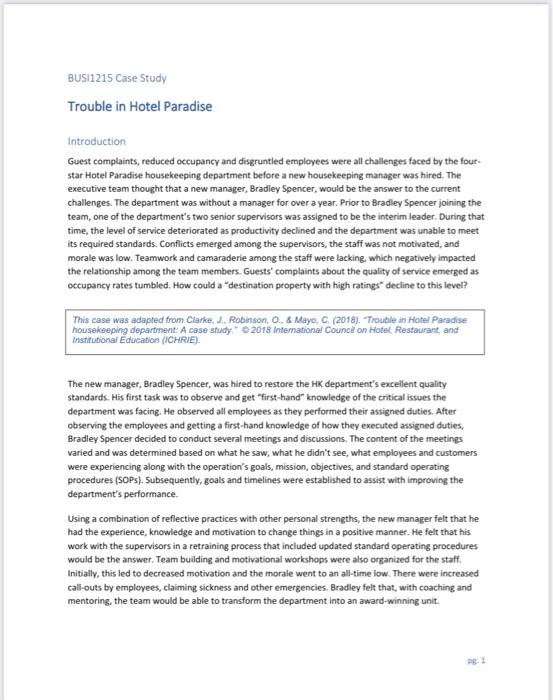
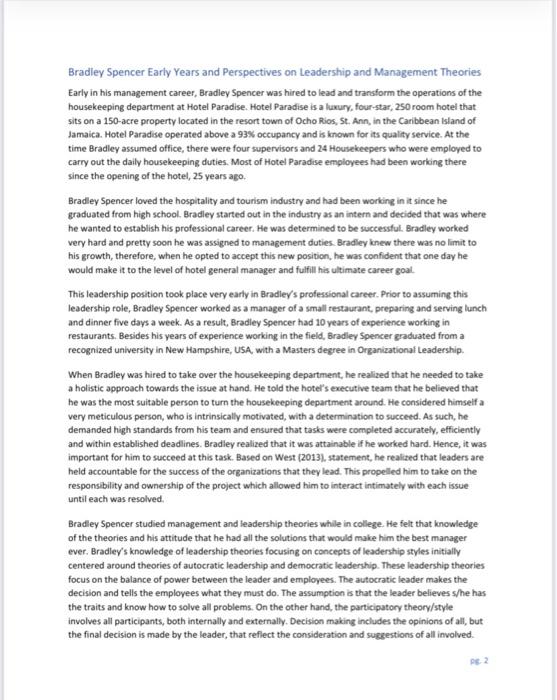
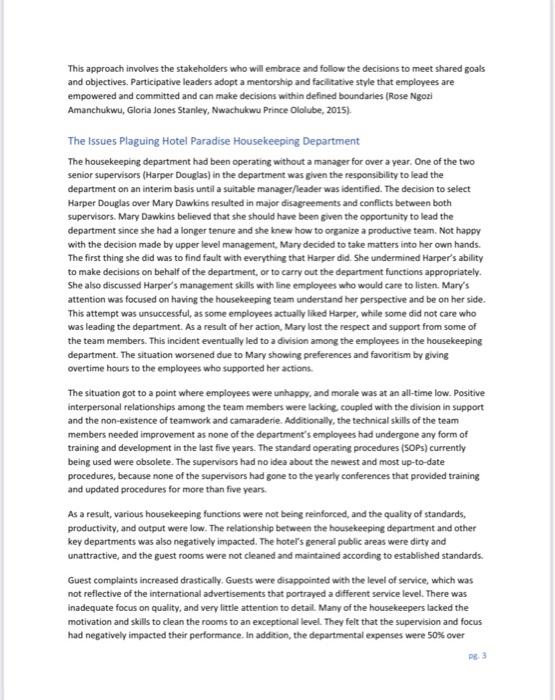
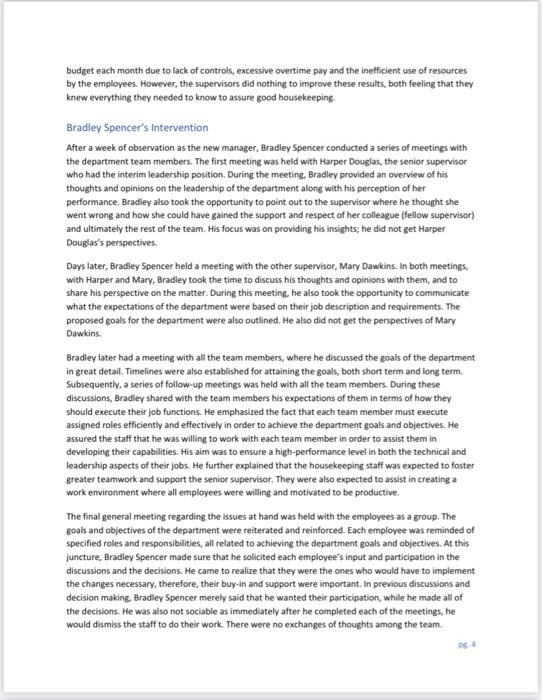
BUS11215 Case Study Trouble in Hotel Paradise Introduction Guest complaints, reduced occupancy and disgruntled employees were all challenges faced by the four- star Hotel Paradise housekeeping department before a new housekeeping manager was hired. The executive team thought that a new manager, Bradley Spencer, would be the answer to the current challenges. The department was without a manager for over a year. Prior to Bradley Spencer joining the team, one of the department's two senior supervisors was assigned to be the interim leader. During that time, the level of service deteriorated as productivity declined and the department was unable to meet its required standards. Conflicts emerged among the supervisors, the staff was not motivated, and morale was low. Teamwork and camaraderie among the staff were lacking, which negatively impacted the relationship among the team members. Guests complaints about the quality of service emerged as occupancy rates tumbled. How could a "destination property with high ratings" decline to this level? This case was adapted from Clarke, J. Robinson, O. & Mayo C (2018). "Trouble an Hotel Paradise housekeeping department A case study. 2018 International Council on Hotel Restaurant and Institutional Education (ICHRIE) The new manager, Bradley Spencer, was hired to restore the HK department's excellent quality standards. His first task was to observe and get "first-hand" knowledge of the critical issues the department was facing. He observed all employees as they performed their assigned duties. After observing the employees and getting a first-hand knowledge of how they executed assigned duties, Bradley Spencer decided to conduct several meetings and discussions. The content of the meetings varied and was determined based on what he saw, what he didn't see what employees and customers were experiencing along with the operation's goals, mission, objectives, and standard operating procedures (SOPs). Subsequently, goals and timelines were established to assist with improving the department's performance. Using a combination of reflective practices with other personal strengths, the new manager felt that he had the experience, knowledge and motivation to change things in a positive manner. He felt that his work with the supervisors in a retraining process that included updated standard operating procedures would be the answer. Team building and motivational workshops were also organized for the staff. Initially, this led to decreased motivation and the morale went to an all-time low. There were increased call-outs by employees, claiming sickness and other emergencies. Bradley felt that with coaching and mentoring, the team would be able to transform the department into an award-winning unit. PE Bradley Spencer Early Years and Perspectives on Leadership and Management Theories Early in his management career, Bradley Spencer was hired to lead and transform the operations of the housekeeping department at Hotel Paradise Hotel Paradise is a luxury, four-star, 250 room hotel that sits on a 150-acre property located in the resort town of Ocho Rios, St. Ann, in the Caribbean Island of Jamaica. Hotel Paradise operated above a 93% occupancy and is known for its quality service. At the time Bradley assumed office, there were four supervisors and 24 Housekeepers who were employed to carry out the daily housekeeping duties. Most of Hotel Paradise employees had been working there since the opening of the hotel, 25 years ago Bradley Spencer loved the hospitality and tourism industry and had been working in it since he graduated from high school. Bradley started out in the industry as an intern and decided that was where he wanted to establish his professional career. He was determined to be successful. Bradley worked very hard and pretty soon he was assigned to management duties. Bradley knew there was no limit to his growth, therefore, when he opted to accept this new position, he was confident that one day he would make it to the level of hotel general manager and fulfill his ultimate career goal. This leadership position took place very early in Bradley's professional career. Prior to assuming this leadership role, Bradley Spencer worked as a manager of a small restaurant, preparing and serving lunch and dinner five days a week. As a result, Bradley Spencer had 10 years of experience working in restaurants, Besides his years of experience working in the field, Bradley Spencer graduated from a recognized university in New Hampshire, USA, with a Masters degree in Organizational Leadership When Bradley was hired to take over the housekeeping department, he realized that he needed to take a holistic approach towards the issue at hand. He told the hotel's executive team that he believed that he was the most suitable person to turn the housekeeping department around. He considered himself a very meticulous person, who is intrinsically motivated, with a determination to succeed. As such, he demanded high standards from his team and ensured that tasks were completed accurately, efficiently and within established deadlines. Bradley realized that it was attainable if he worked hard. Hence, it was important for him to succeed at this task. Based on West (2013), statement, he realized that leaders are held accountable for the success of the organizations that they lead. This propelled him to take on the responsibility and ownership of the project which allowed him to interact intimately with each issue until each was resolved Bradley Spencer studied management and leadership theories while in college. He felt that knowledge of the theories and his attitude that he had all the solutions that would make him the best manager ever. Bradley's knowledge of leadership theories focusing on concepts of leadership styles initially centered around theories of autocratic leadership and democratic leadership. These leadership theories focus on the balance of power between the leader and employees. The autocratic leader makes the decision and tells the employees what they must do. The assumption is that the leader believes s/he has the traits and know how to solve all problems. On the other hand, the participatory theory/style involves all participants, both internally and externally. Decision making includes the opinions of all, but the final decision is made by the leader, that reflect the consideration and suggestions of all involved. E2 This approach involves the stakeholders who will embrace and follow the decisions to meet shared goals and objectives. Participative leaders adopt a mentorship and facilitative style that employees are empowered and committed and can make decisions within defined boundaries (Rose Ngozi Amanchukwu, Gloria Jones Stanley, Nwachukwu Prince Ololube, 2015). The Issues Plaguing Hotel Paradise Housekeeping Department The housekeeping department had been operating without a manager for over a year. One of the two senior supervisors (Harper Douglas) in the department was given the responsibility to lead the department on an interim basis until a suitable manager/leader was identified. The decision to select Harper Douglas over Mary Dawkins resulted in major disagreements and conflicts between both supervisors. Mary Dawkins believed that she should have been given the opportunity to lead the department since she had a longer tenure and she knew how to organize a productive team. Not happy with the decision made by upper level management, Mary decided to take matters into her own hands. The first thing she did was to find fault with everything that Harper did. She undermined Harper's ability to make decisions on behalf of the department, or to carry out the department functions appropriately. She also discussed Harper's management skills with line employees who would care to listen. Mary's attention was focused on having the housekeeping team understand her perspective and be on her side. This attempt was unsuccessful, as some employees actually liked Harper, while some did not care who was leading the department. As a result of her action, Mary lost the respect and support from some of the team members. This incident eventually led to a division among the employees in the housekeeping department. The situation worsened due to Mary showing preferences and favoritism by giving overtime hours to the employees who supported her actions The situation got to a point where employees were unhappy, and morale was at an all-time low. Positive interpersonal relationships among the team members were lacking coupled with the division in support and the non-existence of teamwork and camaraderie. Additionally, the technical skills of the team members needed improvement as none of the department's employees had undergone any form of training and development in the last five years. The standard operating procedures (SOPs) currently being used were obsolete. The supervisors had no idea about the newest and most up-to-date procedures, because none of the supervisors had gone to the yearly conferences that provided training and updated procedures for more than five years. As a result, various housekeeping functions were not being reinforced, and the quality of standards, productivity, and output were low. The relationship between the housekeeping department and other key departments was also negatively impacted. The hotel's general public areas were dirty and unattractive, and the guest rooms were not cleaned and maintained according to established standards. Guest complaints increased drastically. Guests were disappointed with the level of service, which was not reflective of the international advertisements that portrayed a different service level. There was inadequate focus on quality, and very little attention to detail. Many of the housekeepers lacked the motivation and skills to clean the rooms to an exceptional level. They felt that the supervision and focus had negatively impacted their performance. In addition, the departmental expenses were 50% over P3 budget each month due to lack of controls, excessive overtime pay and the inefficient use of resources by the employees. However, the supervisors did nothing to improve these results, both feeling that they knew everything they needed to know to assure good housekeeping Bradley Spencer's Intervention After a week of observation as the new manager, Bradley Spencer conducted a series of meetings with the department team members. The first meeting was held with Harper Douglas, the senior supervisor who had the interim leadership position. During the meeting, Bradley provided an overview of his thoughts and opinions on the leadership of the department along with his perception of her performance. Bradley also took the opportunity to point out to the supervisor where he thought she went wrong and how she could have gained the support and respect of her colleague (fellow supervisor) and ultimately the rest of the team. His focus was on providing his insights, he did not get Harper Douglas's perspectives. Days later, Bradley Spencer held a meeting with the other supervisor, Mary Dawkins. In both meetings, with Harper and Mary, Bradley took the time to discuss his thoughts and opinions with them, and to share his perspective on the matter. During this meeting, he also took the opportunity to communicate what the expectations of the department were based on their job description and requirements. The proposed goals for the department were also outlined. He also did not get the perspectives of Mary Dawkins. Bradley later had a meeting with all the team members, where he discussed the goals of the department in great detail. Timelines were also established for attaining the goals, both short term and long term. Subsequently, a series of follow-up meetings was held with all the team members. During these discussions, Bradley shared with the team members his expectations of them in terms of how they should execute their job functions. He emphasized the fact that each team member must execute assigned roles efficiently and effectively in order to achieve the department goals and objectives. He assured the staff that he was willing to work with each team member in order to assist them in developing their capabilities. His aim was to ensure a high-performance level in both the technical and leadership aspects of their jobs. He further explained that the housekeeping staff was expected to foster greater teamwork and support the senior supervisor. They were also expected to assist in creating a work environment where all employees were willing and motivated to be productive The final general meeting regarding the issues at hand was held with the employees as a group. The goals and objectives of the department were reiterated and reinforced. Each employee was reminded of specified roles and responsibilities, all related to achieving the department goals and objectives. At this juncture, Bradley Spencer made sure that he solicited each employee's input and participation in the discussions and the decisions. He came to realize that they were the ones who would have to implement the changes necessary, therefore, their buy-in and support were important. In previous discussions and decision making. Bradley Spencer merely said that he wanted their participation, while he made all of the decisions. He was also not sociable as immediately after he completed each of the meetings, he would dismiss the staff to do their work. There were no exchanges of thoughts among the team. PE Subsequent to the meetings, a supervisory skill training workshop was conducted to equip the supervisors in team development and performance of job duties. The skills training workshops were identified as the best option to use in the retraining of the supervisory employees. The purpose was to ensure that the work performed was at a higher standard, and that eventually following the training, the housekeeping department would regain its quality assurance. The standard operating procedures for the departmental tasks were reviewed and with the input of the supervisors, amendments were made where necessary. While the scheduled training was a good idea, the training was conducted based on old and outdated housekeeping procedures. Bradley Spencer made no effort to ensure that the training was current and relevant Employees were also surveyed for their feedback. Besides soliciting word-of-mouth input, an on-the-job Satisfaction survey was conducted. The results from the survey revealed that the overall level of job satisfaction from an individual and a team perspective was the same and had not improved. The employees complained that they were told what to do without being allowed to provide some input. They also expressed the desire to learn new and relevant procedures relating to their job. They also asked for a summary of the guests' comments about housekeeping which they did not receive. As a result, several of the HK staff became rebellious The HK standards were developed without the input from the supervisors or line employees until after the fact. Bradley thought that the employees and supervisors were very enthusiastic about the improvements he recommended. As a result, he felt that the employees who had not embraced them should be fired. He claimed that he strives to see the good in people and in the situation without focusing on the negative and that there was no room in the team for negativity. Although some of the team members weren't convinced of the outcome, Bradley maintained an upbeat and optimistic view, hoping that, eventually, the employees would see the light. He believed in the words of Haslam et al. (2011) who noted that, the gap between a leader and his followers can be closed by exercising fairness at all times. He felt that as a result, each employee would develop a sense of trust and respect for his/her superior. This will eventually lead them to become more committed and dedicated to the attainment of the housekeeping department goal as well as increased output Saving Hotel Paradise Housekeeping Department Hotel Paradise housekeeping employees finally asked to have a meeting with Bradley Spencer, because they thought that the new standards were obsolete. They also had issues with the new cleaning chemicals that they thought were dangerous for them to use, and the fact that some of them were not getting the work hours needed to support their families. The employees were told that they could have a meeting with Bradley Spencer, once there was an improvement in occupancy percentage and room revenue. Nonetheless, Bradley felt that the housekeeping department was improving under his leadership, even though there still was a lack of teamwork and desire to meet objectives. Bradley felt that his role after the implementation of the new standards should be to act as a mentor and coach. The employees were 5 told that they could have a meeting with Bradley Spencer, after there was an improvement in occupancy percentage and room revenue Bradley developed and implemented a performance appraisal for each employee. During the appraisal, each employee strengths were highlighted and recommendations were made in the areas in which improvements were needed. Bradley made it his duty to frequently inform and emphasize to the employees the importance of operating in a fair and consistent manner with each other. In addition, a series of conflict resolution and team-building sessions were conducted to help create a more harmonious and team-driven work environment. The employees felt that during the appraisal process, each of them would get a chance to voice their opinions about the operation and how improvements could be realized. However, Bradley did all of the talking. The normal occupancy rate that had once been 95% was now down to an average of 63%. When Bradley realized that the occupancy rate had declined so much, he was disturbed. He soon realized that, although he had great ideas, he needed to do something to engage the employees in order to increase productivity and occupancy Bradley considered his work with the HK department so far. He was forced to admit that, while he had implemented some changes and was a democratic manager and an innovative leader, things had not improved as they should have. He admitted that the employees had requested a meeting with him, but he had not scheduled it as yet. He felt that the employees' performance appraisals, the training of the supervisors and the review of their goals and objectives were all that was needed for improvement. He still believed he was the right person to lead the department and wondered what his next steps should be PE 6









 Study Help