Question: Written Message 4 will test your ability to organize and deliver a negative news message containing professional criticism effectively and positively. Make sure you've read
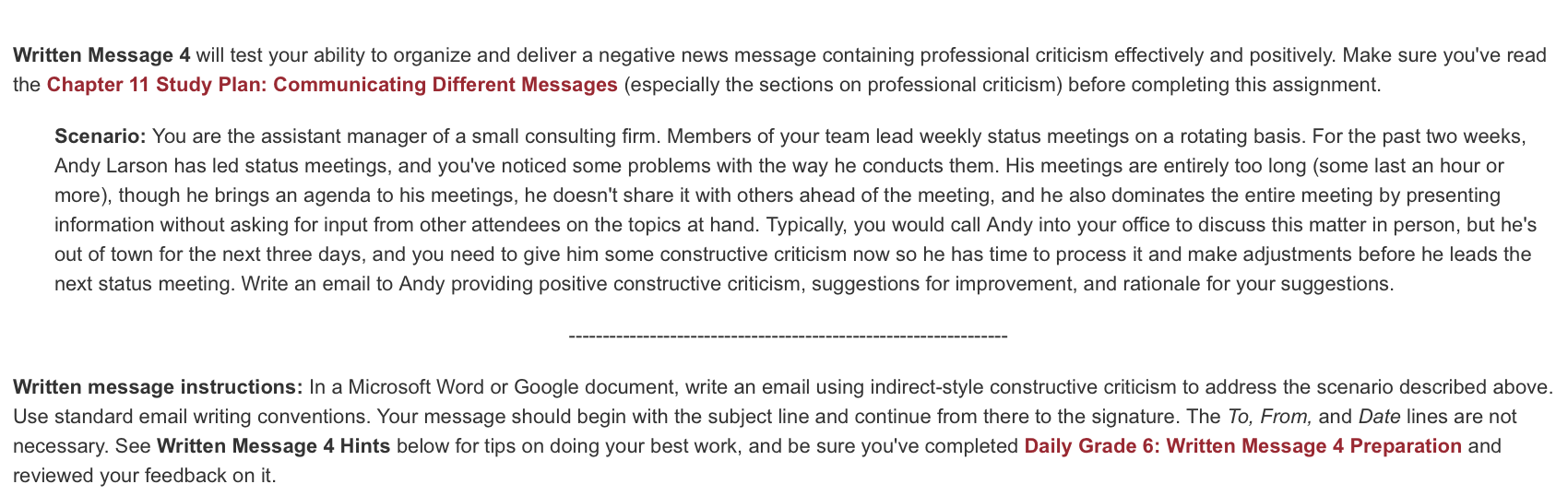
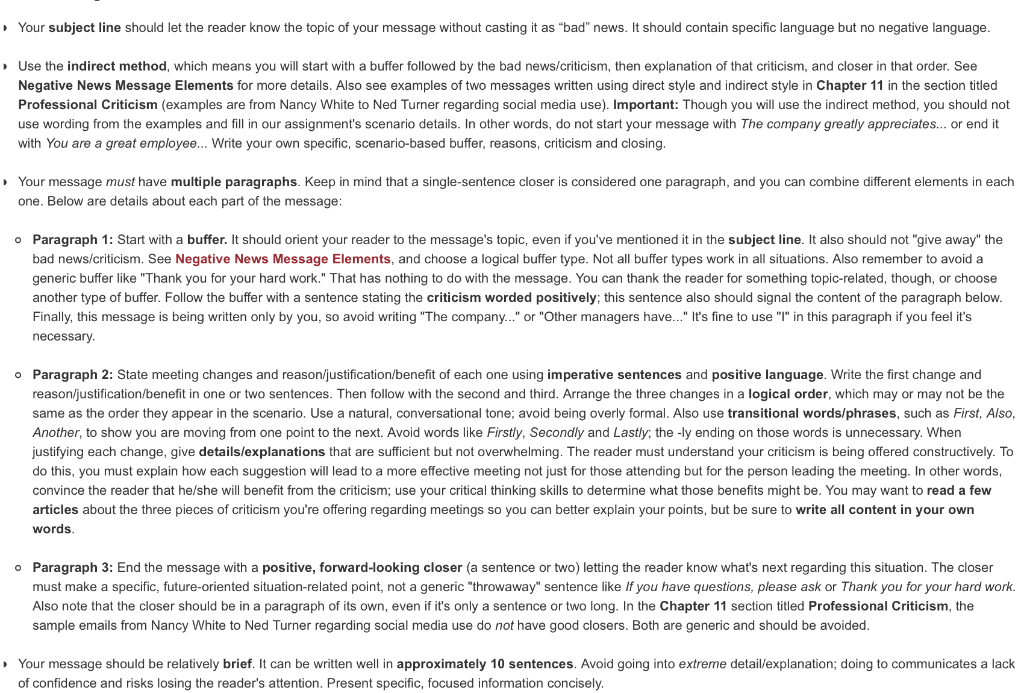
Written Message 4 will test your ability to organize and deliver a negative news message containing professional criticism effectively and positively. Make sure you've read the Chapter 11 Study Plan: Communicating Different Messages (especially the sections on professional criticism) before completing this assignment. Scenario: You are the assistant manager of a small consulting firm. Members of your team lead weekly status meetings on a rotating basis. For the past two weeks, Andy Larson has led status meetings, and you've noticed some problems with the way he conducts them. His meetings are entirely too long (some last an hour or more), though he brings an agenda to his meetings, he doesn't share it with others ahead of the meeting, and he also dominates the entire meeting by presenting information without asking for input from other attendees on the topics at hand. Typically, you would call Andy into your office to discuss this matter in person, but he's out of town for the next three days, and you need to give him some constructive criticism now so he has time to process it and make adjustments before he leads the next status meeting. Write an email to Andy providing positive constructive criticism, suggestions for improvement, and rationale for your suggestions. Written message instructions: In a Microsoft Word or Google document, write an email using indirect-style constructive criticism to address the scenario described above. Use standard email writing conventions. Your message should begin with the subject line and continue from there to the signature. The To, From, and Date lines are not necessary. See Written Message 4 Hints below for tips on doing your best work, and be sure you've completed Daily Grade 6: Written Message 4 Preparation and reviewed your feedback on it. Your subject line should let the reader know the topic of your message without casting it as "bad" news. It should contain specific language but no negative language. Use the indirect method, which means you will start with a buffer followed by the bad news/criticism, then explanation of that criticism, and closer in that order. See Negative News Message Elements for more details. Also see examples of two messages written using direct style and indirect style in Chapter 11 in the section titled Professional Criticism (examples are from Nancy White to Ned Turner regarding social media use). Important: Though you will use the indirect method, you should not use wording from the examples and fill in our assignment's scenario details. In other words, do not start your message with The company greatly appreciates... or end it with You are a great employee... Write your own specific, scenario-based buffer, reasons, criticism and closing. Your message must have multiple paragraphs. Keep in mind that a single-sentence closer is considered one paragraph, and you can combine different elements in each one. Below are details about each part of the message: o Paragraph 1: Start with a buffer. It should orient your reader to the message's topic, even if you've mentioned it in the subject line. It also should not "give away" the bad news/criticism. See Negative News Message Elements, and choose a logical buffer type. Not all buffer types work in all situations. Also remember to avoid a generic buffer like "Thank you for your hard work." That has nothing to do with the message. You can thank the reader for something topic-related, though, or choose another type of buffer. Follow the buffer with sentence stating the criticism worded positively; this sentence also should signal the content of the paragraph below. Finally, this message is being written only by you, so avoid writing "The company..." or "Other managers have..." It's fine to use "T" in this paragraph if you feel it's necessary o Paragraph 2: State meeting changes and reason/justification/benefit of each one using imperative sentences and positive language. Write first change and reason/justification/benefit in one or two sentences. Then follow with the second and third. Arrange the three changes in a logical order, which may or may not be the same as the order they appear in the scenario. Use a natural, conversational tone; avoid being overly formal. Also use transitional words/phrases, such as First, Also, Another, to show you are moving from one point to the next. Avoid words like Firstly, Secondly and Lastly, the-ly ending on those words is unnecessary. When justifying each change, give details/explanations that are sufficient but not overwhelming. The reader must understand your criticism is being offered constructively. To do this, you must explain how each suggestion will lead to a more effective meeting not just for those attending but for the person leading the meeting. In other words, convince the reader that he/she will benefit from the criticism; use your critical thinking skills to determine what those benefits might be. You may want to read a few articles about the three pieces of criticism you're offering regarding meetings so you can better explain your points, but be sure to write all content in your own words. o Paragraph 3: End the message with a positive, forward-looking closer (a sentence or two) letting the reader know what's next regarding this situation. The closer must make a specific, future-oriented situation-related point, not a generic "throwaway" sentence like If you have questions, please ask or Thank you for your hard work. Also note that the closer should be in a paragraph of its own, even if it's only a sentence or two long. In the Chapter 11 section titled Professional Criticism, the sample emails from Nancy White to Ned Turner regarding social media use do not have good closers. Both are generic and should be avoided. Your message should be relatively brief. It can be written well in approximately 10 sentences. Avoid going into extreme detail/explanation; doing to communicates a lack of confidence and risks losing the reader's attention. Present specific, focused information concisely









 Study Help