







Question: { x } , overlapping. Disjoint difference, which returns rectangles th t are disjoint. Largest - Cover Difference Given two rectangles R = ( I
overlapping.
Disjoint difference, which returns rectangles tht are disjoint.
LargestCover Difference
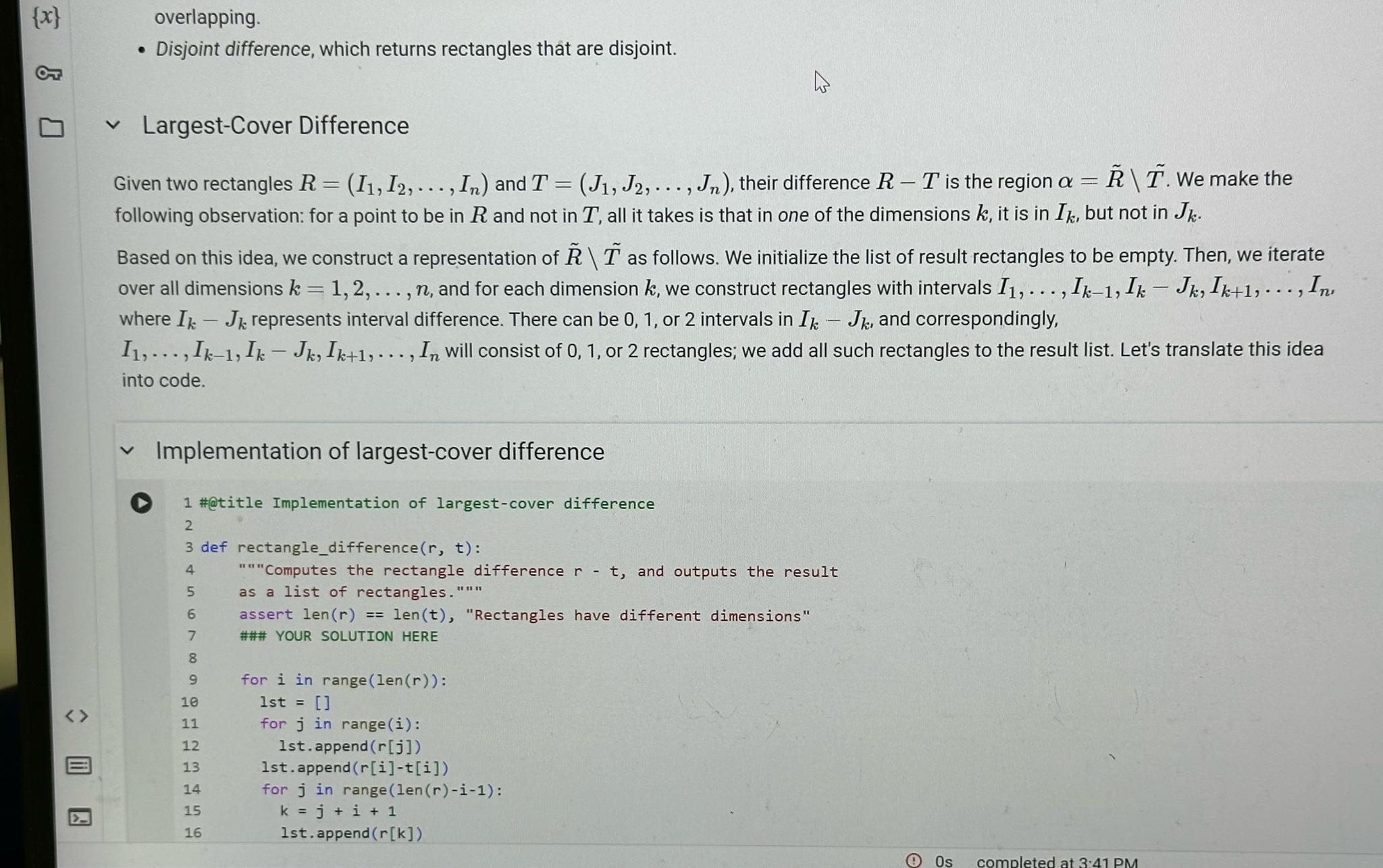
Given two rectangles dots, and dots, their difference is the region tildetilde We make the following observation: for a point to be in and not in all it takes is that in one of the dimensions it is in but not in
Based on this idea, we construct a representation of tildetilde as follows. We initialize the list of result rectangles to be empty. Then, we iterate over all dimensions dots, and for each dimension we construct rectangles with intervals dots,dots, where represents interval difference. There can be or intervals in and correspondingly, dots,dots, will consist of or rectangles; we add all such rectangles to the result list. Let's translate this idea into code.
Implementation of largestcover difference
#@title Implementation of largestcover difference
def rectangledifference :
Computes the rectangle difference and outputs the result
as a list of rectangles." n
assert len len "Rectangles have different dimensions"
### YOUR SOLUTION HERE
for in rangelen :
lst
for in rangei:
Ist.append
lstappend riti
for in rangelen :
st append
Step by Step Solution
There are 3 Steps involved in it
1 Expert Approved Answer
Step: 1 Unlock

Question Has Been Solved by an Expert!
Get step-by-step solutions from verified subject matter experts
Step: 2 Unlock
Step: 3 Unlock
 Study Help