







Question: + X pole - = = px1 = (Exercise 11.3) Let Zp px1 = Y where E(Y) = E(X) = 0, E(YY') = 0 =
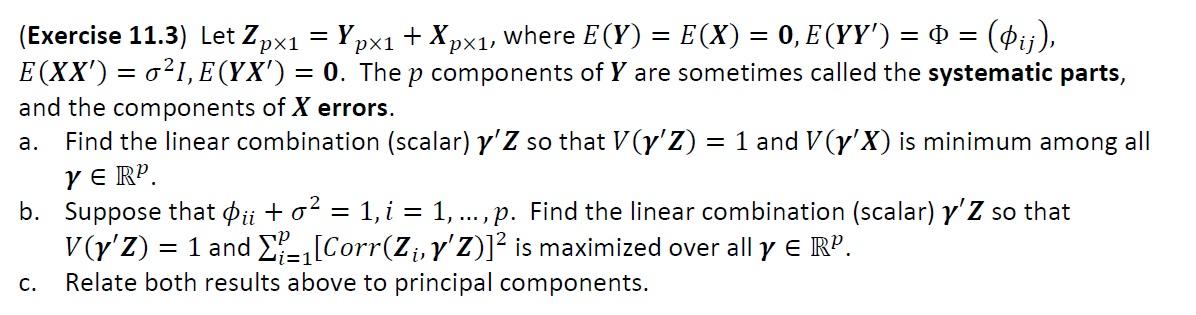
+ X pole - = = px1 = (Exercise 11.3) Let Zp px1 = Y where E(Y) = E(X) = 0, E(YY') = 0 = (dij), E(XX') = 021, E(YX') = 0. The p components of Y are sometimes called the systematic parts, and the components of X errors. a. Find the linear combination (scalar) y'Z so that V(y'Z) = 1 and V(y'X) is minimum among all VERP. b. Suppose that Qii + o2 = 1, i = 1, ..., p. Find the linear combination (scalar) y'Z so that V(y'Z) = 1 and 2?=[Corr(Z, y'Z)]2 is maximized over all y RP. Relate both results above to principal components. = = i c. + X pole - = = px1 = (Exercise 11.3) Let Zp px1 = Y where E(Y) = E(X) = 0, E(YY') = 0 = (dij), E(XX') = 021, E(YX') = 0. The p components of Y are sometimes called the systematic parts, and the components of X errors. a. Find the linear combination (scalar) y'Z so that V(y'Z) = 1 and V(y'X) is minimum among all VERP. b. Suppose that Qii + o2 = 1, i = 1, ..., p. Find the linear combination (scalar) y'Z so that V(y'Z) = 1 and 2?=[Corr(Z, y'Z)]2 is maximized over all y RP. Relate both results above to principal components. = = i c
Step by Step Solution
There are 3 Steps involved in it

Get step-by-step solutions from verified subject matter experts
 Study Help