







Question: x + V X F - C Relaunch to update : 5 / 5 |- 90% Problem 5. For a smooth curve C, the directed
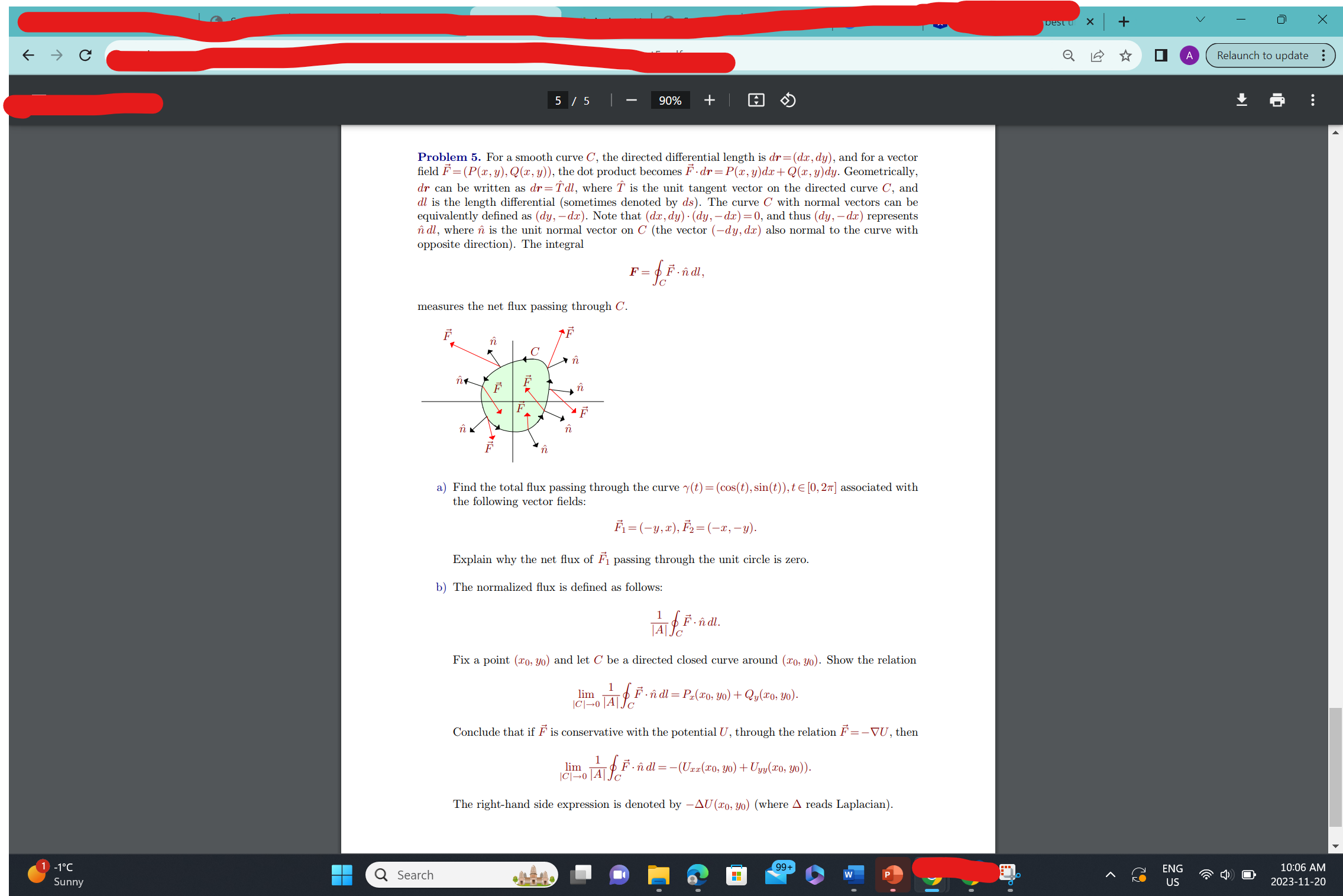
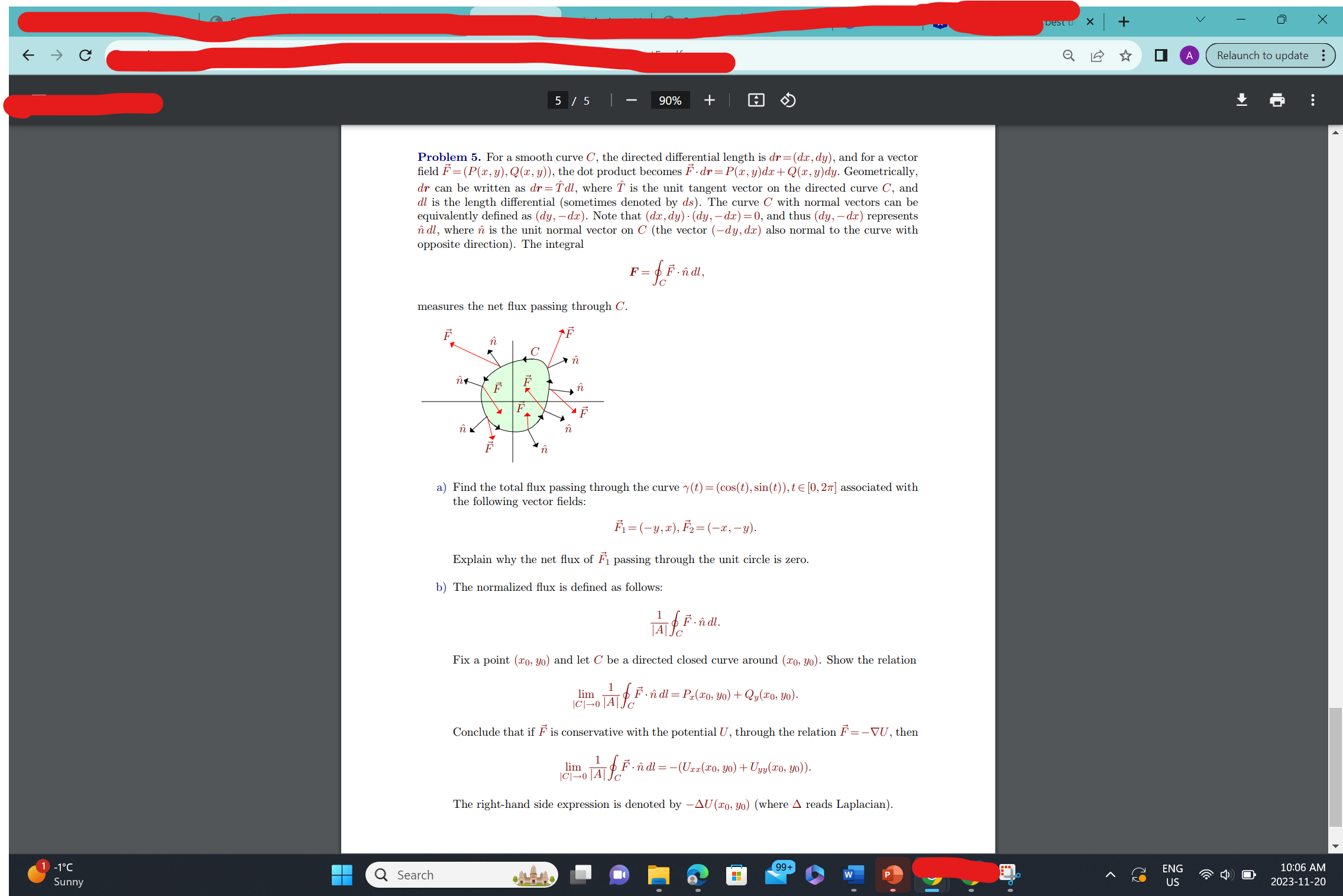
x + V X F - C Relaunch to update : 5 / 5 |- 90% Problem 5. For a smooth curve C, the directed differential length is dr = (dr, dy), and for a vector field F = (P(x, y), Q(x, y)), the dot product becomes F . dr = P(x, y)dx + Q(x, y)dy. Geometrically, dr can be written as dr = Tal, where T is the unit tangent vector on the directed curve C, and dl is the length differential (sometimes denoted by ds). The curve C with normal vectors can be equivalently defined as (dy, -dx). Note that (dx, dy) . (dy, - dx) =0, and thus (dy, - dx) represents n dl, where n is the unit normal vector on C (the vector (-dy, dx) also normal to the curve with opposite direction). The integral F = $ Findl, measures the net flux passing through C. F a) Find the total flux passing through the curve y(t) = (cos(t), sin(t) ), te [0, 2x] associated with the following vector fields: Fi = (-y, x), F2 = (-x, -y). Explain why the net flux of F1 passing through the unit circle is zero. b) The normalized flux is defined as follows: A F. nal. Fix a point (To, yo) and let C be a directed closed curve around (To, yo). Show the relation ToTAJ Find= Pz(zo, yo) + Qu(20, 30). Conclude that if F is conservative with the potential U, through the relation F= -VU, then Findl= -(Uzz(10, yo) + Uyy(20, yo)). The right-hand side expression is denoted by -AU(To, yo) (where A reads Laplacian). -1. C Q Search 10:06 AM Sunny -90+ W P ENG 1 0 2023-11-20
Step by Step Solution
There are 3 Steps involved in it

Get step-by-step solutions from verified subject matter experts
 Study Help