







Question: x x 22 Consider the second lemonade stand scenario with the addition of debt: Price of $0.5/cup, Sales of $240, COGS of $180, Interest expense
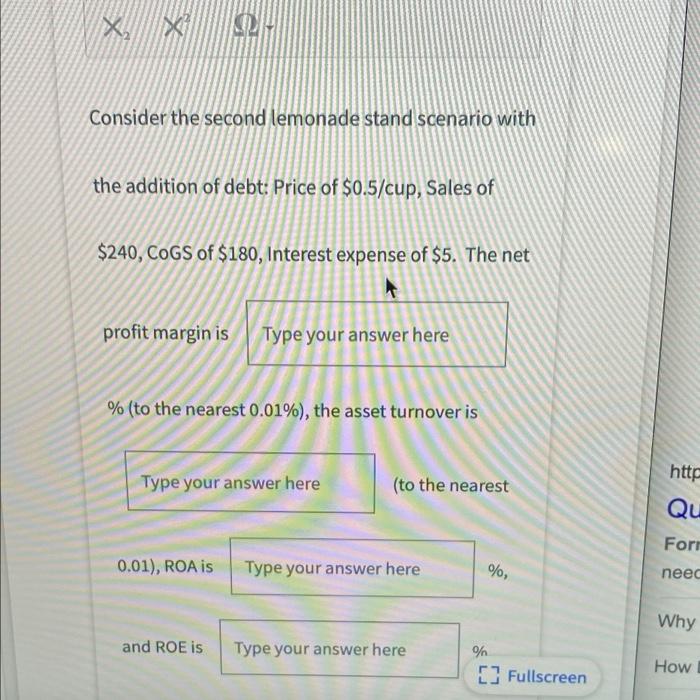
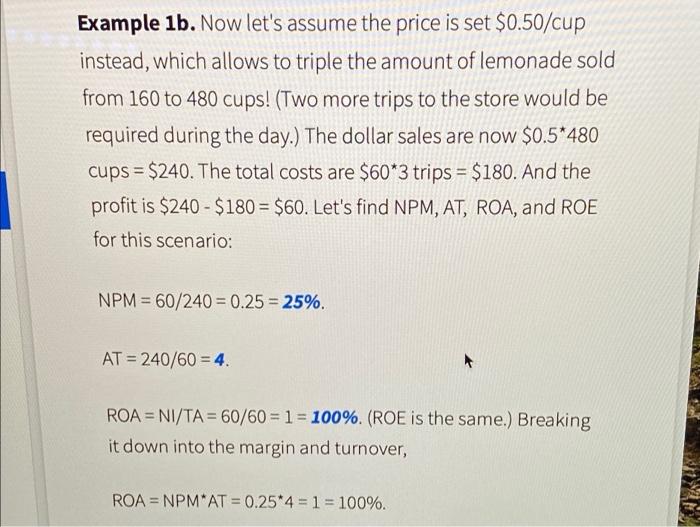
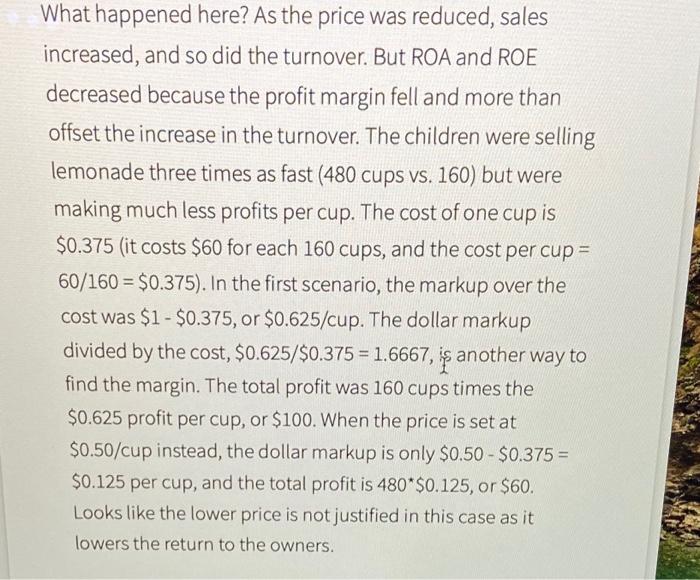
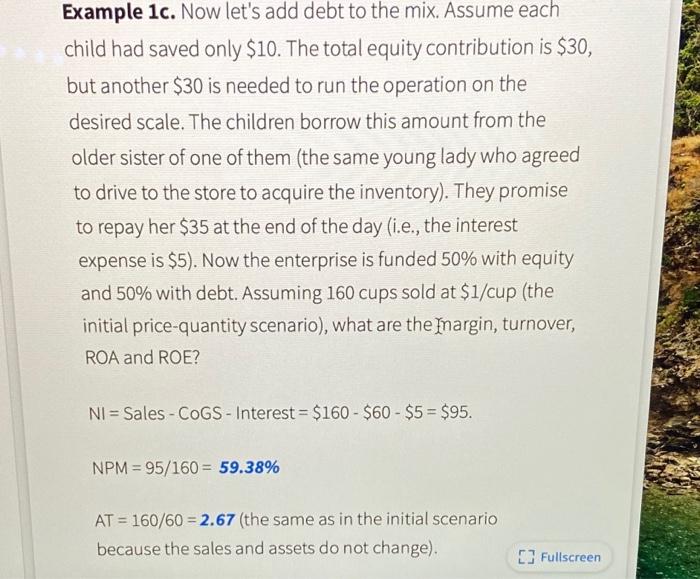
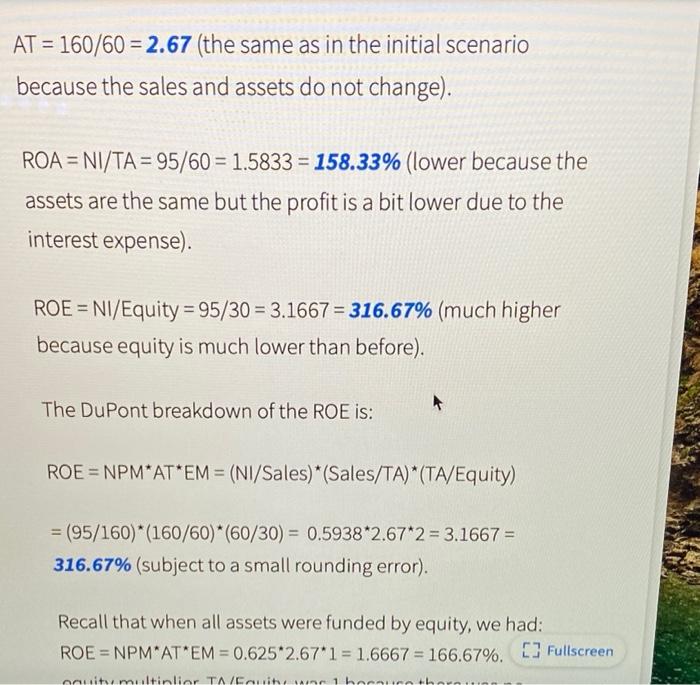
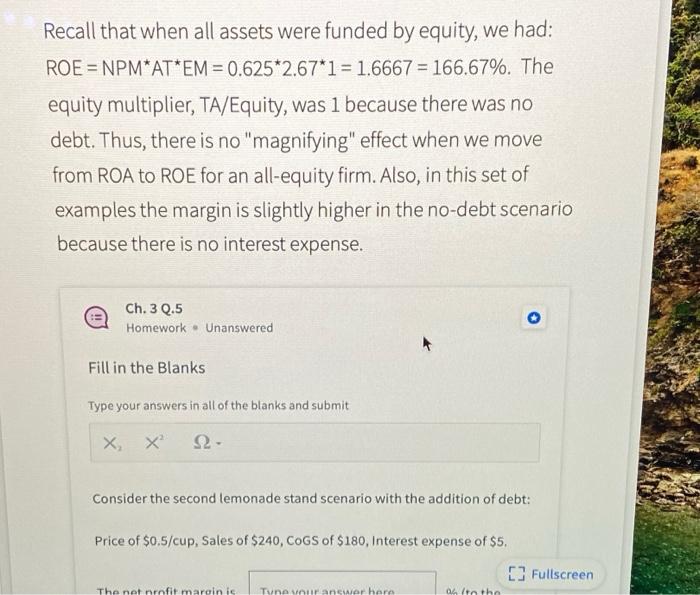
x x 22 Consider the second lemonade stand scenario with the addition of debt: Price of $0.5/cup, Sales of $240, COGS of $180, Interest expense of $5. The net profit margin is Type your answer here % (to the nearest 0.01%), the asset turnover is http Type your answer here (to the nearest Qu Forr 0.01), ROA is Type your answer here %, need Why and ROE is Type your answer here % [] Fullscreen How Example 1b. Now let's assume the price is set $0.50/cup instead, which allows to triple the amount of lemonade sold from 160 to 480 cups! (Two more trips to the store would be required during the day.) The dollar sales are now $0.5*480 cups = $240. The total costs are $60*3 trips = $180. And the profit is $240 - $180 = $60. Let's find NPM, AT, ROA, and ROE for this scenario: NPM = 60/240 = 0.25 = 25%. AT = 240/60 = 4. ROA = NI/TA = 60/60 = 1 = 100%. (ROE is the same.) Breaking it down into the margin and turnover, ROA = NPM*AT = 0.25*4 = 1 = 100%. What happened here? As the price was reduced, sales increased, and so did the turnover. But ROA and ROE decreased because the profit margin fell and more than offset the increase in the turnover. The children were selling lemonade three times as fast (480 cups vs. 160) but were making much less profits per cup. The cost of one cup is $0.375 (it costs $60 for each 160 cups, and the cost per cup = 60/160 = $0.375). In the first scenario, the markup over the cost was $1 - $0.375, or $0.625/cup. The dollar markup divided by the cost, $0.625/$0.375 = 1.6667, is another way to find the margin. The total profit was 160 cups times the $0.625 profit per cup, or $100. When the price is set at $0.50/cup instead, the dollar markup is only $0.50 - $0.375 = $0.125 per cup, and the total profit is 480*$0.125, or $60. Looks like the lower price is not justified in this case as it lowers the return to the owners. Example 1c. Now let's add debt to the mix. Assume each child had saved only $10. The total equity contribution is $30, but another $30 is needed to run the operation on the desired scale. The children borrow this amount from the older sister of one of them (the same young lady who agreed to drive to the store to acquire the inventory). They promise to repay her $35 at the end of the day (i.e., the interest expense is $5). Now the enterprise is funded 50% with equity and 50% with debt. Assuming 160 cups sold at $1/cup (the initial price-quantity scenario), what are the Inargin, turnover, ROA and ROE? NI = Sales - COGS - Interest = $160 - $60 - $5 = $95. NPM = 95/160 = 59.38% AT = 160/60 = 2.67 (the same as in the initial scenario because the sales and assets do not change). Fullscreen AT = 160/60 = 2.67 (the same as in the initial scenario because the sales and assets do not change). ROA = NI/TA = 95/60 = 1.5833 = 158.33% (lower because the assets are the same but the profit is a bit lower due to the interest expense). ROE = NI/Equity = 95/30 = 3.1667 = 316.67% (much higher because equity is much lower than before). The DuPont breakdown of the ROE is: ROE = NPM*AT*EM = (NI/Sales)*(Sales/TA)*(TA/Equity) = (95/160)*(160/60)*(60/30) = 0.5938*2.67*2 = 3.1667 = 316.67% (subject to a small rounding error). Recall that when all assets were funded by equity, we had: ROE = NPM*AT*EM = 0.625*2.67*1 = 1.6667 = 166.67%. 3 Fullscreen uit.multinliar TACAuitinho Recall that when all assets were funded by equity, we had: ROE = NPM*AT*EM = 0.625*2.67*1 = 1.6667 = 166.67%. The equity multiplier, TA/Equity, was 1 because there was no debt. Thus, there is no "magnifying" effect when we move from ROA to ROE for an all-equity firm. Also, in this set of examples the margin is slightly higher in the no-debt scenario because there is no interest expense. Ch. 3 Q.5 Homework Unanswered Fill in the Blanks Type your answers in all of the blanks and submit X 12- Consider the second lemonade stand scenario with the addition of debt: Price of $0.5/cup, Sales of $240, COGS of $180, Interest expense of $5. [ Fullscreen The net neofit marginic TNNA VAr answer here Ito thn
Step by Step Solution
There are 3 Steps involved in it

Get step-by-step solutions from verified subject matter experts
 Study Help