







Question: X3, and X1X2 in your model). Does adding weight when height is already in the model add to the explanatory strength of the model? j.
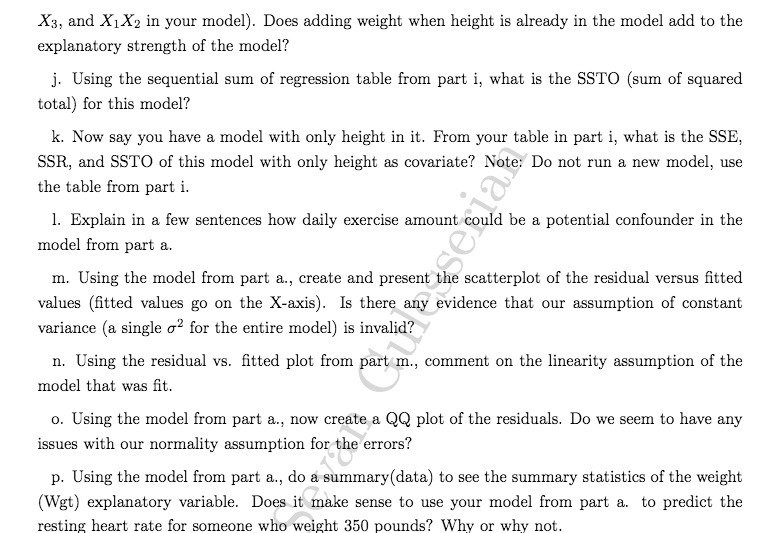
X3, and X1X2 in your model). Does adding weight when height is already in the model add to the explanatory strength of the model? j. Using the sequential sum of regression table from part i, what is the SSTG (sum of squared total) for this model? it. Now say you have a model with only height in it. From your table in part i, what is the SSE: SSH, and SSTU of this model with only height as covariate? Note: Do not run a new model, use the table from part i. 1. Explain in a few sentences how daily exercise amount could be a potential confounder in the model from part a. m. Using the model from part a., create and present the scatterplot of the residual versus tted values [tted values go on the X-axis). Is there any evidence that our assumption of constant variance {a single {1'2 for the entire model] is invalid? n. Using the residual vs. tted plot from part m., comment on the linearity assumption of the model that was t. o. Using the model from part a., now create a QQ plot of the residuals. Do we seem to have any issues with our normality assumption for the errors? p. Using the model from part a., do a summarydata] to see the sununary statistics of the weight {Wgt} explanatory variable. Does it make sense to use your model from part a. to predict the resting heart rate for someone who weight 35!] pounds? Why or why not
Step by Step Solution
There are 3 Steps involved in it

Get step-by-step solutions from verified subject matter experts
 Study Help