



Question: y+Dy'+Ky=K:B+Da:' (3) which is a DE we can solve for y, keeping in mind that the .1: terms depend on 1' (this describes how the
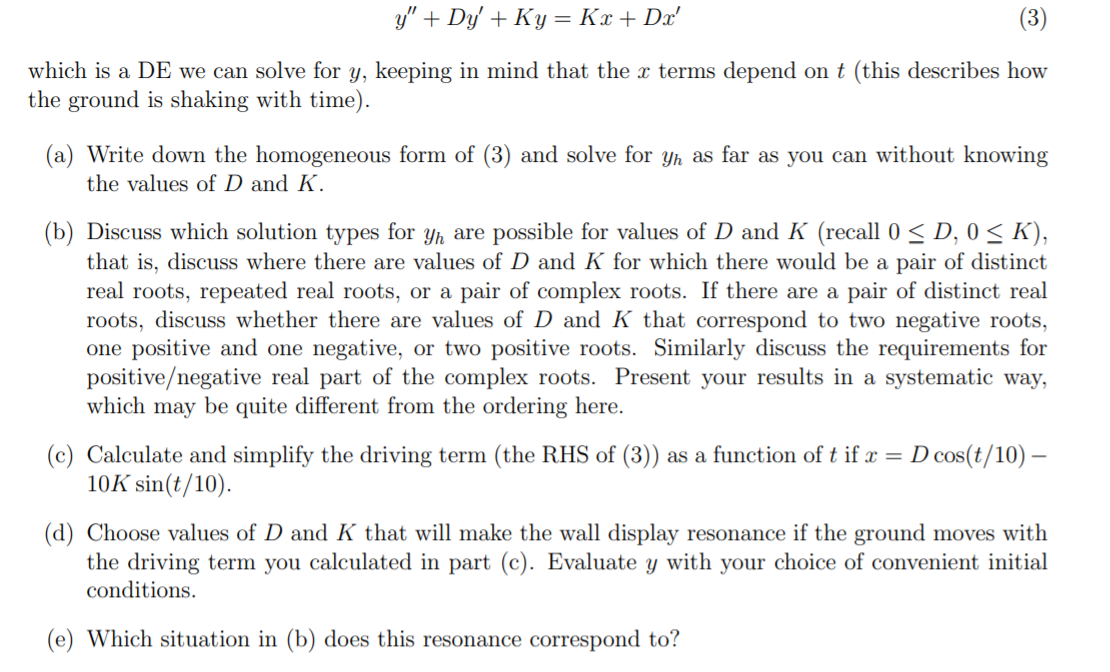
y\"+Dy'+Ky=K:B+Da:' (3) which is a DE we can solve for y, keeping in mind that the .1: terms depend on 1' (this describes how the ground is shaking with time). (a) Write down the homogeneous form of (3) and solve for 3;}, as far as you can without knowing the values of D and K. ('0) Discuss which solution types for 3;}, are possible for values of D and K (recall 0 S D, {l s K), that is, discuss where there are values of D and K for which there would be a pair of distinct real roots, repeated real roots, or a pair of complex roots. If there are a pair of distinct real roots, discuss whether there are values of D and K that correspond to two negative roots, one positive and one negative, or two positive roots. Similarly discuss the requirements for positiveegative real part of the complex roots. Present your results in a systematic way, which may be quite different from the ordering here. (c) Calculate and simplify the driving term (the RHS of (3)} as a function of t if a: = D cos(t/ 10) 10K sin(t/10). (d) Choose values of D and K that will make the wall display resonance if the ground moves with the driving term you calculated in part (c). Evaluate y with your choice of convenient initial conditions. (e) Which situation in (b) does this resonance correspond to
Step by Step Solution
There are 3 Steps involved in it

Get step-by-step solutions from verified subject matter experts