







Question: yes case study Introduction It is the mid 1990s and General Motors faces serious challenges regarding health and safety. The corporations senior leadership decides at
Introduction
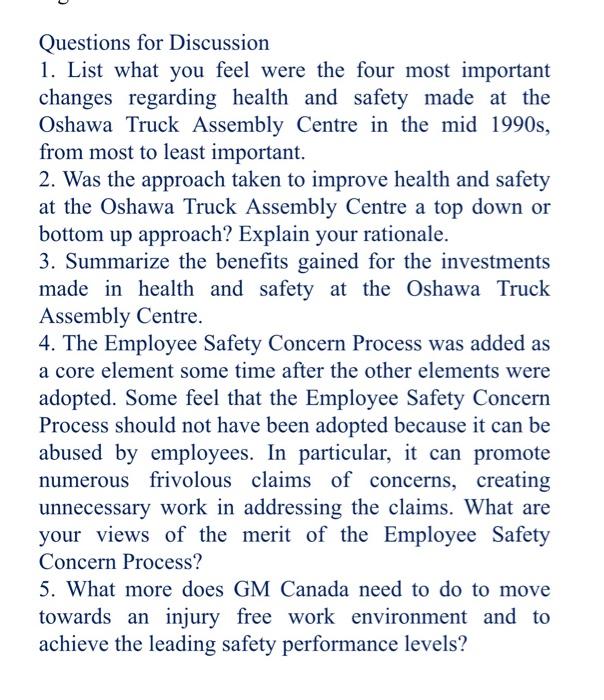
It is the mid 1990s and General Motors faces serious challenges regarding health and safety. The corporations senior leadership decides at that time to take action to improve significantly General Motors health and safety record, at all of its facilities. One such facility is the General Motors of Canada (GM Canada) Truck Assembly Centre based in Oshawa, Ontario, Canada. Like other General Motors facilities, the Oshawa Truck Assembly Centre is trying in the mid 1990s to address serious occupational health and safety concerns. Senior management has already taken many positive steps, including putting into place all necessary policies regarding health and safety, but the results in terms of improved health and safety are not as successful as desired. To further improve the situation, outside help is sought. Flash forward to 2007 and the situation is entirely different at the Oshawa Truck Assembly Centre. Injuries, lost days and worker safety concerns are down markedly. In fact, the Centre is receiving accolades for its occupational health and safety performance, and is recognized as a leader in this area in the industry, especially in its approach to managing workplace health and safety. This case study describes the steps taken and measures implemented by GM Canadas Oshawa Truck Assembly Centre to dramatically improve its safety record, ultimately allowing that Centre to become both a leader and model in the automotive industry for workplace safety.
Company Background
GM Canada, currently the largest automaker in the country, directly employs roughly 15,000 employees in six assembly and components facilities, with an annual production capacity of over 1 million vehicles. It also has responsibility for approximately 765 vehicle dealerships and retail outlets that employ more than 34,000 people from coast to coast. GM Canada is Canadas largest exporter, and manufactures more vehicles in Canada than any other automaker. The GM Oshawa Autoplex includes two car assembly lines and a truck assembly centre.
The facility has 10.4 million square feet of production floor space. The Centre was producing over 1300 trucks per day at the time this case study was developed. It began producing the current generation of trucks from GM Canada (GMT-900 trucks) in October 2006.
Some statistics on the Truck Assembly Centres operations follow:
Approximately 20 hours are required to build a truck.
A truck is comprised of about 2000 parts.
About 90% of the trucks produced are sent to the U.S., while 10% are sold in Canada.
95% of the trucks produced are transported to market by rail and 5% by transport truck.
At the time this case study was prepared, the Centre had approximately 3700 employees, about 3400 of whom were represented by the Canadian Auto Workers union. The average employee age at the time was about 47.
All aspects of Oshawa Truck Assembly Centres operation consist of a diverse set of health and safety challenges.
Company Safety History and When and Why Safety Became a Crucial Company Issue
To appreciate the steps taken by GM Canada to improve safety, it is instructive to understand when in corporate history health and safety became important and what factors contributed to this recognition. Given that all aspects of the Oshawa Truck Assembly Centres operation involve health and safety challenges, efforts had always been made to ensure occupational health and safety is managed properly in the Centre. Senior management had established policies regarding health and safety, and several full-time joint health and safety committees. Safety risks in many areas (e.g., hazardous materials, excessive noise, ergonomic injury) were addressed by these policies and committees. Also, the Centre used new technology and the safest equipment available. In addition, the Centres management had instituted what they felt were good safety procedures and standards, good and extensive safety training, and good safety talk programs.
Nonetheless, health and safety was a concern in the early 1990s at GM Canadas Oshawa Truck Assembly Centre for a variety of reasons:
The Centre had a high injury frequency, which had remained stable over a number of years. For example, the annual lost time incident frequency at Oshawa Truck Assembly Centre for 1982-1993 is shown in Fig. 3, where the frequency is seen to be consistently high.
Workers compensation costs at the Centre were increasing.
Workers at the Centre frequently expressed health and safety concerns. Note that the frequency cited in Fig. 3 and elsewhere throughout this case study is usually normalized on the basis of either 200,000 hours worked or 100 employees per year. These are equivalent, as 200,000 hours is the approximate time worked by 100 full-time employees working 40 hours/week for 50 weeks per year. Addressing health and safety issues was consequently occupying a significant proportion of the time and attention of Centre management. Furthermore, the Oshawa Truck Assembly Centre had one of the poorest safety records in the industry. For example, a comparison of lost time incident frequencies for different companies for 1992 showed GM Canada to have a very poor record compared to other automotive and non-automotive companies. That comparison also showed the lost time incident frequency of the Oshawa Truck Assembly Centre to be markedly poorer than that for GM Canada as a whole. A critical driver for the improvements described in this case study is that in the early 1990s General Motors Corporation was focusing on improving health and safety at all of its operations, on a broad context and scale. Safety became an overriding priority starting at the very top of the corporation, and a commitment was made to improve health and safety. Leadership-driven culture change efforts at General Motors are outlined well by Simon and Frazee.
In addition, new health and safety legislation (Bill 20 n 8) was introduced in Ontario in the early 1990s, amending the Ontario Occupational Health and Safety Act and the Workers' Compensation Act. Some of the main changes involved enhancing the requirements of joint health and safety committees for workplaces of more than 20 employees, requiring the preparation of enhanced written occupational safety and health policies, broadening the grounds which allowed workers to refuse to perform unsafe work, and allowing safety committee members to order a work shutdown under certain circumstances. These changes increased labour involvement in health and safety management and increased the emphasis on the partnership between management and workers on health and safety committees. Additional safety-improvement measures were implemented where it seemed appropriate, and safety improved somewhat over the following few years. But, the improvements were relatively minor, and the safety situation remained problematic overall. The senior managers wanted very much to improve the Centres health and safety record but could not determine what else to do to improve the situation, so they sought help from outside the company.
A Shift in Direction Regarding Safety
Outside help came through General Motors partnering with Dupont, a company which had an excellent track record in health and safety. Four core safety elements (discussed subsequently) used at Dupont were adopted by General Motors. The Canadian Auto Workers were also partners in the introduction of the core safety elements in Canada. This point is important, as a good labour-management partnership increases significantly the likelihood of success in improving health and safety. In 1998, GM Canadas Oshawa Truck Assembly Centre turned to an outside agency specialized in culture change, which helps companies improve their performance through changes in aspects of their cultures. The agency used by the Truck Assembly Centre has particular expertise in improving safety performance. The culture change agency reviewed the Centres safety-related documentation, including policies, procedures and records, and interviewed personnel ranging from workers on the floor to senior managers. To help ascertain how safety is dealt with and viewed across the Centre, the agency carried out a detailed survey of plant personnel.
Several important findings flowed from that survey, the executive overview for which follows:
Executive Overview of the Oshawa Safety Culture The Oshawa truck plant, one of General Motors premier manufacturing facilities, opened in 1965 at its present site. It has earned a well-deserved reputation within the General Motors Truck Division for excellence, both in terms of profitability and quality, and in 1984 was awarded the GMT 400 Project. This project launched Oshawa into innovative dimensions for engineering, manufacturing and technology to build trucks. It required both managers and hourly workers to change, learn and acquire new skills. Given its success over the years with the GMT 400 project, Oshawa was the logical choice to launch the GMT 800 project, the next generation of full-size pick-ups. Oshawa is a crucial component in the NAO [North American Operations] competitive strategy. The Oshawa plant has achieved its reputation because managers have the knowledge and the workforce has the ability and skills to build excellent trucks. It has met engineering and manufacturing goals because those goals have been clearly articulated, well thought out, planned and received the fullest attention. Improved technology has enabled Oshawa to produce nearly 1,400 trucks per day, and an experienced workforce is required to optimize this technology. The Oshawa plant has made progress over the last few years in safety and it has taken many important administrative steps to prevent accidents and injuries. Most people in the plant believe it to be a safe environment. The plant is well maintained and housekeeping is kept up. Safety information is readily available through the posted safe operating procedures. It is agreed by hourly and salaried workers alike that the proper safety equipment is provided. The safety staff is highly rated by management and there is a good working relationship with the union health and safety reps. Faced with an untenable situation of excessive work refusals, a model for administratively addressing employee safety concerns has been developed. This procedure clearly establishes accountability and is backed up by Section 28. The procedure has become a model for the Canadian automotive industry. Lost time accidents have been reduced. Yet, there still remain nearly 600 claims a year and 2,000 monthly visits to first aid. Safety, from an administrative standpoint has been significantly improved in the Oshawa plant. Policies and procedures have been developed. They have been put in place with the hope that management and employees will follow them. But the reality is that many of the policies and procedures that have been put in place are not followed. Though the administration of safety has been done well, there has been little attention placed on the safety culture of the Oshawa plant. The safety culture score for the plant surveyed in March, 1998 indicated an overall score of 3.21 which can be characterized as a moderately weak safety culture. In safety, the Oshawa plant has not achieved the level of excellence it has achieved in the production and quality of trucks. The safety culture of Oshawa can best be described as two worlds apart. The overall perspective from management, from first-line supervisors to area managers is that in all, but minor aspects, the safety culture is healthy. Exceedingly healthy. Based on the survey scores, one could readily come to the conclusion that this is, indeed, a culture where Safety is Our Overriding Priority. In several categories management assesses the plant very well and in some categories the self-assessment is equivalent to scores achieved only by worldclass safety facilities. Facilities with far fewer lost time accidents, far fewer recordables, far fewer ergonomic injuries, far lower workmans compensation costs. The safety culture of the Oshawa truck plant from the hourly perspective is significantly different than that of management. In fact, it is statistically different on every one of 16 subscales. Where management rates the safety culture moderately positive to excellent, the hourly worker perspective rates it as a weak culture, with some well-meaning individuals and pockets of positivism, but weak nevertheless. It is a perspective that maintains that management cares more about jobs out the door than the safety of the worker on the line. It is a perspective that sees little recognition for safety contributions in the plant and believes that safety performance simply doesnt matter in terms of performance appraisal or promotion. It is a perspective that believes that management places little value on the potential contribution of line workers to improving plant safety. It is a perspective that believes that safety mistakes are more opportunities for blaming than opportunities for learning. It is a perspective that finds safety leadership lacking in being role models, in caring more about safety statistics than people, in failing to communicate safety goals, in being unclear that my safety and my well-being and the safety and well-being of my fellow workers is important. It is a perspective that does not believe that Safety is Our Overriding Priority. There are important positive elements which exist within the safety culture perspective of the hourly worker. Hourly workers in the Oshawa plant have a strong belief that accidents are preventable, that the people they work with, work safely and that the safety goals of the plant are achievable. Hourly workers highly value the union safety reps and feel they listen and act on their safety concerns. Hourly workers believe that people are willing to take personal responsibility for their own safety and that people in the plant wear personal safety equipment as required. They acknowledge that the condition of the building and housekeeping demonstrate that the company cares about safety and they largely believe that the information needed to operate safely is available. The majority believe that the company provides the resources necessary to do a job safely. The majority of hourly workers believe that they are not asked to perform operations that are unsafe. There are many strengths within the safety perspective of the hourly worker. One thing that differentiates the Oshawa truck plant from truly excellent safety cultures, is that truly excellent safety cultures tap into the positivism of their hourly workers so that they contribute to the safety of all for the greater good. Few people would maintain, hourly and salaried alike, that that is the case in Oshawa. The challenge facing the Oshawa truck plant regarding safety is not a set of technological or administrative dilemmas. Giant steps have been taken to address those problems. The challenge is providing the collective leadership for working on the people systems that will maximize the good work that has already been done. The Oshawa plant is at the very beginning stages of dedicating itself to walking the talk of safety. It will require the same intensity, dedication and leadership that has been brought to bear on engineering problems. As with the launch of the GMT 800 project and the GMT 400 project before it, there must be leadership and unity of purpose. To achieve this alignment, there needs to be a clarity of expectations and commitment about safety within the management team. Only then will the stage be set for the kind of joint leadership that will more effectively tap into the positivism of the hourly workers. These steps will lead the Oshawa plant to achieving a world-class safety culture. In the above, two definitions are important. A recordable (i.e., recordable injury) is any work-related injury or illness condition requiring greater than superficial first-aid treatment. A lost workday case is any work-related injury or illness condition requiring greater than the balance of the shift time off (usually at least the next full shift or subsequent days off) and associated with an active (open) medical case. The overall conclusions of the survey report were that safety is managed administratively, not culturally, in the Oshawa Truck Assembly Centre, significant progress has been made by managing safety administratively, through policies and procedures, and the next step needed to improve safety performance is to manage the safety culture by attending to the soft (or people) side of safety, which involves demonstrating caring, dedication and leadership regarding safety, and ensuring safety measures are followed. The culture change agency felt that the Oshawa Truck Assembly Centre was at the very beginning at managing the safety culture by attending to the soft side of safety, and recommended that effort be made to create a real safety culture at the Centre. The culture of an organization can be thought of in many ways. A simple explanation is that, while an organizations policies represent the rules of conduct, the culture represents what is really done in the organization or its norms. For example, we have speed limits for our roadways (rules), which generally differ from the typical speeds that people actually drive on them (norms). A culture is driven by values, in that people usually behave in ways that they feel are appropriate and acceptable. A culture resists change, so changing a culture is difficult and normally always requires leadership.
Developing a safety culture often requires several years, involves numerous important factors and normally requires several stages:
To initiate the culture change, leadership needs to be a champion and role model for the desired culture and its new values.
Then, agreement and consistency from the rest of the management team must be obtained.
Next, the safety messages need to be communicated effectively to workers and workers need to be given opportunities to participate in the development and improvement of safety systems. This process leads workers to assume proprietorship for the improved systems and a belief in a personal responsibility for safety. The partnership between labour and management that this process fosters is very important to improving the safety culture.
In line with the objective of implementing a safety culture at the Oshawa Truck Assembly Centre, two broad recommendations were made in the safety culture report to address the problems highlighted:
Centre management should focus on the central issue of leadership intensity, consistency and unity around safety as a core value. Otherwise inconsistency in safety management occurs, which greatly impedes developing a world-class safety culture.
Once the management team is unified around safety assumptions and commitment, a culture change process should be infused into safety programs.
The Oshawa Truck Assembly Centres safety culture is perceived as uncaring, run by numbers and not placing a high priority on safety. Excellent safety cultures are caring about people. When the focus is on production rather than worker safety, accidents are often not reported. This results in underlying safety problems not being examined, because managers do not know they are occurring.
To support these broad recommendations, several specific recommendations were made in the safety culture report:
Plant leadership team should engage mid-level management (supervisors and team leaders) in safety culture leadership dialogues regarding the safety assumptions by which the Centre will be run, including expectations for acceptable risk, consequences of violating safety procedures and responsiveness and feedback on safety requests. It is necessary to eliminate the gap between the official position on safety as presented by senior leaders, and what others in the plant believe, as well as the lack of coherence within management ranks regarding how safety should be managed, as reflected in different expectations, perceptions and assumptions between the supervisors, superintendents and area managers. The leadership dialogues are intended to resolve underlying differences and emerge with a unified leadership view and commitment to managing safety from the point of view of a common management culture. Also, the leadership dialogues need to institute a system that ensures the safety values and beliefs desired by upper management are communicated to the workforce.
A safety culture change guidance team should be created to plan the strategy over the full-course of the three to five year safety culture change process, in part by examining the safety culture survey findings and developing projects to build on strengths and remediate the cultures deficiencies. The team should lead the culture change effort, develop a long-term culture change implementation plan and make it a business initiative. An aim within the culture should be to attain Centre safety goals. The team should empower grassroots teams to develop action items to address the culture survey weaknesses from a front-line perspective. The team should include the Centre manager, staff and supervisor representatives and union leaders, and meet for one to two hours biweekly.
A short-term, cross-functional group should be formed to examine current safety meetings and recommend ways to improve them. Where necessary, safety policies and/or supervisory practices should be changed. Safety teams should be established within the skilled trades to increase employee involvement in safety, thereby engendering employee safety ownership and using the knowledge of the people doing the work to improve safety. The teams should be able to develop departmental improvements and work with management to gain approval for and implement recommendations. The teams should focus on improving communication about safety concerns and responses, making safety part of the daily routine, recommending improvements for safety meetings and programs, instituting culture change projects, such as sharing near misses or changing safety norms, as well as physical projects, and removing obstacles to cooperation in safety matters between workers, departments, shifts, etc.
A small group of supervisors should form a short-term task team to evaluate if safety contacts are made regularly and, if so, to determine the quality of the I care message being delivered. This task team should make recommendations for improvements.
A task team should be formed to develop ways to present and explain the survey findings to all Centre employees and to indicate that it is being acted upon. This serves to educate people, raise awareness and demonstrate important changes are occurring in current practice.
The reporting of accident, injury and illness data should be modified so managers see it as useful for determining where to place their energies on a department-bydepartment basis.
Upstream safety process should be measured, not just injury rates, to establish a new safety norm to reverse the perception that management cares more for numbers than individuals. This task can include an annual safety culture perception survey which is used to improve the cultures weak areas and to ensure progress on the soft (people) side of safety. Introducing metrics that focus on leading in addition to lagging indicators facilitates proactive, long-term planning of preventive actions necessary in a positive safety culture.
The Safety Departments roles and responsibilities should be better defined and ensure they are clearly distinct from line management roles and safety responsibilities, with the intent of ensuring safety is clearly a responsibility and priority where the work is done. Safety data should be made available visibly, showing areas where injuries occur and the types of injuries, in order to draw attention to safety, foster discussion of possible improvements and demonstrate managements commitment to safety.
Communication objectives for management and supervisors should be established that focus on communicating clearly safety goals, indicating concern about safety and not just numbers, the measuring safety parameters for benchmarking and improvement, and modeling appropriate behavior regarding safety.
Step by Step Solution
There are 3 Steps involved in it

Get step-by-step solutions from verified subject matter experts
 Study Help