







Question: You are a purchasing manager at Simon and Singh, a consumer food products company located in the UK. You recently attended a seminar that discussed
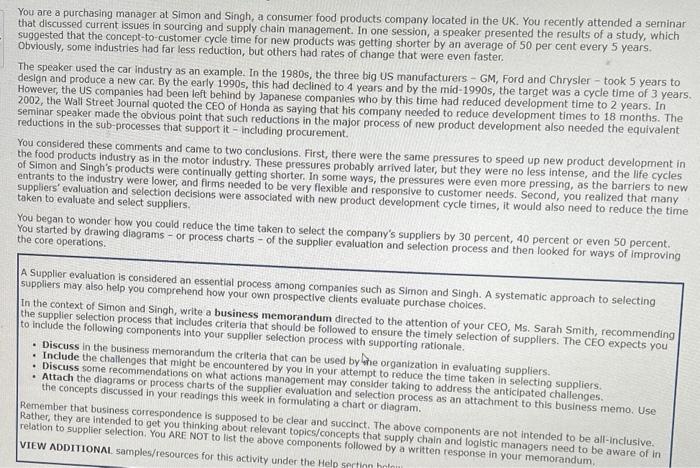
You are a purchasing manager at Simon and Singh, a consumer food products company located in the UK. You recently attended a seminar that discussed current issues in sourcing and supply chain management. In one session, a speaker presented the results of a study, which suggested that the concept-to-customer cycle time for new products was getting shorter by an average of 50 per cent every 5 years. Obviously, some industries had far less reduction, but others had rates of change that were even faster. The speaker used the car industry as an example. In the 1980s, the three big US manufacturers - GM, Ford and Chrysler - took 5 years to design and produce a new car. By the early 1990 s, this had declined to 4 years and by the mid-1990s, the target was a cycle time of 3 years. 2002 , the Wall Street lourles had been left behind by lapanese companies who by this time had reduced development time to 2 years. In seminar speaker made the obvious point that of Honda as saying that his company needed to reduce development times to 18 months. The reductions in the sub-processes that support it - including proction in the major process of new product development also needed the equivalent You considered these the food products se comments and came to two conclusions. First, there were the same pressures to speed up new product development in of Simon and Singh's products were contindustry. These pressures probably arrived later, but they were no less intense, and the life cycles entrants to the industry were lower, and firms needed to shorter. In some ways, the pressures were even more pressing, as the barriers to new suppliers' evaluation and selection decisions were assoclated with flexible and responsive to customer needs. Second, you realized that many taken to evaluate and select suppliers. You began to wonder how you could reduce the time taken to select the company's suppliers by 30 percent, 40 percent or even 50 percent. You started by drawing diagrams - or process charts - of the supplier evaluation and selection process and then looked for ways of improving the core operations. A Supplier evaluation is considered an essential process among companies such as Simon and Singh. A systematic approach to selecting suppliers may aiso help you comprehend how your own prospective clients evaluate purchase choices. In the context of Simon and Singh, write a business memorandum directed to the attention of your CEO, Ms. Sarah Smith, recommending the supplier selection process that indudes criteria that should be followed to ensure the timely selection of suppliers. The CEO expects you to indude the following components into your supplier selection process with supporting rationale. - Include the challenges memorandum the criteria that can be used by hine organization in evaluating suppliers. - Discuss some recommendations on what actions by you in your attempt to reduce the time taken in selecting suppliers. - Attach the diagrams or process charts of the supplier evement may consider taking to address the anticipated challenges. the concepts discussed in your readings this week in formulating and selection process Remember that business correspondence is supposed to be clear and succinct. Rather, they are intended to get you thinking aboosed to be clear and succinct. The above components are not intended to be all-inclusive. relation to supplier selection. You ARE NOT to list the above copics/concepts that supply chain and logistic managers need to be aware of in VIEW ADDIIIONAL samples/resources for this activity under the colponents followed by a written response in your memorandum
Step by Step Solution
There are 3 Steps involved in it

Get step-by-step solutions from verified subject matter experts
 Study Help