



Question: You are a statistical trainee actuary working for an insurance company. You are part of a statistical modelling team that is developing models based
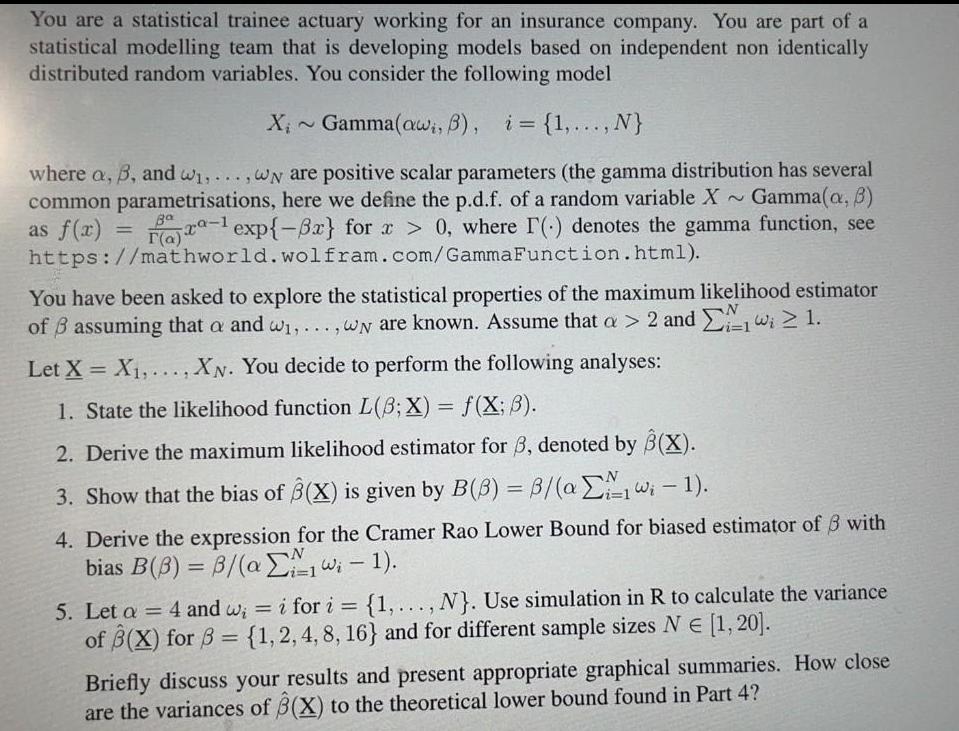
You are a statistical trainee actuary working for an insurance company. You are part of a statistical modelling team that is developing models based on independent non identically distributed random variables. You consider the following model X ~ Gamma(awi, B), i = {1,..., N} where a, , and w,..., wy are positive scalar parameters (the gamma distribution has several common parametrisations, here we define the p.d.f. of a random variable X~ Gamma(a, 6) Fara-1 exp{-x} for x > 0, where I(-) denotes the gamma function, see https://mathworld. wolfram.com/GammaFunction.html). Ba as f(x) = You have been asked to explore the statistical properties of the maximum likelihood estimator of B assuming that a and w,...,wy are known. Assume that a > 2 and w 1. Let X = X,..., XN. You decide to perform the following analyses: 1. State the likelihood function L(3; X) = f(X; 3). 2. Derive the maximum likelihood estimator for 3, denoted by B(X). 3. Show that the bias of B(X) is given by B(B) = 3/(a W - 1). 4. Derive the expression for the Cramer Rao Lower Bound for biased estimator of with bias B(B) = 3/(a 1 Wi-1). 5. Let a = 4 and w; = i for i = {1,..., N}. Use simulation in R to calculate the variance of B(X) for 6= {1, 2, 4, 8, 16) and for different sample sizes N [1,20]. Briefly discuss your results and present appropriate graphical summaries. How close are the variances of 3(X) to the theoretical lower bound found in Part 4?
Step by Step Solution
3.45 Rating (158 Votes )
There are 3 Steps involved in it
8 given Xi Gamm... View full answer

Get step-by-step solutions from verified subject matter experts