







Question: You are assigned an unknown solution that contains Group IV and Vcations To-1 mL of this solution 6 M NHg is added until the solution
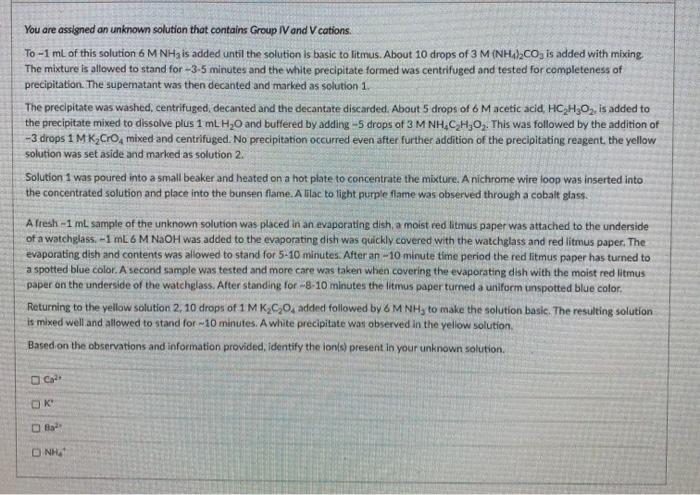
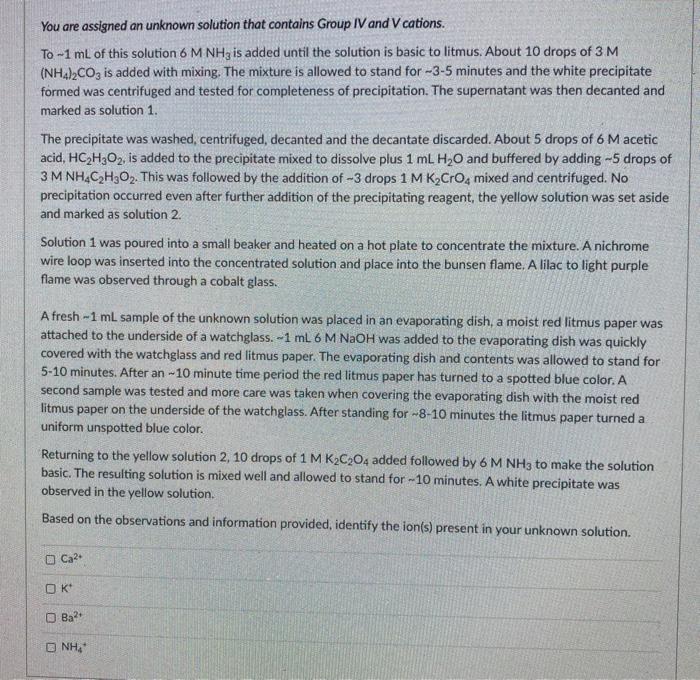
You are assigned an unknown solution that contains Group IV and Vcations To-1 mL of this solution 6 M NHg is added until the solution is basic to litmus. About 10 drops of 3 M (NH)CO, is added with mixing The mixture is allowed to stand for -3-5 minutes and the white precipitate formed was centrifuged and tested for completeness of precipitation. The supernatant was then decanted and marked as solution 1. The precipitate was washed, centrifuged, decanted and the decantate discarded. About 5 drops of 6 Macetic acid, HC H302, is added to the precipitate mixed to dissolve plus 1 ml H,0 and buffered by adding - 5 drops of 3 MNH.C_H30. This was followed by the addition of - 3 drops 1M KCrO mixed and centrifuged. No precipitation occurred even after further addition of the precipitating reagent, the yellow solution was set aside and marked as solution 2. Solution 1 was poured into a small beaker and heated on a hot plate to concentrate the mixture. A nichrome wire loop was inserted into the concentrated solution and place into the bunsen flame. Alllac to light purple flame was observed through a cobalt glass A fresh - 1 ml sample of the unknown solution was placed in an evaporating dish, a moist red litmus paper was attached to the underside of a watchglass. - 1 mL.6 M NaOH was added to the evaporating dish was quickly covered with the watchglass and red litmus paper. The evaporating dish and contents was allowed to stand for 5-10 minutes. After an -10 minute time period the red litmus paper has turned to a spotted blue color. A second sample was tested and more care was taken when covering the evaporating dish with the moist red litmus paper on the underside of the watchglass. After standing for --8-10 minutes the litmus paper turned a uniform unspotted blue color Returning to the yellow solution 2. 10 drops of 1 MK.C,0, added followed by 6 MNH, to make the solution basic. The resulting solution is mixed well and allowed to stand for 10 minutes. A white precipitate was observed in the yellow solution Based on the observations and information provided, identify the lon's) present in your unknown solution DNHG You are assigned an unknown solution that contains Group IV and V cations. To -1 mL of this solution 6 M NH is added until the solution is basic to litmus. About 10 drops of 3 M (NH4)2CO3 is added with mixing. The mixture is allowed to stand for --3-5 minutes and the white precipitate formed was centrifuged and tested for completeness of precipitation. The supernatant was then decanted and marked as solution 1. The precipitate was washed, centrifuged, decanted and the decantate discarded. About 5 drops of 6 M acetic acid, HC2H302, is added to the precipitate mixed to dissolve plus 1 mL H2O and buffered by adding -5 drops of 3M NH4C2H302. This was followed by the addition of -3 drops 1 M K CrOx mixed and centrifuged. No precipitation occurred even after further addition of the precipitating reagent, the yellow solution was set aside and marked as solution 2. Solution 1 was poured into a small beaker and heated on a hot plate to concentrate the mixture. A nichrome wire loop was inserted into the concentrated solution and place into the bunsen flame. A lilac to light purple flame was observed through a cobalt glass. A fresh - 1 mL sample of the unknown solution was placed in an evaporating dish, a moist red litmus paper was attached to the underside of a watchglass. - 1 mL 6 M NaOH was added to the evaporating dish was quickly covered with the watchglass and red litmus paper. The evaporating dish and contents was allowed to stand for 5-10 minutes. After an - 10 minute time period the red litmus paper has turned to a spotted blue color. A second sample was tested and more care was taken when covering the evaporating dish with the moist red litmus paper on the underside of the watchglass. After standing for 8-10 minutes the litmus paper turned a uniform unspotted blue color. Returning to the yellow solution 2, 10 drops of 1 MK2C204 added followed by 6 M NH3 to make the solution basic. The resulting solution is mixed well and allowed to stand for -10 minutes. A white precipitate was observed in the yellow solution. Based on the observations and information provided, identify the ion(s) present in your unknown solution. Ca2+ Ba2 NH
Step by Step Solution
There are 3 Steps involved in it

Get step-by-step solutions from verified subject matter experts
 Study Help