







Question: You are developing a process for the synthesis of proprietary chemical D from reagent A . The process involves three process units. First, reagent A
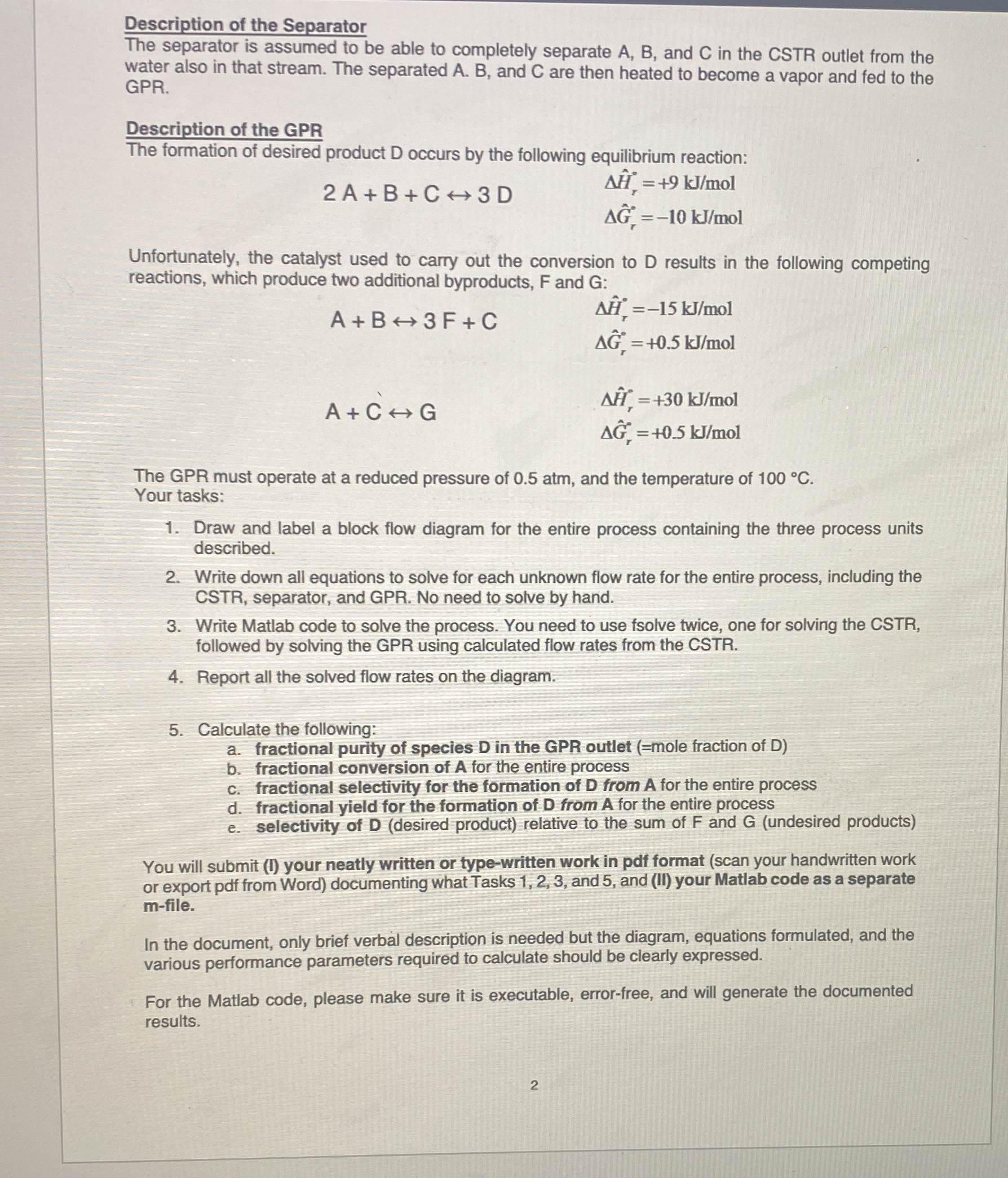
You are developing a process for the synthesis of proprietary chemical from reagent The process involves three process units. First, reagent A as a solution in water is fed to a continuous stirred tank reactor CSTR with an enzyme catalyst preimmobilized on silica particles. The enzyme catalyst contains two unique active sites and is capable of transforming A into at active site and A into at active site The enzyme can be retained inside the CSTR such that the only species in the output stream are A and water. Second, a separation unit then recovers the water and vaporizes the remaining Finally, the vapor stream is fed to an isothermal equilibrium gas phase reactor GPR in which is produced. Unfortunately, two undesired side reactions also occur, producing byproducts and For this assignment, you are only concerned with this final product gas stream, which contains unreacted B and C together with all three products, D desired F undesired and G undesired
Description of the CSTR
The CSTR has a volume of L and is to be run with input and output flow rates of The concentration of in the feed is held at The enzyme E concentration inside the reactor is fixed at assuming the enzyme remains active and not degraded during the entire process runtime The reactions can be described as follows:
hat
where represents the reaction rate constant for the direction indicated by the arrow. The reaction rates for these enzymecatalyzed reactions follow MichaelisMenten kinetics, which result in the following rate expressions:
where the rates are in and
The useful expressions at the right of each rate equation boxed were derived from recognizing that at steady state, the concentration of species A in the reactor is identical to that in the output CSTR assumption such that:
For the enzyme developed:
tablerate constant,
Step by Step Solution
There are 3 Steps involved in it
1 Expert Approved Answer
Step: 1 Unlock

Question Has Been Solved by an Expert!
Get step-by-step solutions from verified subject matter experts
Step: 2 Unlock
Step: 3 Unlock
 Study Help