







Question: You are given an initially empty queue and perform the following operations on it: enqueue (B), enqueue (A), enqueue(T), enqueue(), dequeue(), dequeue(), enqueue (Z), enqueue(A),
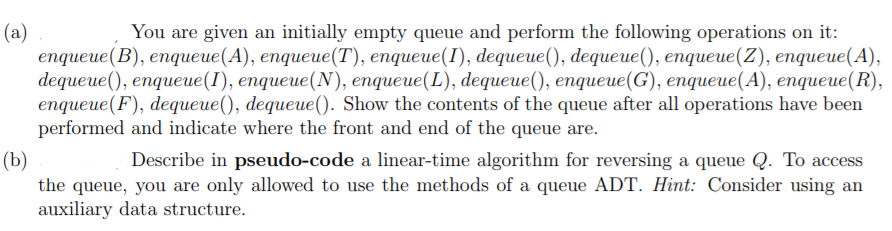
You are given an initially empty queue and perform the following operations on it: enqueue (B), enqueue (A), enqueue(T), enqueue(), dequeue(), dequeue(), enqueue (Z), enqueue(A), dequeue(), enqueue(1), enqueue(), enqueue(L), dequeue(), enqueue(G), enqueue(A), enqueue(R) enqueue(F), dequeue), dequeue(). Show the contents of the queue after all operations have been performed and indicate where the front and end of the queue are. Describe in pseudo-code a linear-time algorithm for reversing a queue Q. To access the queue, you are only allowed to use the methods of a queue ADT. Hint: Consider using an auxiliary data structure
Step by Step Solution
There are 3 Steps involved in it
1 Expert Approved Answer
Step: 1 Unlock

Question Has Been Solved by an Expert!
Get step-by-step solutions from verified subject matter experts
Step: 2 Unlock
Step: 3 Unlock
 Study Help