







Question: You are required to solve some design problems for a one - shell two - passes shell - and - tube heat exchanger to cool
You are required to solve some design problems for a oneshell twopasses shellandtube heat exchanger to cool down hot reaction products dissolved in water you can assume properties for water For that purpose,
Find empirical correlations and a method to calculate shell side convection heat transfer coefficient and overall heat transfer coefficient and answer the following questions
a How do the convection heat transfer coefficients depend on mass flow rate or
b Why baffles are used in shellandtube type heat exchangers?
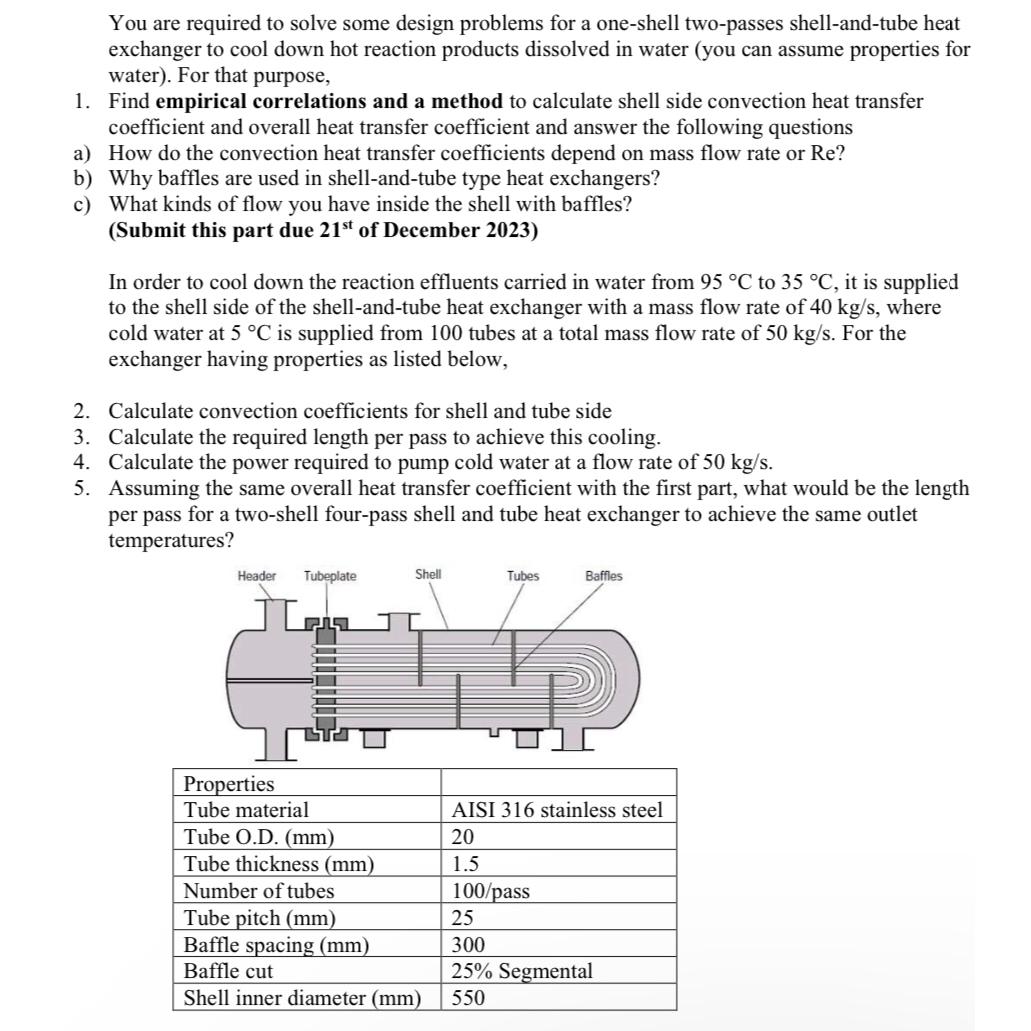
c What kinds of flow you have inside the shell with baffles?
Submit this part due of December
In order to cool down the reaction effluents carried in water from to it is supplied to the shell side of the shellandtube heat exchanger with a mass flow rate of where cold water at is supplied from tubes at a total mass flow rate of For the exchanger having properties as listed below,
Calculate convection coefficients for shell and tube side
Calculate the required length per pass to achieve this cooling.
Calculate the power required to pump cold water at a flow rate of
Assuming the same overall heat transfer coefficient with the first part, what would be the length per pass for a twoshell fourpass shell and tube heat exchanger to achieve the same outlet temperatures?
tablePropertiesTube material,AISI stainless steelTube ODTube thickness Number of tubes, passTube pitch Baffle spacing Baffle cut, SegmentalShell inner diameter
Step by Step Solution
There are 3 Steps involved in it
1 Expert Approved Answer
Step: 1 Unlock

Question Has Been Solved by an Expert!
Get step-by-step solutions from verified subject matter experts
Step: 2 Unlock
Step: 3 Unlock
 Study Help