







Question: You are to design, write, assemble, and simulate an assembly language program which will generate Fibonacci sequence numbers. Giving is a table NARR of byte-long
You are to design, write, assemble, and simulate an assembly language program which will generate Fibonacci sequence numbers. Giving is a table NARR of byte-long numbers (with a $00 sentinel). Each element in the table corresponds to the sequence number of a Fibonacci number to be generated. The actual calculation of the corresponding 4-byte Fibonacci numbers has to be implemented in a subroutine. The 4-byte Fibonacci numbers have to be passed back to the main program, which stores them in the RESARR array. Template is blow
T
his is Motorola 68HC11 microcontroller
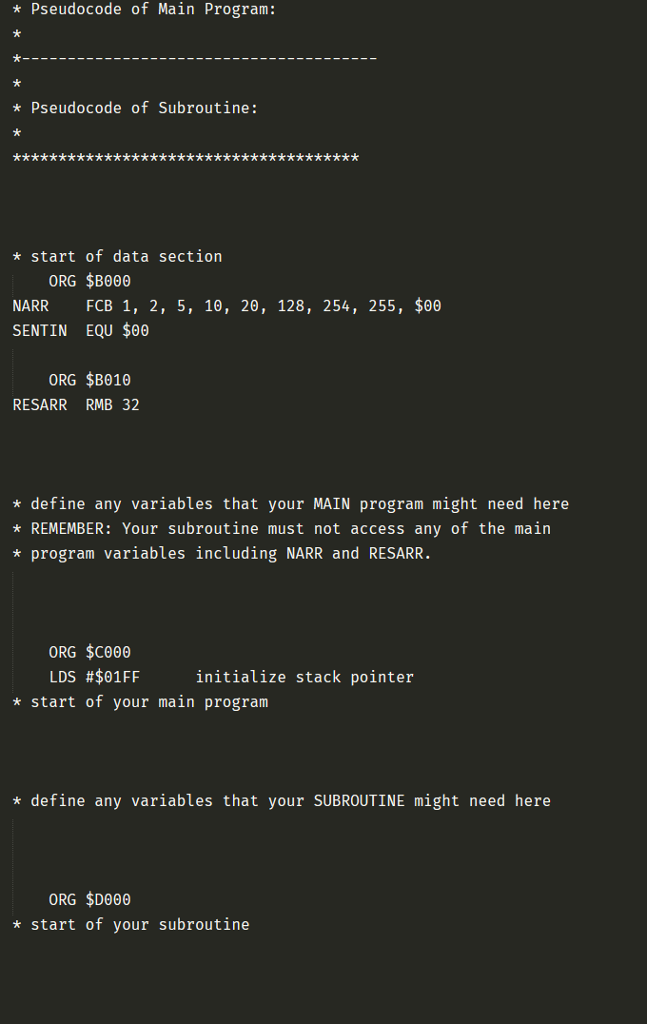
* Pseudocode of Main Program: Pseudocode of Subroutine: *x**xi* start of data sectiorn ORG $B000 NARR FCB 1, 2, 5, 10, 20, 128, 254, 255, $00 SENTIN EQU $00 ORG $B01e RESARR RMB 32 * define any variables that your MAIN program might need here *REMEMBER: Your subroutine must not access any of the main * program variables including NARR and RESARR. main es including NARRand RESAR8 ORG $Ce0G0 LDS #$01FF initialize stack pointer * start of your main program * define any variables that your SUBROUTINE might need here ORG $D00G0 * start of your subroutine * Pseudocode of Main Program: Pseudocode of Subroutine: *x**xi* start of data sectiorn ORG $B000 NARR FCB 1, 2, 5, 10, 20, 128, 254, 255, $00 SENTIN EQU $00 ORG $B01e RESARR RMB 32 * define any variables that your MAIN program might need here *REMEMBER: Your subroutine must not access any of the main * program variables including NARR and RESARR. main es including NARRand RESAR8 ORG $Ce0G0 LDS #$01FF initialize stack pointer * start of your main program * define any variables that your SUBROUTINE might need here ORG $D00G0 * start of your subroutine
Step by Step Solution
There are 3 Steps involved in it

Get step-by-step solutions from verified subject matter experts
 Study Help