







Question: [You do not need the article below to answer this. The screenshot is from the textbook which leads me to believe the answer is C,
[You do not need the article below to answer this. The screenshot is from the textbook which leads me to believe the answer is C, but others say the answer is D... if it's not C, please explain why, thank you!]
Refer to the article titled "San Francisco's Problem Isn't Robots; It's the $15 Wage Floor" from the Wall Street Journal.Assume as in class Labor is on the horizontal axis and Kapital on the vertical axis and the firm currently produces 100 units at a cost of $1,000.When the minimum wage in San Francisco is raised to $15, the Isocost line representing Total Cost would:
a.Shift to the left but remain parallel to the previous Isocost line and the cost of producing 100 units would increase.
b.Shift to the right but remain parallel to the previous Isocost line and the cost of producing 100 units would increase.
c.Rotate out from the current Isocost line, pivoting around its intersection on the vertical axis, and its slope will decrease and the cost of producing 100 units would increase.
d.Rotate in from the current Isocost line, pivoting around its intersection on the vertical axis, and its slope will increase and the cost of producing 100 units would increase.
e.Rotate in from the current Isocost line, pivoting around its intersection on the horizontal axis, and its slope will increase and the cost of producing 100 units would increase.
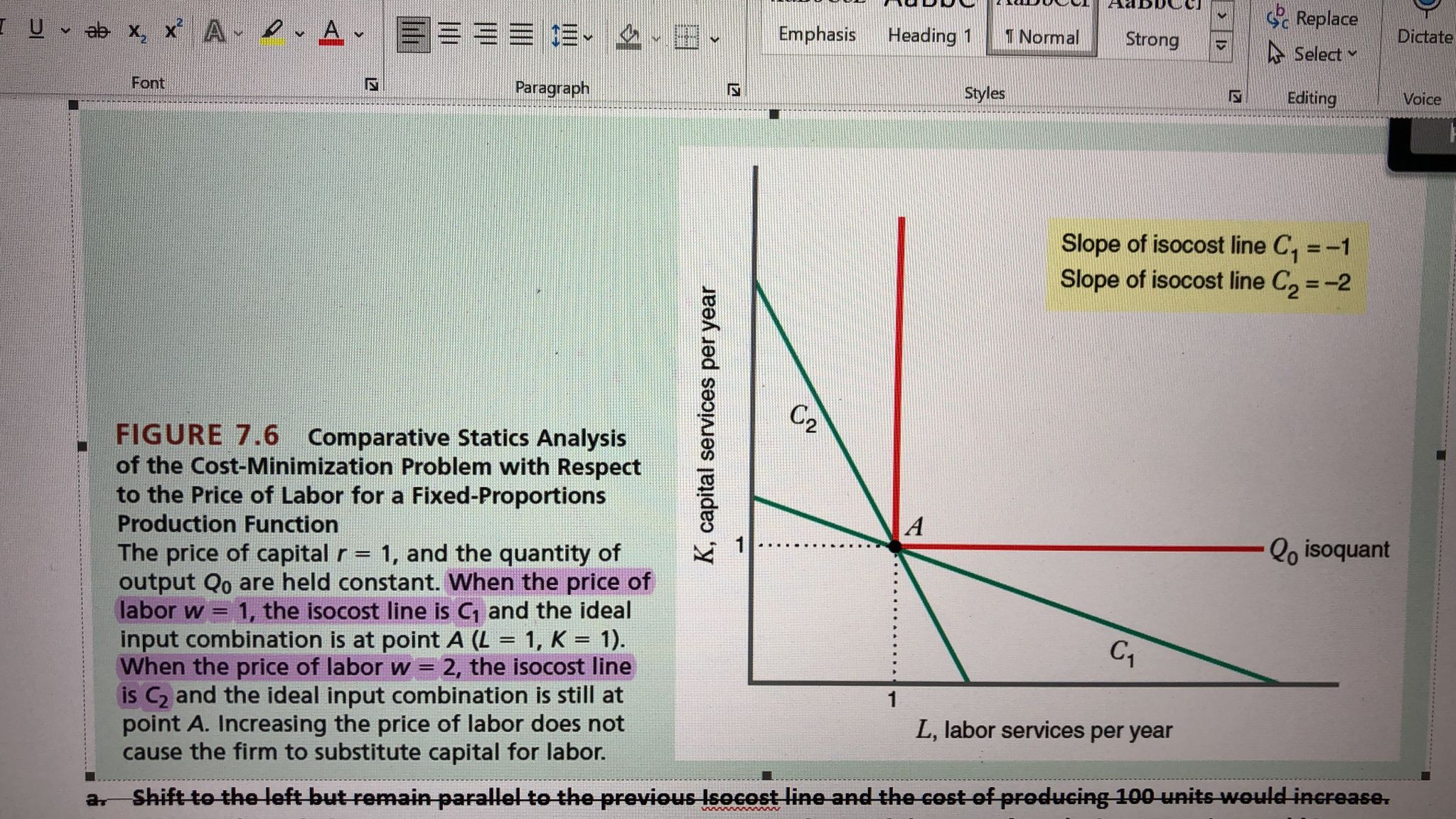
Replace Uvab x x A D. A - = == Emphasis Heading 1 1 Normal Strong Dictate Select Font Paragraph Styles Editing Voice Slope of isocost line C1 =-1 Slope of isocost line C2 = -2 K, capital services per year C2 FIGURE 7.6 Comparative Statics Analysis of the Cost-Minimization Problem with Respect to the Price of Labor for a Fixed-Proportions Production Function A The price of capital r = 1, and the quantity of Qo isoquant output Qo are held constant. When the price of labor w = 1, the isocost line is C1 and the ideal input combination is at point A (L = 1, K = 1). C1 When the price of labor w = 2, the isocost line is C2 and the ideal input combination is still at point A. Increasing the price of labor does not L, labor services per year cause the firm to substitute capital for labor. ar Shift to the left but remain parallel to the previous Isocost line and the cost of producing 100 units would increase
Step by Step Solution
There are 3 Steps involved in it

Get step-by-step solutions from verified subject matter experts
 Study Help