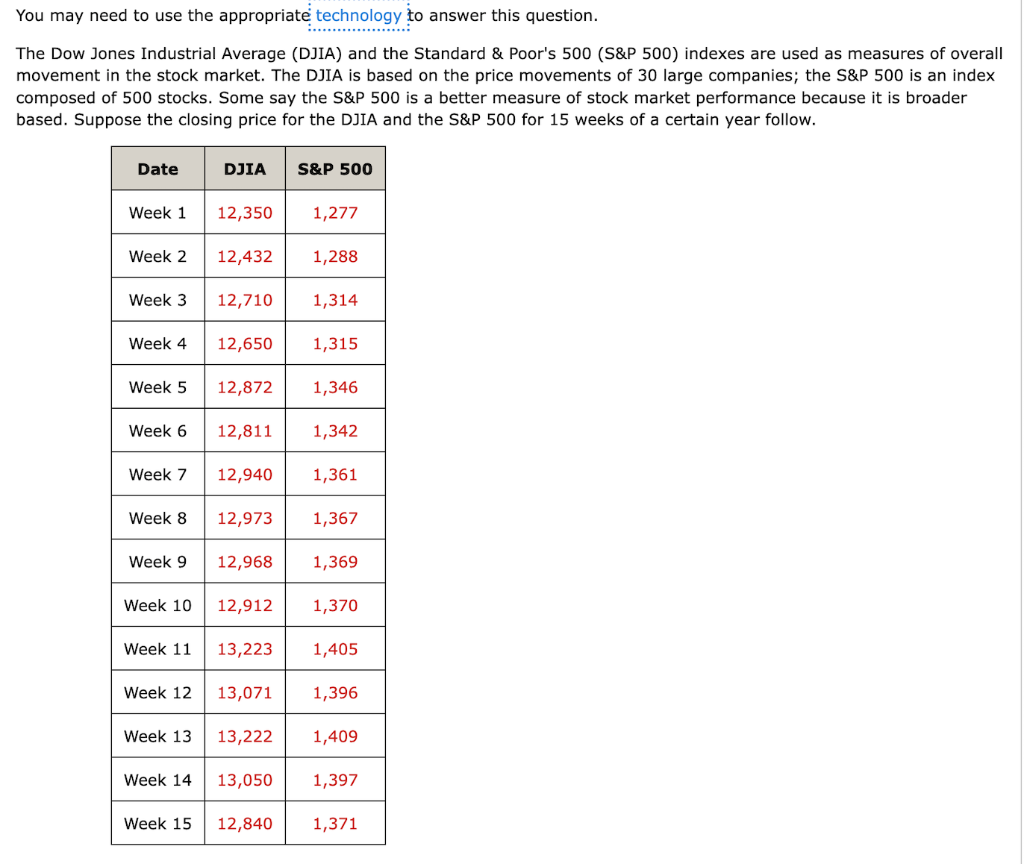
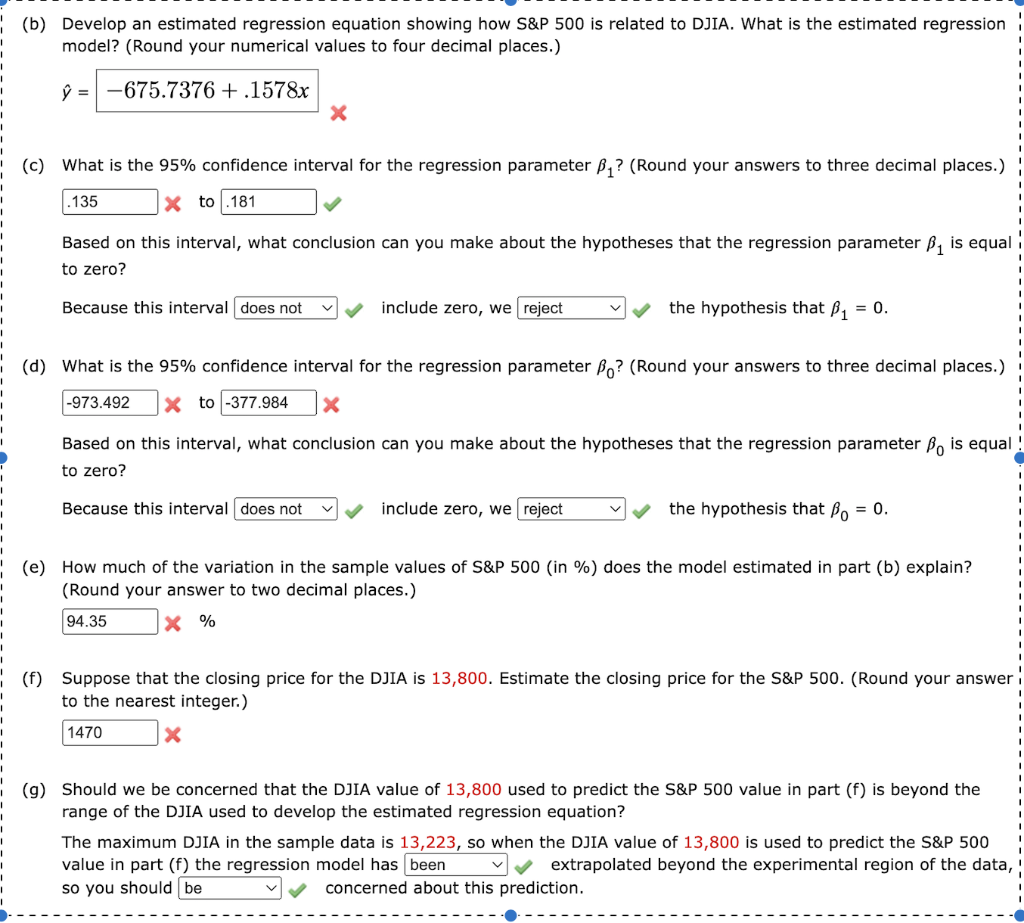
You may need to use the appropriate technology to answer this question. *********** The Dow Jones Industrial Average (DJIA) and the Standard & Poor's 500 (S&P 500) indexes are used as measures of overall movement in the stock market. The DJIA is based on the price movements of 30 large companies; the S&P 500 is an index composed of 500 stocks. Some say the S&P 500 is a better measure of stock market performance because it is broader based. Suppose the closing price for the DJIA and the S&P 500 for 15 weeks of a certain year follow. Date DJIA S&P 500 Week 1 12,350 1,277 Week 2 12,432 1,288 Week 3 12,710 1,314 Week 4 12,650 1,315 Week 5 12,872 1,346 Week 6 12,811 1,342 Week 7 12,940 1,361 Week 8 12,973 1,367 Week 9 12,968 1,369 Week 10 12,912 1,370 Week 11 13,223 1,405 Week 12 13,071 1,396 Week 13 13,222 1,409 Week 14 13,050 1,397 Week 15 12,840 1,371 (b) Develop an estimated regression equation showing how S&P 500 is related to DJIA. What is the estimated regression model? (Round your numerical values to four decimal places.) I =-675.7376 +.1578x (c) What is the 95% confidence interval for the regression parameter ? (Round your answers to three decimal places.) .135 X to .181 Based on this interval, what conclusion can you make about the hypotheses that the regression parameter is equal to zero? I Because this interval does not include zero, we reject the hypothesis that B = 0. I (d) What is the 95% confidence interval for the regression parameter ? (Round your answers to three decimal places.) -973.492 X to -377.984 X i Based on this interval, what conclusion can you make about the hypotheses that the regression parameter Bo is equal to zero? Because this interval does not include zero, we reject the hypothesis that p = 0. I I I (e) How much of the variation in the sample values of S&P 500 (in %) does the model estimated in part (b) explain? (Round your answer to two decimal places.) I I 94.35 X % (f) Suppose that the closing price for the DJIA is 13,800. Estimate the closing price for the S&P 500. (Round your answer to the nearest integer.) I 1470 I X I I (g) Should we be concerned that the DJIA value of 13,800 used to predict the S&P 500 value in part (f) is beyond the range of the DJIA used to develop the estimated regression equation? The maximum DJIA in the sample data is 13,223, so when the DJIA value of 13,800 is used to predict the S&P 500 value in part (f) the regression model has been extrapolated beyond the experimental region of the data, so you should be concerned about this prediction




