Question: You need dataset to solve it by R software. how can i add dataset here? DieFace C B B C B A C B B
 You need dataset to solve it by R software. how can i add dataset here?
DieFace
C
B
B
C
B
A
C
B
B
A
C
C
B
C
A
A
B
C
C
B
B
A
C
C
B
C
A
A
A
B
C
B
C
C
B
A
C
B
A
C
C
B
B
A
C
C
C
C
B
A
C
C
B
B
C
B
C
C
B
A
A
B
A
A
C
C
A
A
A
A
A
C
C
C
B
A
C
A
B
B
B
A
A
A
A
C
B
C
A
C
B
C
A
C
B
B
B
C
C
B
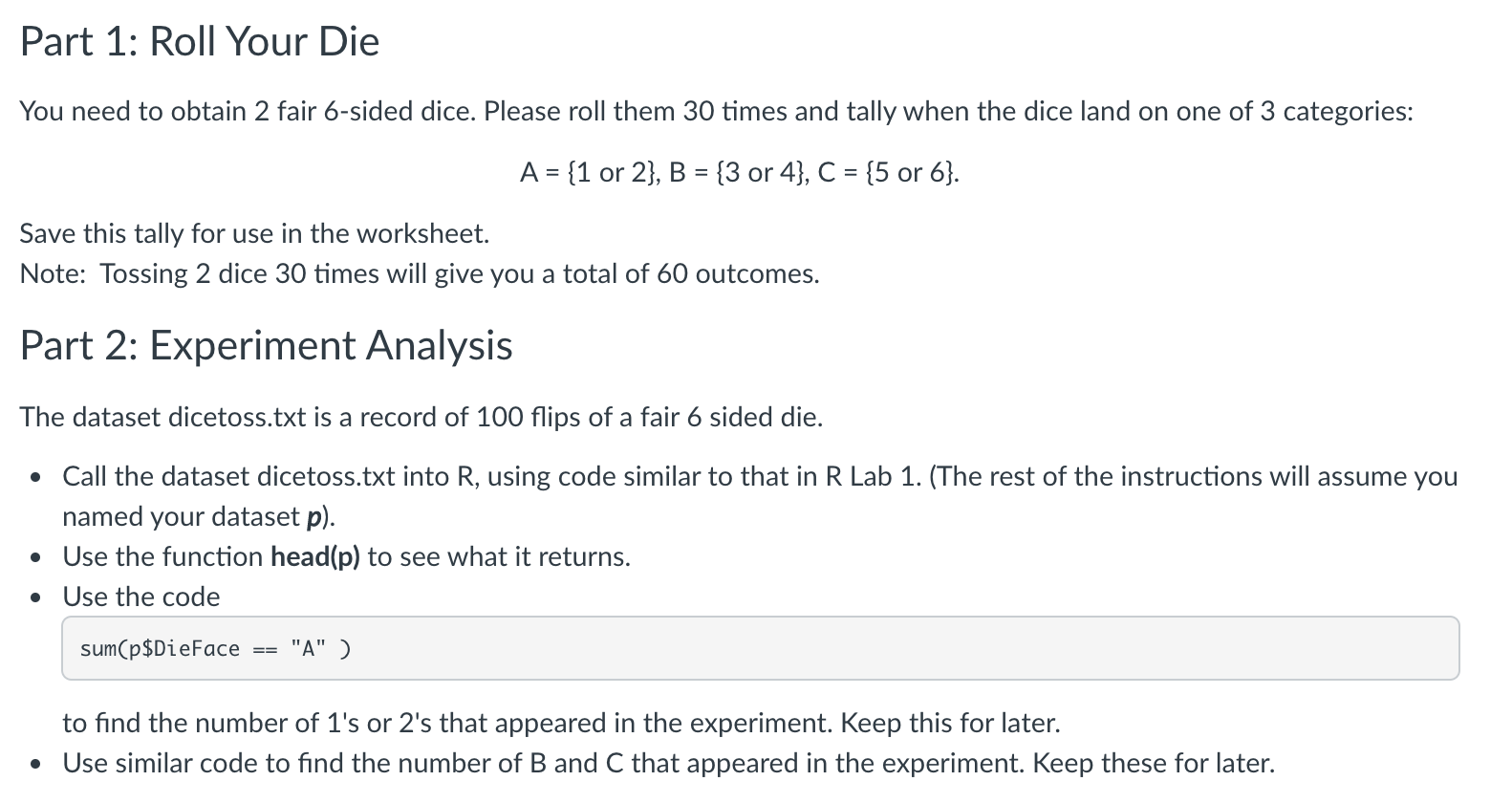
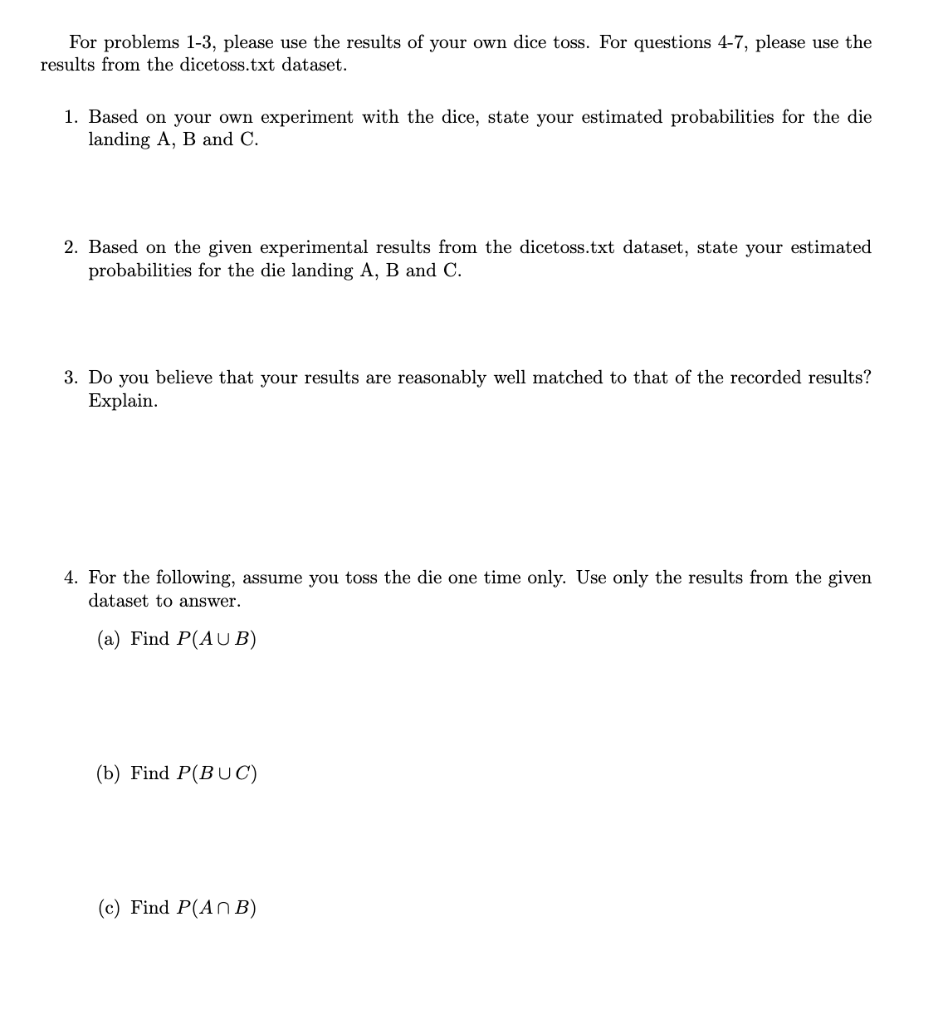
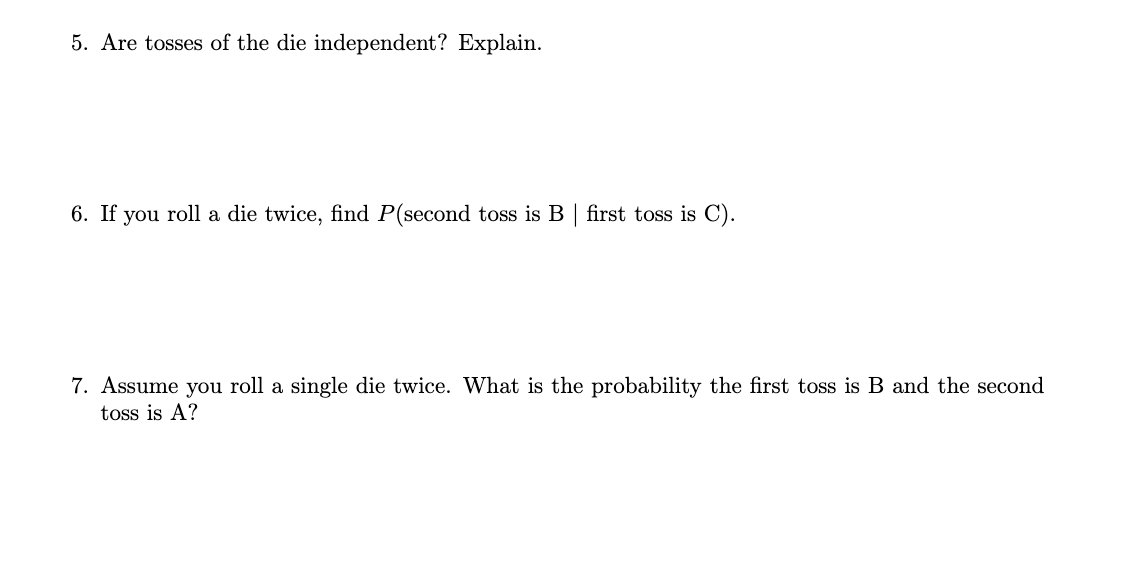
Part 1: Roll Your Die You need to obtain 2 fair 6-sided dice. Please roll them 30 times and tally when the dice land on one of 3 categories: A = {1 or 2}, B = {3 or 4}, C = {5 or 6}. Save this tally for use in the worksheet. Note: Tossing 2 dice 30 times will give you a total of 60 outcomes. Part 2: Experiment Analysis The dataset dicetoss.txt is a record of 100 flips of a fair 6 sided die. Call the dataset dicetoss.txt into R, using code similar to that in R Lab 1. (The rest of the instructions will assume you named your dataset p). Use the function head(p) to see what it returns. Use the code sum(p$DieFace == "A" ) to find the number of 1's or 2's that appeared in the experiment. Keep this for later. Use similar code to find the number of B and C that appeared in the experiment. Keep these for later. For problems 1-3, please use the results of your own dice toss. For questions 4-7, please use the results from the dicetoss.txt dataset. 1. Based on your own experiment with the dice, state your estimated probabilities for the die landing A, B and C. 2. Based on the given experimental results from the dicetoss.txt dataset, state your estimated probabilities for the die landing A, B and C. 3. Do you believe that your results are reasonably well matched to that of the recorded results? Explain. 4. For the following, assume you toss the die one time only. Use only the results from the given dataset to answer. (a) Find P(AUB) (b) Find P(BUC) (c) Find P(ANB) 5. Are tosses of the die independent? Explain. 6. If you roll a die twice, find P(second toss is B | first toss is C). 7. Assume you roll a single die twice. What is the probability the first toss is B and the second toss is A? Part 1: Roll Your Die You need to obtain 2 fair 6-sided dice. Please roll them 30 times and tally when the dice land on one of 3 categories: A = {1 or 2}, B = {3 or 4}, C = {5 or 6}. Save this tally for use in the worksheet. Note: Tossing 2 dice 30 times will give you a total of 60 outcomes. Part 2: Experiment Analysis The dataset dicetoss.txt is a record of 100 flips of a fair 6 sided die. Call the dataset dicetoss.txt into R, using code similar to that in R Lab 1. (The rest of the instructions will assume you named your dataset p). Use the function head(p) to see what it returns. Use the code sum(p$DieFace == "A" ) to find the number of 1's or 2's that appeared in the experiment. Keep this for later. Use similar code to find the number of B and C that appeared in the experiment. Keep these for later. For problems 1-3, please use the results of your own dice toss. For questions 4-7, please use the results from the dicetoss.txt dataset. 1. Based on your own experiment with the dice, state your estimated probabilities for the die landing A, B and C. 2. Based on the given experimental results from the dicetoss.txt dataset, state your estimated probabilities for the die landing A, B and C. 3. Do you believe that your results are reasonably well matched to that of the recorded results? Explain. 4. For the following, assume you toss the die one time only. Use only the results from the given dataset to answer. (a) Find P(AUB) (b) Find P(BUC) (c) Find P(ANB) 5. Are tosses of the die independent? Explain. 6. If you roll a die twice, find P(second toss is B | first toss is C). 7. Assume you roll a single die twice. What is the probability the first toss is B and the second toss is A









 Study Help