



Question: You only need to answer E,F,G. Other questions are given for help you understand the whole question to provide more ideas for you to solve
You only need to answer E,F,G. Other questions are given for help you understand the whole question to provide more ideas for you to solve the parts of E, F, G.
You only need to answer E,F,G. Other questions are given for help you understand the whole question to provide more ideas for you to solve the parts of E, F, G.
You only need to answer E,F,G. Other questions are given for help you understand the whole question to provide more ideas for you to solve the parts of E, F, G.
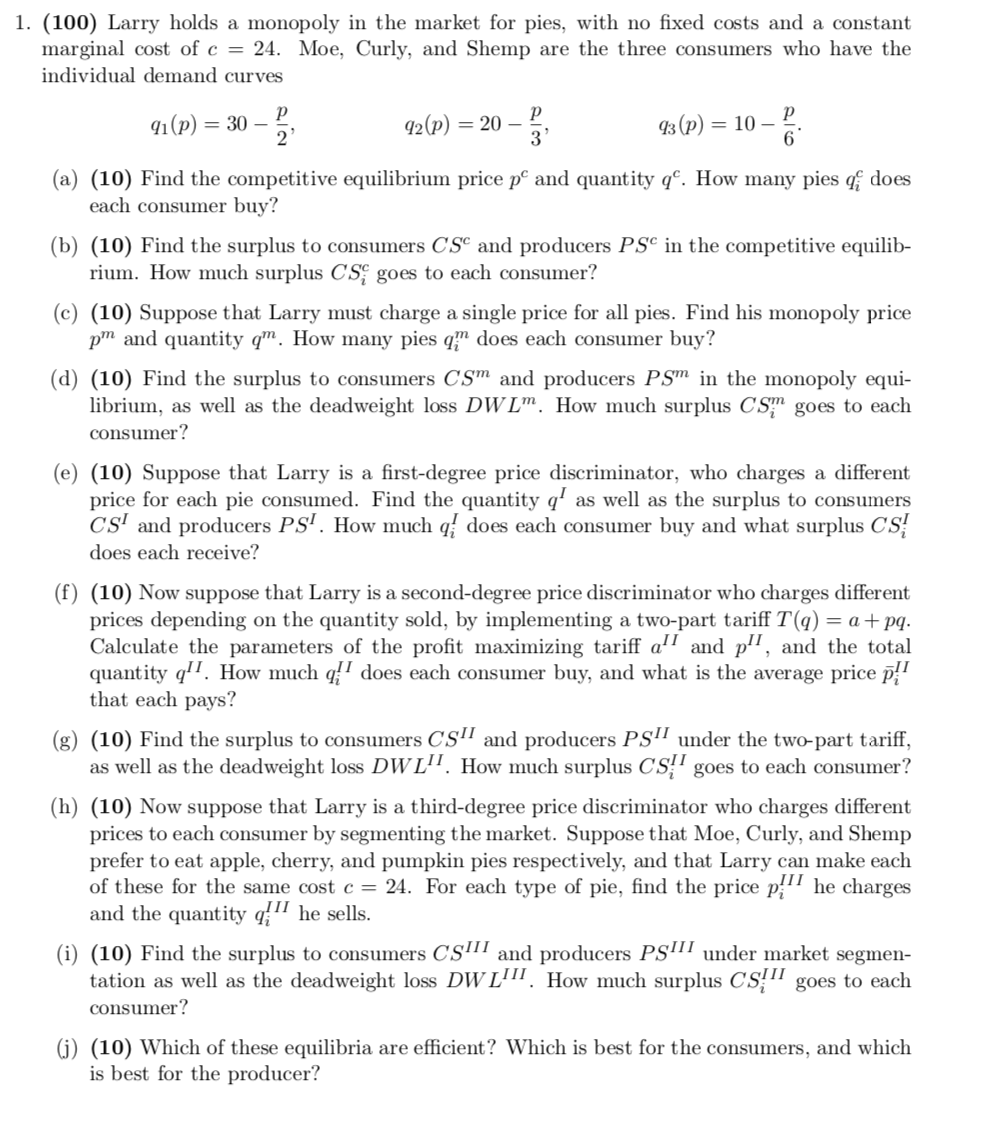
1. (100) Larry holds a monopoly in the market for pies, with no fixed costs and a constant marginal cost of c = 24. Moe, Curly, and Shemp are the three consumers who have the individual demand curves 91 (p) = 30 - , 92(p) = 20 - P, 93 (p) = 10 - 2. (a) (10) Find the competitive equilibrium price p" and quantity q. How many pies of does each consumer buy? (b) (10) Find the surplus to consumers CS" and producers PS" in the competitive equilib rium. How much surplus CS; goes to each consumer? (c) (10) Suppose that Larry must charge a single price for all pies. Find his monopoly price pm and quantity q". How many pies q," does each consumer buy? (d) (10) Find the surplus to consumers CS" and producers PS" in the monopoly equi- librium, as well as the deadweight loss DWL". How much surplus CS," goes to each consumer? (e) (10) Suppose that Larry is a first-degree price discriminator, who charges a different price for each pie consumed. Find the quantity q as well as the surplus to consumers CS' and producers PS . How much q, does each consumer buy and what surplus CS, does each receive? (f) (10) Now suppose that Larry is a second-degree price discriminator who charges different prices depending on the quantity sold, by implementing a two-part tariff T(q) = a + pq. Calculate the parameters of the profit maximizing tariff a and p , and the total quantity q. How much q, does each consumer buy, and what is the average price p, that each pays? (g) (10) Find the surplus to consumers CS" and producers PS under the two-part tariff, as well as the deadweight loss DWL . How much surplus CS, goes to each consumer? (h) (10) Now suppose that Larry is a third-degree price discriminator who charges different prices to each consumer by segmenting the market. Suppose that Moe, Curly, and Shemp prefer to eat apple, cherry, and pumpkin pies respectively, and that Larry can make each of these for the same cost c = 24. For each type of pie, find the price p, he charges and the quantity q, he sells. (i) (10) Find the surplus to consumers CS! and producers PS! under market segment tation as well as the deadweight loss DWL'. How much surplus CS, goes to each consumer? (j) (10) Which of these equilibria are efficient? Which is best for the consumers, and which is best for the producer
Step by Step Solution
There are 3 Steps involved in it

Get step-by-step solutions from verified subject matter experts