







Question: You should recall that in a three-dimensional Cartesian coordinate system, we can generally denote a vector as V = Ai + Bj + Ck where
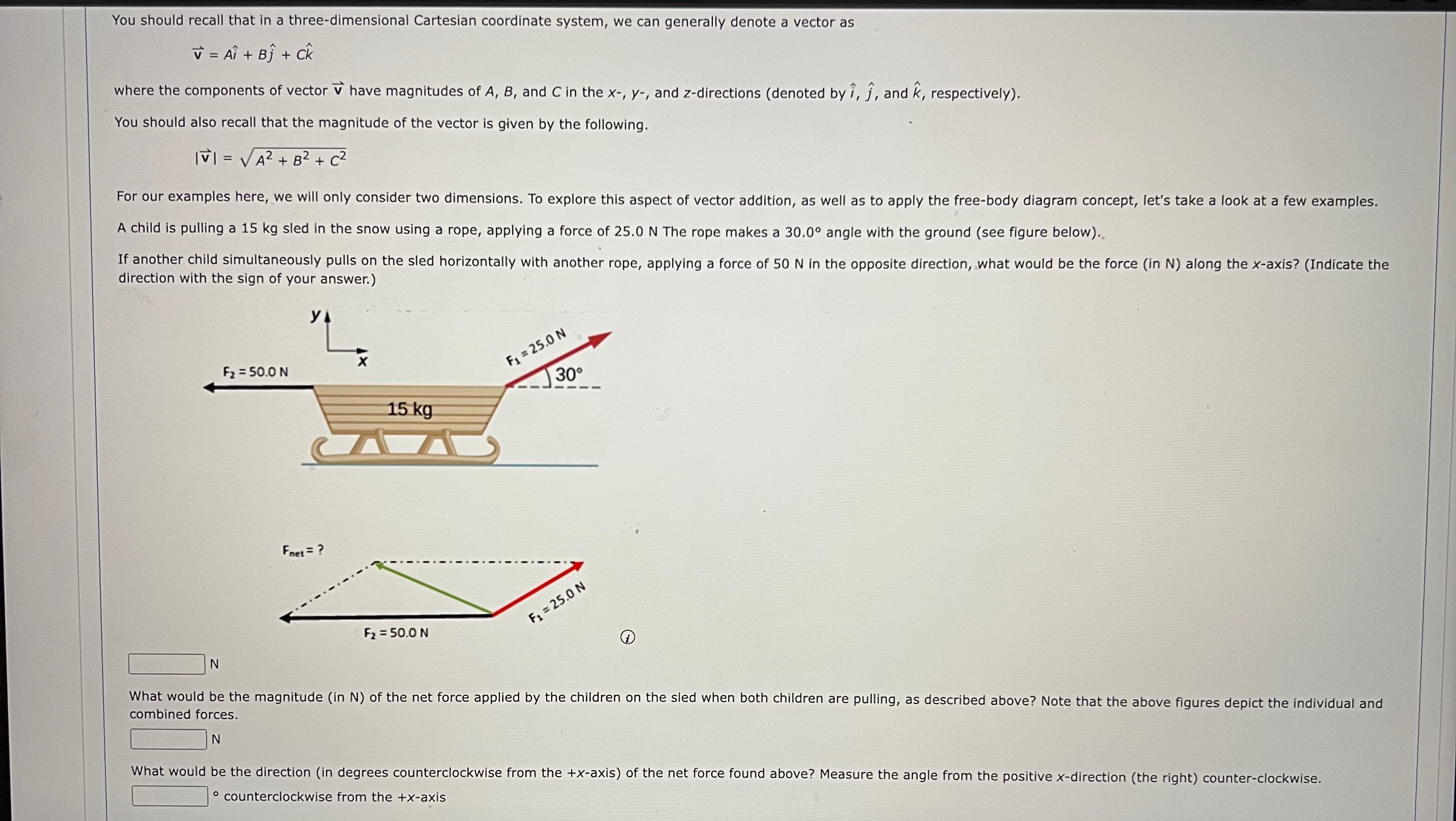
You should recall that in a three-dimensional Cartesian coordinate system, we can generally denote a vector as V = Ai + Bj + Ck where the components of vector v have magnitudes of A, B, and C in the x-, y-, and z-directions (denoted by ), j, and k, respectively). You should also recall that the magnitude of the vector is given by the following. 1VI = VA2 + B2 + C2 For our examples here, we will only consider two dimensions. To explore this aspect of vector addition, as well as to apply the free-body diagram concept, let's take a look at a few examples. A child is pulling a 15 kg sled in the snow using a rope, applying a force of 25.0 N The rope makes a 30.0 angle with the ground (see figure below). If another child simultaneously pulls on the sled horizontally with another rope, applying a force of 50 N in the opposite direction, what would be the force (in N) along the x-axis? (Indicate the direction with the sign of your answer.) F1 = 25.0 N X F2 = 50.0 N 30 15 kg Fnet = ? F1 = 25.0 N F2 = 50.0 N N What would be the magnitude (in N) of the net force applied by the children on the sled when both children are pulling, as described above? Note that the above figures depict the individual and combined forces. What would be the direction (in degrees counterclockwise from the +x-axis) of the net force found above? Measure the angle from the positive x-direction (the right) counter-clockwise. . counterclockwise from the +x-axis
Step by Step Solution
There are 3 Steps involved in it

Get step-by-step solutions from verified subject matter experts
 Study Help