Question: You will summarize each chapter and relate tips about what you learned and how you can implement what you have read about customer service into
You will summarize each chapter and relate tips about what you learned and how you can implement what you have read about customer service into your work or student life. Each of tgese 3 Chapter summary will be approximately one page in length for each. 3 page length in total.
CHAPTER-28
CHAPTER-37
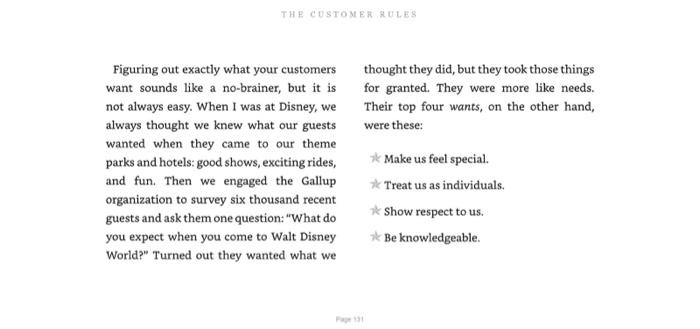
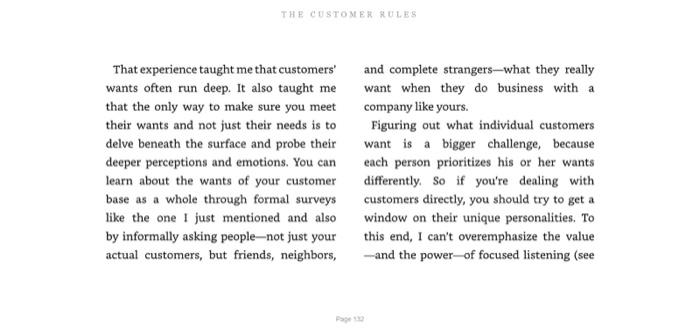
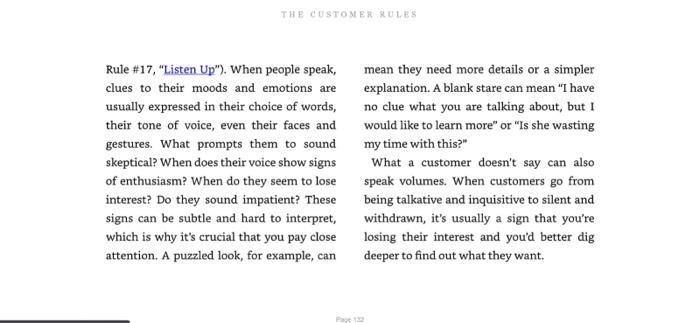
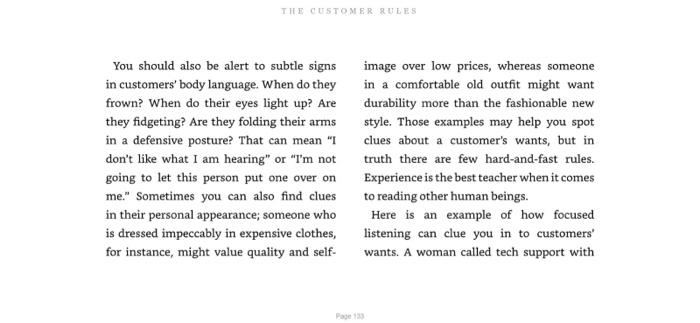
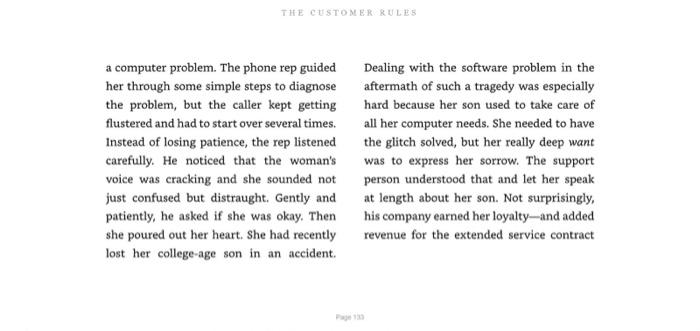
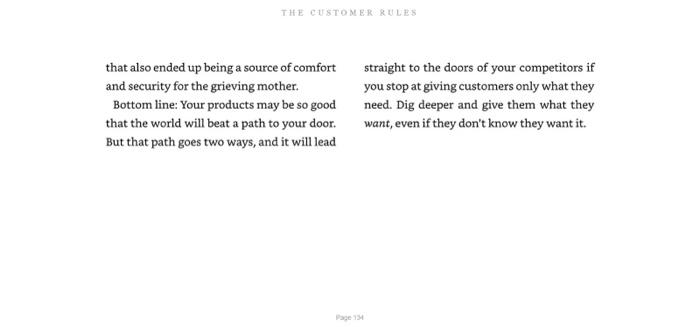
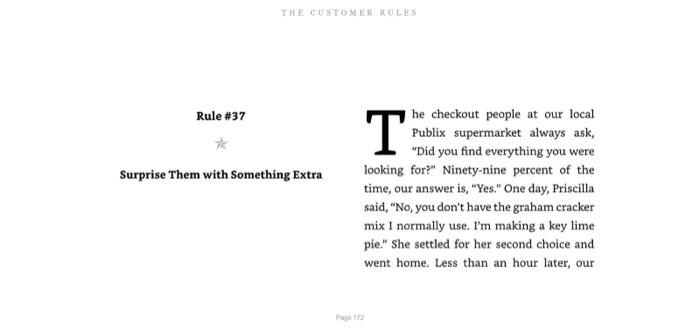
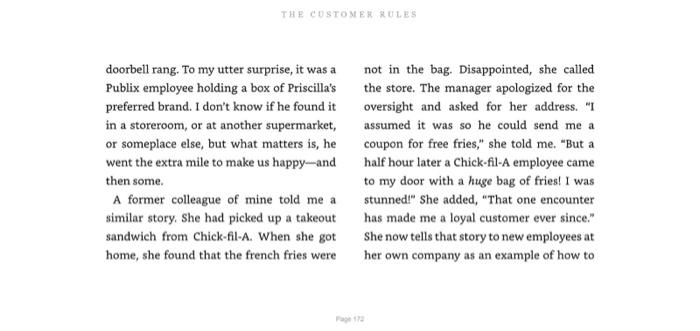
THE CUSTOMER RULES Rule #19 WE Fish Where the Fishermen Ain't arren Buffett, America's most admired investor, once said that one simple rule dictates his approach to investing: "Be fearful when others are greedy, and be greedy when others are fearful." This is the flip side of the copycat rule: Look at what others are not doing, and seize that opportunity to do it yourself. It's kind of like how in fishing it's Page THE CUSTOMER RULES sometimes best to cast your line where no one else thinks there are fish. It's not a question of being different just for the sake of being different. That can get you nowhere quickly. Great businesses stand out by being different from the rest in the right way: by finding customer needs that are going unmet and figuring out a way to meet them. One example of a company that has done this successfully is Chick-fil-A. When S. Truett Cathy founded Chick-fil-A, it didn't take him long to figure out that every other fast-food chain was serving hamburgers but very few were serving chicken. That's why today, Chick-fil-A serves chicken, chicken, and nothing but chicken. How is that a good business proposition? Think of it this way. If you have a hankering for a burger, you could go to any of a number of fast-food chains competing for your business. But if you are in the mood for chicken, you have fewer Page THE CUSTOMER RULES choices, and if there's a Chick-fil-A nearby, that's where you're likely to go. Doing what others don't do has also paid off for Southwest Airlines. For instance, they are one of the few airlines that let customers change flights with no charge a huge plus for someone who travels a lot and often has to adjust departure dates or times. If you cancel a flight, they give you full credit for up to twelve months. And unlike most other airlines, they don't charge for checking baggage (up to two pieces). But you don't have to be a giant corporation or a national chain to stand out by offering a service no one else does. For example, consider Mollie Stone's Markets in the San Francisco Bay Area. Two of the local chain's nine stores-both located in areas where hills are steep and parking is impossible-offer something called the Mollie Bus, a drop-off service that transports customers and their packages from the store to their homes. It VE THE CUSTOMER RULES runs regularly, according to demand, and it's free with a purchase of $30 or more. You can imagine how welcome that is to area residents, especially those with physical limitations. It no doubt gives Mollie Stone's a huge advantage in a highly competitive business. When you're out and about every time you have a thought such as "Wouldn't it be great if they..." or "If only they offered...," write it down, because you might be able to convert that idea into a unique service innovation. And while you're checking out what your competitors are doing, ask yourself not only what you can imitate, but what you can do that's radically different. Is there something that's the opposite of what they do? If they're trying to sell every product under the sun, like Target or Walmart, can you specialize in a single item? If they pride themselves on having lots of store locations, can you consolidate to a single space but THE CUSTOMER RULES offer a super-efficient delivery service? If they take three days to do something, can you do it today? If they're open from nine to five, can you stay open from eight to six? if they charge for shipping, can you ship for free or for a dollar? If their voice mail says they'll get back to you within twenty- four hours, can you answer the phone and take care of customers immediately? If they sell it unassembled, can you sell it fully assembled? You get the picture. The idea is to find out what customers aren't getting from your competitors and give it to them. In a competitive, fast-changing world, the companies that can satisfy a unique customer need will emerge the winners. If you need any more incentive, just remember the slogan that helped propel Apple from near ruin to the most profitable company in America back in 1997: "Think Different." THE CUSTOMER &ULES Rule #28 C Know the Difference Between Needs and wants ustomers come to you for something they need, or think they need, whether it's a shirt, a meal, a smartphone, roof repair, a checking account, or a luxury vacation. This is what gets them in the door. But if you want to keep them coming back and singing your praises, it's not enough to give them what THE CUSTOMER RULES they need; you have to also give them what they really want. Your customers may all have more or less the same apparent need, but that doesn't mean they all want the same thing. Everyone needs certain basics, like food, leisure, clothing, transportation, health care, and so on. Different wants are what give us both burger chains and Whole Foods, vintage clothing stores and Neiman Marcus, campsites and luxury cruises, SUVs and hybrids. Customers' wants can be just as varied when it comes to service. Some customers just want to be served quickly and efficiently. Others care most about convenience. Still others just want the best possible deal. And for some, the quality of human interaction ranks highest; they want to be treated with warmth, friendliness, and respect. Being able to ferret out and deliver what each customer wants most will go a THE CUSTOMER RULES long way toward winning you their repeat business and their loyalty. I sometimes shop at Walmart, but it's not for their "everyday low prices." I go because the store is close to my house, is open twenty-four hours a day, and has very fast checkout. Shopping there saves me time, and saving time is what I happen to want. I would pay everyday high prices if it meant ! could get in and out of there quickly. Here's another way to look at it: Products and services are needs; wants are about the experience of obtaining them. Needs are obvious and practical; wants are subtle and usually emotional Health insurance is a need; wants include low premiums, expert advice, and speedy resolution of claims. Car repair is a need; wants include honesty, a clear explanation of the problem, and quick, reliable completion of the work. A cup of coffee is a need; wants include good taste and fast, pleasant service. A cell THE CUSTOMER RULES phone provider is a need; wants are reliable reception, expert tech support, and a hassle- free process for redeeming upgrades. One woman shared a story with me that illustrates the power of discerning a customer's wants. She had been working at hospices for ten years when she suddenly lost her job. She was worn out and money was tight, but she needed to have her hair cut, so she went to a salon. The hairdresser, she said, "washed my hair with such care that I was certain I was being attended by the fingers of God. Someone who knew nothing about me was giving me service with the same comforting energy and spirit that I gave to the dying and their families for a decade. I needed a hair trim, but what I really wanted was some comfort and care. This young woman sensed that I will never forget her. This is the only place I go now to get my hair done." That hairdresser knew the difference between a need and a want. THE CUSTOMER RULES thought they did, but they took those things for granted. They were more like needs. Their top four wants, on the other hand, were these: Figuring out exactly what your customers want sounds like a no-brainer, but it is not always easy. When I was at Disney, we always thought we knew what our guests wanted when they came to our theme parks and hotels: good shows, exciting rides, and fun. Then we engaged the Gallup organization to survey six thousand recent guests and ask them one question: "What do you expect when you come to Walt Disney World?" Turned out they wanted what we Make us feel special * Treat us as individuals. Show respect to us. Be knowledgeable THE CUSTOMER RULES That experience taught me that customers' wants often run deep. It also taught me that the only way to make sure you meet their wants and not just their needs is to delve beneath the surface and probe their deeper perceptions and emotions. You can learn about the wants of your customer base as a whole through formal surveys like the one I just mentioned and also by informally asking people not just your actual customers, but friends, neighbors, and complete strangers-what they really want when they do business with a company like yours. Figuring out what individual customers want is a bigger challenge, because each person prioritizes his or her wants differently. So if you're dealing with customers directly, you should try to get a window on their unique personalities. To this end, I can't overemphasize the value --and the power of focused listening (see THE CUSTOMER RULES Rule #17, "Listen Up"). When people speak, clues to their moods and emotions are usually expressed in their choice of words, their tone of voice, even their faces and gestures. What prompts them to sound skeptical? When does their voice show signs of enthusiasm? When do they seem to lose interest? Do they sound impatient? These signs can be subtle and hard to interpret, which is why it's crucial that you pay close attention. A puzzled look, for example, can mean they need more details or a simpler explanation. A blank stare can mean "I have no clue what you are talking about, but I would like to learn more" or "Is she wasting my time with this?" What a customer doesn't say can also speak volumes. When customers go from being talkative and inquisitive to silent and withdrawn, it's usually a sign that you're losing their interest and you'd better dig deeper to find out what they want. THE CUSTOMER RULES You should also be alert to subtle signs in customers' body language. When do they frown? When do their eyes light up? Are they fidgeting? Are they folding their arms in a defensive posture? That can mean "I don't like what I am hearing" or "I'm not going to let this person put one over on me." Sometimes you can also find clues in their personal appearance; someone who is dressed impeccably in expensive clothes, for instance, might value quality and self- image over low prices, whereas someone in a comfortable old outfit might want durability more than the fashionable new style. Those examples may help you spot clues about a customer's wants, but in truth there are few hard-and-fast rules. Experience is the best teacher when it comes to reading other human beings. Here is an example of how focused listening can clue you in to customers' wants. A woman called tech support with THE CUSTOMER RULES a computer problem. The phone rep guided her through some simple steps to diagnose the problem, but the caller kept getting flustered and had to start over several times. Instead of losing patience, the rep listened carefully. He noticed that the woman's voice was cracking and she sounded not just confused but distraught. Gently and patiently, he asked if she was okay. Then she poured out her heart. She had recently lost her college-age son in an accident Dealing with the software problem in the aftermath of such a tragedy was especially hard because her son used to take care of all her computer needs. She needed to have the glitch solved, but her really deep want was to express her sorrow. The support person understood that and let her speak at length about her son. Not surprisingly, his company earned her loyalty and added revenue for the extended service contract THE CUSTOMER RULES that also ended up being a source of comfort and security for the grieving mother. Bottom line: Your products may be so good that the world will beat a path to your door. But that path goes two ways, and it will lead straight to the doors of your competitors if you stop at giving customers only what they need. Dig deeper and give them what they want, even if they don't know they want it. 14 THE CUSTOMER RULES Rule #37 Surprise Them with Something Extra he checkout people at our local Publix supermarket always ask, "Did you find everything you were looking for?" Ninety-nine percent of the time, our answer is, "Yes." One day, Priscilla said, "No, you don't have the graham cracker mix I normally use. I'm making a key lime pie." She settled for her second choice and went home. Less than an hour later, our THE CUSTOMER RULES doorbell rang. To my utter surprise, it was a Publix employee holding a box of Priscilla's preferred brand. I don't know if he found it in a storeroom, or at another supermarket, or someplace else, but what matters is, he went the extra mile to make us happy-and then some. A former colleague of mine told me a similar story. She had picked up a takeout sandwich from Chick-fil-A. When she got home, she found that the french fries were not in the bag. Disappointed, she called the store. The manager apologized for the oversight and asked for her address. "I assumed it was so he could send me a coupon for free fries," she told me. "But a half hour later a Chick-fil-A employee came to my door with a huge bag of fries! I was stunned!" She added, "That one encounter has made me a loyal customer ever since." She now tells that story to new employees at her own company as an example of how to THE CUSTOMER RULES surprise and delight a customer. No matter what you think of Chick-fil-A's politics, that's good service We all love the surprise of getting something extra when it's not expected. I'm sure you remember being excited about finding an extra prize in a box of Cracker Jack or the thrill of getting a brightly wrapped present when it wasn't a special day. What about the nice woman at the farmers' market who throws in an extra plum? The gas station attendant who cleans your windshield when you're at the self- service pump? The bakery that lets you sample a cookie? They're not just being generous; they know that the cost of those little surprises is nothing compared with the revenue they get from repeat customers. The practice is probably as old as commerce itself. You know the term baker's dozen? It was coined hundreds of years ago, when THE CUSTOMER RULES bakers in England added a thirteenth loaf of bread to a purchase of twelve. This isn't rocket science. Actually, it's brain science. In 2011, neuroscientists confirmed the wisdom of the ages when they found evidence that our brains crave the excitement of surprise. It seems that the region of the brain called the nucleus accumbens, aka the pleasure center, experiences more activation when a pleasurable stimulus comes unexpectedly than it does when the same pleasure is predictable. As the lead researcher on the brain-imaging study, Dr. Gregory Berns of Emory University, explained it, "So if you get a present for your birthday, that's nice. But you'll like it a lot more if you get a present and it's not your birthday." That's why the same beer tastes better when a bartender gives you a free one out of the blue than it does when the bar advertises "two for one." THE CUSTOMER RULES There are countless ways to give a little extra service, and many of them will cost you little or nothing. You can take more time with a customer. You can offer her a cup of coffee. You can make a contribution to his favorite charity. Once, the general manager of a hotel I often stayed at surprised me with a bottle of my favorite wine. How did he know it was my favorite? He called my home and consulted with Priscilla. During the months of writing this book, I asked virtually everyone I came into contact with to e- mail me stories about a time they received stupendous service. Almost every story I received involved a company surprising the customer with something extra. Some were simple gestures, like the RadioShack employee who, after fetching the battery a customer needed for a certain gadget, offered to put the battery in the device. Others were more elaborate, such as the owner of an independent bookstore THE CUSTOMER RULES who, upon realizing she didn't have a and roses" from the company, along with a particular book that a customer wanted to personal note wishing her a speedy recovery give his child for Christmas, phoned her and an upgrade that entitled her to free chief competitor and had them set aside a delivery on subsequent orders. copy for the man. Then there was the service That company was Zappos. I've heard rep who stayed on the phone longer than a lot of great above-and-beyond stories she needed to because the customer who'd about that online retailer, which has called was housebound owing to a severe what Businessweek magazine called "a near- medical condition and was obviously lonely fanatical devotion to customer service." For The next day, the customer was stunned example, there was the time a guy ordered to receive an enormous bouquet of lilies a specific pair of shoes he had to wear as THE CUSTOMER RULES best man at a wedding, UPS messed up the shipment, and the shoes didn't arrive before he left for the airport to fly to the wedding site. What did Zappos do? They sent a replacement pair overnight to the customer's destination. Not only did they cover the charge for shipping, they gave him a complete refund. With a bit of imagination, you too can delight customers by giving them a little extra when they least expect it. They'll surprise you in return by coming back early and often and by singing your praises to others









 Study Help