



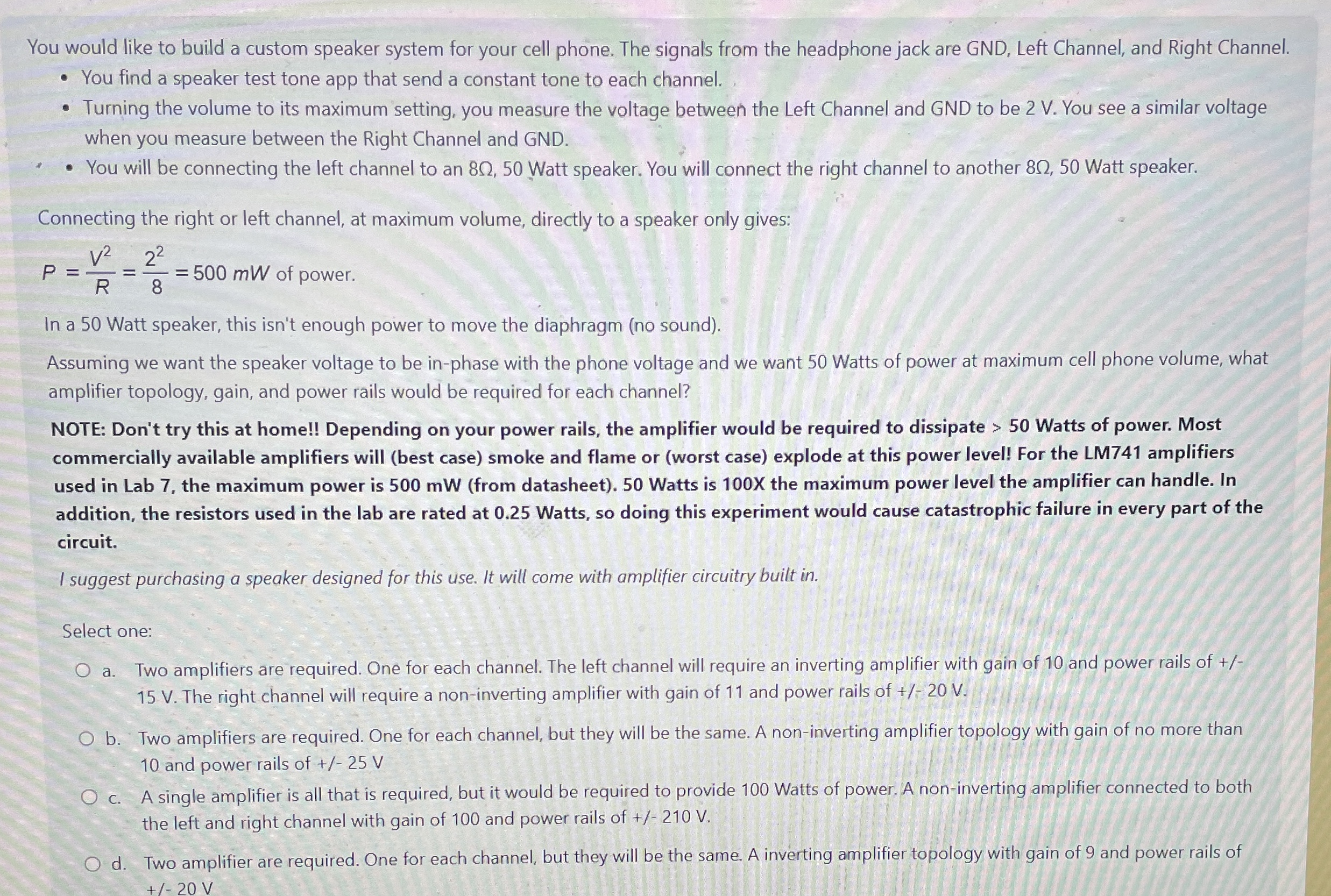
Question: You would like to build a custom speaker system for your cell phone. The signals from the headphone jack are GND , Left Channel, and
You would like to build a custom speaker system for your cell phone. The signals from the headphone jack are GND Left Channel, and Right Channel.
You find a speaker test tone app that send a constant tone to each channel.
Turning the volume to its maximum setting, you measure the voltage between the Left Channel and GND to be V You see a similar voltage when you measure between the Right Channel and GND
You will be connecting the left channel to an Watt speaker. You will connect the right channel to another Watt speaker.
Connecting the right or left channel, at maximum volume, directly to a speaker only gives:
of power.
In a Watt speaker, this isn't enough power to move the diaphragm no sound
Assuming we want the speaker voltage to be inphase with the phone voltage and we want Watts of power at maximum cell phone volume, what amplifier topology, gain, and power rails would be required for each channel?
NOTE: Don't try this at home!! Depending on your power rails, the amplifier would be required to dissipate Watts of power. Most commercially available amplifiers will best case smoke and flame or worst case explode at this power level! For the LM amplifiers used in Lab the maximum power is mW from datasheet Watts is X the maximum power level the amplifier can handle. In addition, the resistors used in the lab are rated at Watts, so doing this experiment would cause catastrophic failure in every part of the circuit.
I suggest purchasing a speaker designed for this use. It will come with amplifier circuitry built in
Select one:
a Two amplifiers are required. One for each channel. The left channel will require an inverting amplifier with gain of and power rails of V The right channel will require a noninverting amplifier with gain of and power rails of
b Two amplifiers are required. One for each channel, but they will be the same. A noninverting amplifier topology with gain of no more than and power rails of
c A single amplifier is all that is required, but it would be required to provide Watts of power. A noninverting amplifier connected to both the left and right channel with gain of and power rails of
d Two amplifier are required. One for each channel, but they will be the same. A inverting amplifier topology with gain of and power rails of
Step by Step Solution
There are 3 Steps involved in it
1 Expert Approved Answer
Step: 1 Unlock

Question Has Been Solved by an Expert!
Get step-by-step solutions from verified subject matter experts
Step: 2 Unlock
Step: 3 Unlock