Question: Your chance to be creative. Write a positioning statement for Cialis. Vet your statement using the six criteria described in Moore and Helstein. Choosing how
Your chance to be creative. Write a positioning statement for "Cialis". Vet your statement using the six criteria described in Moore and Helstein.
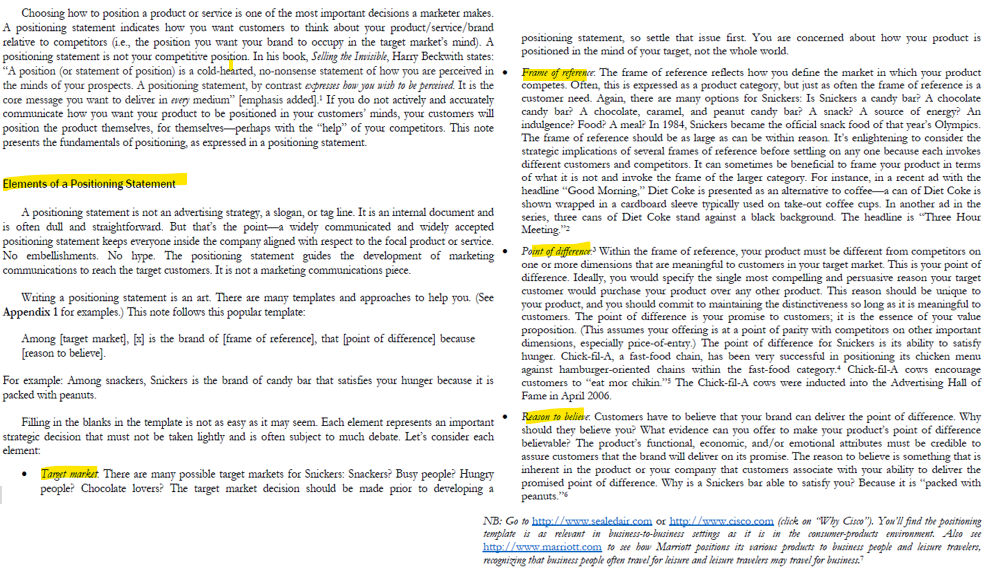
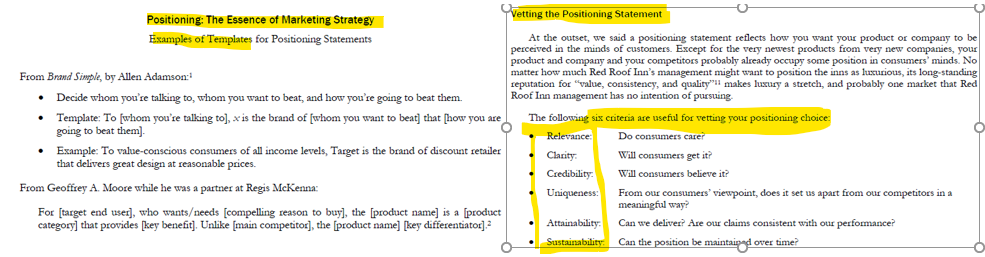
Choosing how to position a product or service is one of the most important decisions a marketer makes A positioning statement indicates how you want customers to think about your product/service/brand relative to competitors ie, the position you want your brand to occupy in the tarpet market's mind). A positioning statement is not your competitive position. In his book, Selling the Invisible, Harry Beckwith states: "A position (or statement of position) is a cold-hearted, no-nonsense statement of how you are perceived in. the minds of your prospects. A positioning statement, by contrast expresses how you wish to be perceived. It is the core message you want to deliver in every medium" (emphasis added). If you do not actively and accurately communicate how you want your product to be positioned in your customers' minds, your customers will position the product themselves, for themselves-perhaps with the "help" of your competitors. This note presents the fundamentals of positioning, as expressed in a positioning statement. Elements of a Positioning Statement A positioning statement is not an advertising strategy, a slogan, or tag line. It is an internal document and is often dull and straightforward. But that's the point- widely communicated and widely accepted positioning statement keeps everyone inside the company aligned with respect to the focal product or service. No embellishments. No hype. The positioning statement guides the development of marketing communications to reach the target customers. It is not a marketing communications piece. positioning statement, so settle that issue first. You are concerned about how your product is positioned in the mind of your target, not the whole world Frame of reference. The frame of reference reflects how you define the market in which your product competes. Often, this is expressed as a product category, but just as often the frame of reference is a customer need. Again, there are many options for Snickers: Is Snickers a candy bar? A chocolate candy bar? A chocolate, caramel, and peanut candy bar? A snack? A source of energy? An indulgence? Food? A meal? In 1984, Snickers became the official snack food of that year's Olympics The frame of reference should be as large as can be within reason. It's enlightening to consider the strategic implications of several frames of reference before settling on any one because each invokes different customers and competitors. It can sometimes be beneficial to frame your product in terms of what it is not and invoke the frame of the larger category. For instance, in a recent ad with the headline "Good Morning," Diet Coke is presented as an alternative to coffee can of Diet Coke is shown wrapped in a cardboard sleeve typically used on take-out coffee cups. In another ad in the series, three cans of Diet Coke stand against a black background. The headline is "Three Hour Meeting Port of difference. Within the frame of reference, your product must be different from competitors on one or more dimensions that are meaningful to customers in your target market. This is your point of difference. Ideally, you would specify the single most compelling and persuasive reason your target customer would purchase your product over any other product. This reason should be unique to your product, and you should commit to maintaining the distinctiveness so long as it is meaningful to customers. The point of difference is your promise to customers, it is the essence of your value proposition. (This assumes your offering is at a point of parity with competitors on other important dimensions, especially price-of-entry.) The point of difference for Snickers is its ability to satisfy hunger. Chick-fil-A, a fast-food chain, has been very successful in positioning its chicken menu against hamburger-oriented chains within the fast-food category. Chick-fil-A cows encourage customers to "eat mor chikin." The Chick-fil-A cows were inducted into the Advertising Hall of Fame in April 2006. Reason to beliese. Customers have to believe that your brand can deliver the point of difference. Why should they believe you? What evidence can you offer to make your product's point of difference believable? The product's functional, economic, and/or emotional attributes must be credible to assure customers that the brand will deliver on its promise. The reason to believe is something that is inherent in the product or your company that customers associate with your ability to deliver the promised point of difference. Why is a Snickers bar able to satisfy you? Because it is "packed with peanuts." Writing a positioning statement is an art. There are many templates and approaches to help you. (See Appendix 1 for examples.) This note follows this popular template: Among (target market], [s] is the brand of [frame of reference), that point of difference] because (reason to believe). For example: Among snackers, Snickers is the brand of candy bar that satisfies your hunger because it is packed with peanuts. Filling in the blanks in the template is not as easy as it may seem. Each element represents an important strategic decision that must not be taken lightly and is often subject to much debate. Let's consider each element: Target market. There are many possible target markets for Snickers: Snackers? Busy people? Hungry people? Chocolate lovers? The target market decision should be made prior to developing a NB: Go to http://www.sealedair.com or http://www.cisco.com (click on "Why Ciao"). You'll find the positioning template is a relevant in business-to-business settings as it is in the CONSNINer product environment. Also se http://www.marriott.com to see how Marriott positions its rarions products to business people and leisure travelers, wizing that business prople often travel for leisure and leisure travelers may travel for business? m Vetting the Positioning Statement Positioning: The Essence of Marketing Strategy Examples of Templates for Positioning Statements At the outset, we said a positioning statement reflects how you want your product or company to be perceived in the minds of customers. Except for the very newest products from very new companies, you product and company and your competitors probably already occupy some position in consumers' minds. No matter how much Red Roof Inn's management might want to position the innsas lucious, its long-standing reputation for "value, consistency, and quality" makes luxury a stretch, and probably one market that Red Roof Inn management has no intention of pursuing From Brand Simple, by Allen Adamson: Decide whom you're talking to whom you want to beat, and how you're going to beat them. Template: To (whom you're talking to), x is the brand of (whom you want to beat] that how you are going to beat them). Example: To value-conscious consumers of all income levels, Target is the brand of discount retailer that delivers great design at reasonable prices. The following six criteria are useful for vetting your positioning choice: Relevance Do consumers carer Clarity Will consumers get it? Credibility: Will consumers believe it? Uniqueness: From our consumers' viewpoint, does it set us apart from our competitors in a meaningful way? Attainability Can we deliver? Are our claims consistent with our performance bilier Can the position be maintained over time? From Geoffrey A. Moore while he was a partner at Regis McKenna: For (target end user), who wantseeds [compelling reason to buy], the product name) is a [product Category that provides [key benefit]. Unlike [main competitor), the product name] [key differentiato:] Choosing how to position a product or service is one of the most important decisions a marketer makes A positioning statement indicates how you want customers to think about your product/service/brand relative to competitors ie, the position you want your brand to occupy in the tarpet market's mind). A positioning statement is not your competitive position. In his book, Selling the Invisible, Harry Beckwith states: "A position (or statement of position) is a cold-hearted, no-nonsense statement of how you are perceived in. the minds of your prospects. A positioning statement, by contrast expresses how you wish to be perceived. It is the core message you want to deliver in every medium" (emphasis added). If you do not actively and accurately communicate how you want your product to be positioned in your customers' minds, your customers will position the product themselves, for themselves-perhaps with the "help" of your competitors. This note presents the fundamentals of positioning, as expressed in a positioning statement. Elements of a Positioning Statement A positioning statement is not an advertising strategy, a slogan, or tag line. It is an internal document and is often dull and straightforward. But that's the point- widely communicated and widely accepted positioning statement keeps everyone inside the company aligned with respect to the focal product or service. No embellishments. No hype. The positioning statement guides the development of marketing communications to reach the target customers. It is not a marketing communications piece. positioning statement, so settle that issue first. You are concerned about how your product is positioned in the mind of your target, not the whole world Frame of reference. The frame of reference reflects how you define the market in which your product competes. Often, this is expressed as a product category, but just as often the frame of reference is a customer need. Again, there are many options for Snickers: Is Snickers a candy bar? A chocolate candy bar? A chocolate, caramel, and peanut candy bar? A snack? A source of energy? An indulgence? Food? A meal? In 1984, Snickers became the official snack food of that year's Olympics The frame of reference should be as large as can be within reason. It's enlightening to consider the strategic implications of several frames of reference before settling on any one because each invokes different customers and competitors. It can sometimes be beneficial to frame your product in terms of what it is not and invoke the frame of the larger category. For instance, in a recent ad with the headline "Good Morning," Diet Coke is presented as an alternative to coffee can of Diet Coke is shown wrapped in a cardboard sleeve typically used on take-out coffee cups. In another ad in the series, three cans of Diet Coke stand against a black background. The headline is "Three Hour Meeting Port of difference. Within the frame of reference, your product must be different from competitors on one or more dimensions that are meaningful to customers in your target market. This is your point of difference. Ideally, you would specify the single most compelling and persuasive reason your target customer would purchase your product over any other product. This reason should be unique to your product, and you should commit to maintaining the distinctiveness so long as it is meaningful to customers. The point of difference is your promise to customers, it is the essence of your value proposition. (This assumes your offering is at a point of parity with competitors on other important dimensions, especially price-of-entry.) The point of difference for Snickers is its ability to satisfy hunger. Chick-fil-A, a fast-food chain, has been very successful in positioning its chicken menu against hamburger-oriented chains within the fast-food category. Chick-fil-A cows encourage customers to "eat mor chikin." The Chick-fil-A cows were inducted into the Advertising Hall of Fame in April 2006. Reason to beliese. Customers have to believe that your brand can deliver the point of difference. Why should they believe you? What evidence can you offer to make your product's point of difference believable? The product's functional, economic, and/or emotional attributes must be credible to assure customers that the brand will deliver on its promise. The reason to believe is something that is inherent in the product or your company that customers associate with your ability to deliver the promised point of difference. Why is a Snickers bar able to satisfy you? Because it is "packed with peanuts." Writing a positioning statement is an art. There are many templates and approaches to help you. (See Appendix 1 for examples.) This note follows this popular template: Among (target market], [s] is the brand of [frame of reference), that point of difference] because (reason to believe). For example: Among snackers, Snickers is the brand of candy bar that satisfies your hunger because it is packed with peanuts. Filling in the blanks in the template is not as easy as it may seem. Each element represents an important strategic decision that must not be taken lightly and is often subject to much debate. Let's consider each element: Target market. There are many possible target markets for Snickers: Snackers? Busy people? Hungry people? Chocolate lovers? The target market decision should be made prior to developing a NB: Go to http://www.sealedair.com or http://www.cisco.com (click on "Why Ciao"). You'll find the positioning template is a relevant in business-to-business settings as it is in the CONSNINer product environment. Also se http://www.marriott.com to see how Marriott positions its rarions products to business people and leisure travelers, wizing that business prople often travel for leisure and leisure travelers may travel for business? m Vetting the Positioning Statement Positioning: The Essence of Marketing Strategy Examples of Templates for Positioning Statements At the outset, we said a positioning statement reflects how you want your product or company to be perceived in the minds of customers. Except for the very newest products from very new companies, you product and company and your competitors probably already occupy some position in consumers' minds. No matter how much Red Roof Inn's management might want to position the innsas lucious, its long-standing reputation for "value, consistency, and quality" makes luxury a stretch, and probably one market that Red Roof Inn management has no intention of pursuing From Brand Simple, by Allen Adamson: Decide whom you're talking to whom you want to beat, and how you're going to beat them. Template: To (whom you're talking to), x is the brand of (whom you want to beat] that how you are going to beat them). Example: To value-conscious consumers of all income levels, Target is the brand of discount retailer that delivers great design at reasonable prices. The following six criteria are useful for vetting your positioning choice: Relevance Do consumers carer Clarity Will consumers get it? Credibility: Will consumers believe it? Uniqueness: From our consumers' viewpoint, does it set us apart from our competitors in a meaningful way? Attainability Can we deliver? Are our claims consistent with our performance bilier Can the position be maintained over time? From Geoffrey A. Moore while he was a partner at Regis McKenna: For (target end user), who wantseeds [compelling reason to buy], the product name) is a [product Category that provides [key benefit]. Unlike [main competitor), the product name] [key differentiato:]









 Study Help