



Question: Your company is considering whether it should tender for contracts (MS1 and MS2) on offer from a government department for the supply of certain components.
Your company is considering whether it should tender for contracts (MS1 and MS2) on offer from a government department for the supply of certain components. The company has three options: tender for MS1 only; or tender for MS2 only; or tender for both MS1 and MS2. If tenders are to be submitted the company will incur additional costs. These costs will have to be entirely recouped from the contract price. The risk, of course, is that if a tender is unsuccessful (not having a contract) the company will have made a loss. The cost of tendering for contract MS1 only is 50,000. The component supply cost if the tender is successful (getting a contract) would be 18,000. The cost of tendering for contract MS2 only is 14,000. The component supply cost if the tender is successful (getting a contract) would be 12,000. The cost of tendering for both contract MS1 and contract MS2 is 55,000. The component supply cost if the tender is successful (getting a contract) would be 24,000. For each contract, possible tender prices have been determined. In addition, subjective assessments have been made of the probability of getting the contract with a particular tender price as shown below. Note here that the company can only submit one tender and cannot, for example, submit two tenders (at different prices) for the same contract. Option Possible tender offers (Prices ()) Probability of getting contract 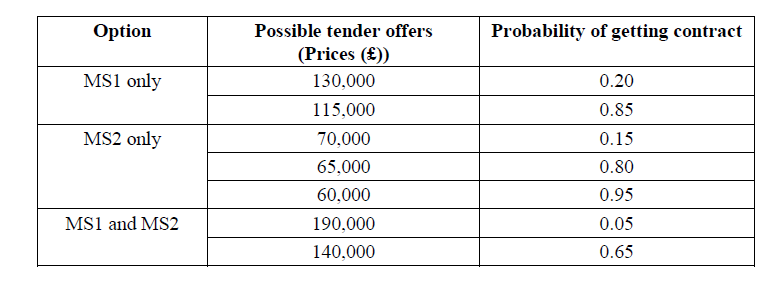 In the event that the company tenders for both MS1 and MS2 it will either win both contracts (at the price shown above) or no contract at all. Draw a complete decision tree for the given case and solve the decision tree with calculating EMV. What is the most profitable alternative?
Step by Step Solution
There are 3 Steps involved in it

Get step-by-step solutions from verified subject matter experts