Your group is a consulting team from a large well known Information Technology company. You are meeting your client in hopes of making a sale based on their needs. If you are able to make this multi-million dollar deal you are assured a promotion and a large year end bonus.
Find your groups background case study, make sure to pick the right case study! You do not need to answer the chapter review questions
Read the case study information and research the technology associated with the system your client is trying to implement. The technology will be in the areas of Policing Predictive Analytics, Health Care, Automotive Industry and Retail Near Field Communication. Prepare a list of reference articles that shows the research you used. (5 points)
Make a list of prospecting questions that you would like your client to answer at your first meeting in order to understand your clients strategic needs.(5 points)
Document the preapproach method you plan to use for your first engagement with the client. And develop a number of SMART objectives for this engagement. Review the class notes on different presentation methods and select the method you plan to use. NOTE: if youve forgotten what preapproach is then review the class notes(5 points)
Add your reference articles, prospecting question and preapproach material into a single report which will complement your sales presentation.
Prepare your sales presentation slides which your group will present in class between 5 and 10 mins. Your instructor will take on the role of your client. Make sure to use your research in your presentation, paying close attention to what makes a great (predictive analytics, health care, automotive and NFC system etc. depending on your groups case study) Assume that your company has a solution that meets all of these requirements. (5 points).
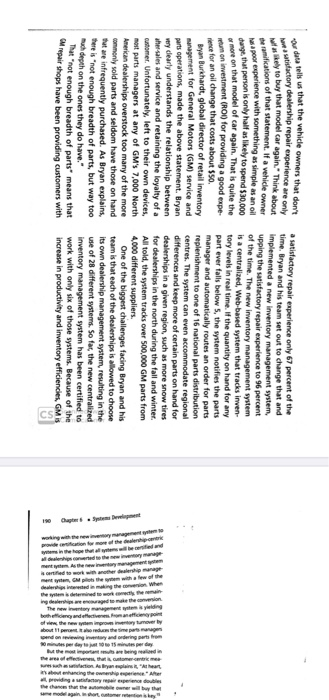
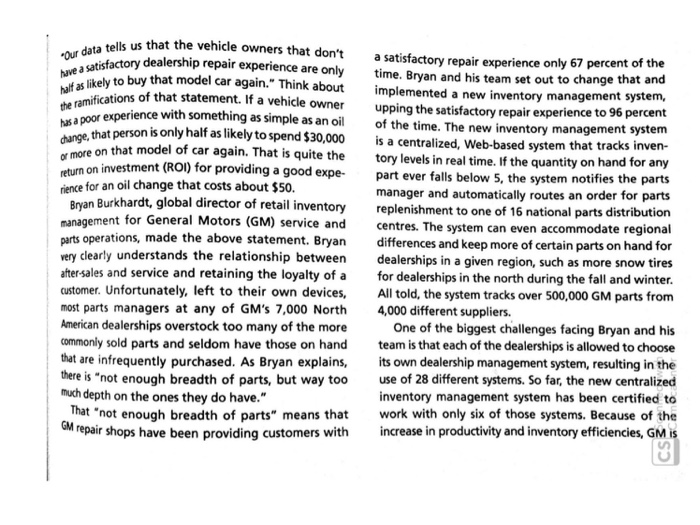
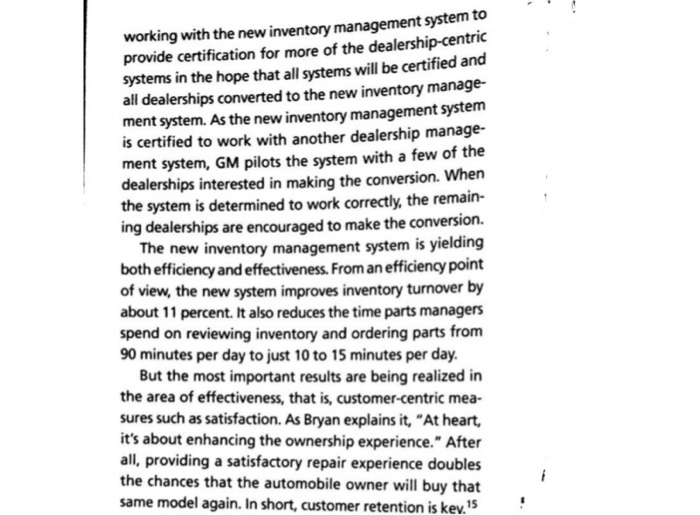
a satisfactory repair experience only 67 percent of the time. Bryan and his team set out to change that and Implemented a new inventory management system, upping the satisfactory repair experience to 96 percent has a poor experience with something as simple as an oil of the time. The new Inventory management system durge, that person is only half as likely to spend $30,000 is a centralized, Web-based system that tracks inven or more on that model of car again. That is quite the Wun on investment (ROI) for providing a good expe tory levels in real time. If the quantity on hand for any part ever falls below 5, the system notifies the parts rience for an oil change that costs about $50. manager and automatically routes an order for parts Bryan Burkhardt, global director of retail Inventory replenishment to one of 16 national parts distribution management for General Motors (GM) service and centres. The system can even accommodate regional parts operations, made the above statement. Bryan differences and keep more of certain parts on hand for very clearly understands the relationship between dealerships in a given region, such as more snow tires her sales and service and retaining the loyalty of a for dealerships in the north during the fall and winter customer. Unfortunately, left to their own devices, All told the system tracks over 500,000 GM parts from most parts managers at any of GM's 7,000 North 4.000 different suppliers. Anerkan dealerships overstock too many of the more One of the biggest challenges facing Bryan and his commonly sold parts and seldom have those on hand team is that each of the dealerships is allowed to choose that are intrequently purchased. As Bryan explains. its own dealership management system, resulting in the there is not enough breadth of parts, but way too use of 28 different systems. So far, the new centralized un depth on the ones they do have." inventory management system has been certified to That not enough breadth of parts means that work with only six of those systems. Because of the CM repair shops have been providing customers with increase in productivity and inventory efficiencies, GM is w with a few of the er dealer w more of the menetelma Med mentem. As the winner deale wedding the convenien When the termined to work The winning thing and electronice of wow, there were wbout these end on .. wel een hulle things, the wwe satisfactory dealership repair experience are only Our de tels us that the vehicle owners that don't las likely to buy that model car again. Think about the ramifications of that statement of a vehicle owner Our data tells us that the vehicle owners that don't have a satisfactory dealership repair experience are only half as likely to buy that model car again." Think about the ramifications of that statement. If a vehicle owner has a poor experience with something as simple as an oil change, that person is only half as likely to spend $30,000 or more on that model of car again. That is quite the return on investment (ROI) for providing a good expe- rience for an oil change that costs about $50. Bryan Burkhardt, global director of retail inventory management for General Motors (GM) service and parts operations, made the above statement. Bryan very clearly understands the relationship between after-sales and service and retaining the loyalty of a customer. Unfortunately, left to their own devices, most parts managers at any of GM's 7,000 North American dealerships overstock too many of the more commonly sold parts and seldom have those on hand that are infrequently purchased. As Bryan explains, there is not enough breadth of parts, but way too much depth on the ones they do have." That "not enough breadth of parts" means that GM repair shops have been providing customers with a satisfactory repair experience only 67 percent of the time. Bryan and his team set out to change that and implemented a new inventory management system, upping the satisfactory repair experience to 96 percent of the time. The new inventory management system is a centralized, Web-based system that tracks inven- tory levels in real time. If the quantity on hand for any part ever falls below 5, the system notifies the parts manager and automatically routes an order for parts replenishment to one of 16 national parts distribution centres. The system can even accommodate regional differences and keep more of certain parts on hand for dealerships in a given region, such as more snow tires for dealerships in the north during the fall and winter. All told, the system tracks over 500,000 GM parts from 4,000 different suppliers. One of the biggest challenges facing Bryan and his team is that each of the dealerships is allowed to choose its own dealership management system, resulting in the use of 28 different systems. So far, the new centralized inventory management system has been certified to work with only six of those systems. Because of the increase in productivity and inventory efficiencies, GM is working with the new inventory management system to provide certification for more of the dealership-centric systems in the hope that all systems will be certified and all dealerships converted to the new inventory manage- ment system. As the new inventory management system is certified to work with another dealership manage ment system, GM pilots the system with a few of the dealerships interested in making the conversion. When the system is determined to work correctly, the remain- ing dealerships are encouraged to make the conversion. The new inventory management system is yielding both efficiency and effectiveness. From an efficiency point of view, the new system improves inventory turnover by about 11 percent. It also reduces the time parts managers spend on reviewing inventory and ordering parts from 90 minutes per day to just 10 to 15 minutes per day. But the most important results are being realized in the area of effectiveness, that is, customer-centric mea- sures such as satisfaction. As Bryan explains it, "At heart, it's about enhancing the ownership experience." After all, providing a satisfactory repair experience doubles the chances that the automobile owner will buy that same model again. In short, customer retention is kev." a satisfactory repair experience only 67 percent of the time. Bryan and his team set out to change that and Implemented a new inventory management system, upping the satisfactory repair experience to 96 percent has a poor experience with something as simple as an oil of the time. The new Inventory management system durge, that person is only half as likely to spend $30,000 is a centralized, Web-based system that tracks inven or more on that model of car again. That is quite the Wun on investment (ROI) for providing a good expe tory levels in real time. If the quantity on hand for any part ever falls below 5, the system notifies the parts rience for an oil change that costs about $50. manager and automatically routes an order for parts Bryan Burkhardt, global director of retail Inventory replenishment to one of 16 national parts distribution management for General Motors (GM) service and centres. The system can even accommodate regional parts operations, made the above statement. Bryan differences and keep more of certain parts on hand for very clearly understands the relationship between dealerships in a given region, such as more snow tires her sales and service and retaining the loyalty of a for dealerships in the north during the fall and winter customer. Unfortunately, left to their own devices, All told the system tracks over 500,000 GM parts from most parts managers at any of GM's 7,000 North 4.000 different suppliers. Anerkan dealerships overstock too many of the more One of the biggest challenges facing Bryan and his commonly sold parts and seldom have those on hand team is that each of the dealerships is allowed to choose that are intrequently purchased. As Bryan explains. its own dealership management system, resulting in the there is not enough breadth of parts, but way too use of 28 different systems. So far, the new centralized un depth on the ones they do have." inventory management system has been certified to That not enough breadth of parts means that work with only six of those systems. Because of the CM repair shops have been providing customers with increase in productivity and inventory efficiencies, GM is w with a few of the er dealer w more of the menetelma Med mentem. As the winner deale wedding the convenien When the termined to work The winning thing and electronice of wow, there were wbout these end on .. wel een hulle things, the wwe satisfactory dealership repair experience are only Our de tels us that the vehicle owners that don't las likely to buy that model car again. Think about the ramifications of that statement of a vehicle owner Our data tells us that the vehicle owners that don't have a satisfactory dealership repair experience are only half as likely to buy that model car again." Think about the ramifications of that statement. If a vehicle owner has a poor experience with something as simple as an oil change, that person is only half as likely to spend $30,000 or more on that model of car again. That is quite the return on investment (ROI) for providing a good expe- rience for an oil change that costs about $50. Bryan Burkhardt, global director of retail inventory management for General Motors (GM) service and parts operations, made the above statement. Bryan very clearly understands the relationship between after-sales and service and retaining the loyalty of a customer. Unfortunately, left to their own devices, most parts managers at any of GM's 7,000 North American dealerships overstock too many of the more commonly sold parts and seldom have those on hand that are infrequently purchased. As Bryan explains, there is not enough breadth of parts, but way too much depth on the ones they do have." That "not enough breadth of parts" means that GM repair shops have been providing customers with a satisfactory repair experience only 67 percent of the time. Bryan and his team set out to change that and implemented a new inventory management system, upping the satisfactory repair experience to 96 percent of the time. The new inventory management system is a centralized, Web-based system that tracks inven- tory levels in real time. If the quantity on hand for any part ever falls below 5, the system notifies the parts manager and automatically routes an order for parts replenishment to one of 16 national parts distribution centres. The system can even accommodate regional differences and keep more of certain parts on hand for dealerships in a given region, such as more snow tires for dealerships in the north during the fall and winter. All told, the system tracks over 500,000 GM parts from 4,000 different suppliers. One of the biggest challenges facing Bryan and his team is that each of the dealerships is allowed to choose its own dealership management system, resulting in the use of 28 different systems. So far, the new centralized inventory management system has been certified to work with only six of those systems. Because of the increase in productivity and inventory efficiencies, GM is working with the new inventory management system to provide certification for more of the dealership-centric systems in the hope that all systems will be certified and all dealerships converted to the new inventory manage- ment system. As the new inventory management system is certified to work with another dealership manage ment system, GM pilots the system with a few of the dealerships interested in making the conversion. When the system is determined to work correctly, the remain- ing dealerships are encouraged to make the conversion. The new inventory management system is yielding both efficiency and effectiveness. From an efficiency point of view, the new system improves inventory turnover by about 11 percent. It also reduces the time parts managers spend on reviewing inventory and ordering parts from 90 minutes per day to just 10 to 15 minutes per day. But the most important results are being realized in the area of effectiveness, that is, customer-centric mea- sures such as satisfaction. As Bryan explains it, "At heart, it's about enhancing the ownership experience." After all, providing a satisfactory repair experience doubles the chances that the automobile owner will buy that same model again. In short, customer retention is kev