







Question: Your homework assignment is to write a program to compare the timing of three array sorting algorithms on 4 arrays each. A timing example is
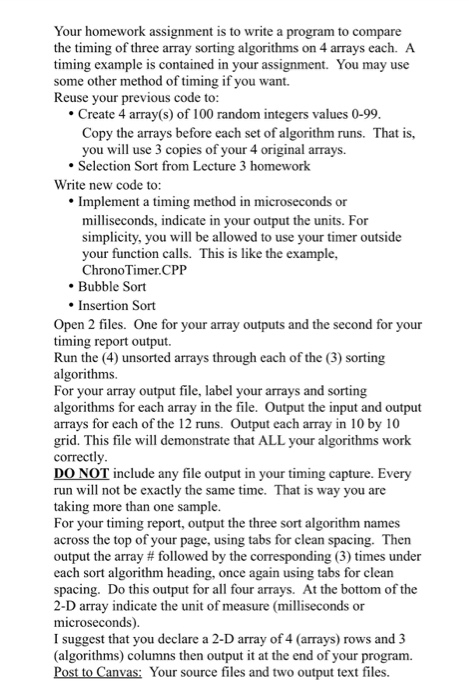
Your homework assignment is to write a program to compare the timing of three array sorting algorithms on 4 arrays each. A timing example is contained in your assignment. You may use some other method of timing if you want. Reuse your previous code to Create 4 array(s) of 100 random integers values 0-99 Copy the arrays before each set of algorithm runs. That is, you will use 3 copies of your 4 original arrays. . Selection Sort from Lecture 3 homework Write new code to: Implement a timing method in microseconds or milliseconds, indicate in your output the units. For simplicity, you wil be allowed to use your timer outside your function calls. This is like the example, ChronoTimer.CPP Bubble Sort Insertion Sort Open 2 files. One for your array outputs and the second for your timing report output. Run the (4) unsorted arrays through each of the (3) sorting algorithms. For your array output file, label your arrays and sorting algorithms for each array in the file. Output the input and output arrays for each of the 12 runs. Output each array in 10 by 10 grid. This file will demonstrate that ALL your algorithms work correctly DO NOT include any file output in your timing capture. Every run will not be exactly the same time. That is taking more than one sample For your timing report, output the three sort algorithm names across the top of your page, using tabs for clean spacing. Then output the array # followed by the corresponding (3) times under each sort algorithm heading, once again using tabs for clean spacing. Do this outpu 2-D array indicate the unit of measure (milliseconds or microseconds). I suggest that you declare a 2-D array of 4 (arrays) rows and 3 (algorithms) columns then output it at the end of your program. Post to Canvas: Your source files and two output text files. way you are t for all four arrays. At the bottom of the
Step by Step Solution
There are 3 Steps involved in it

Get step-by-step solutions from verified subject matter experts
 Study Help