







Question: Your program creates a single child process, printing at least one message from both the parent and child process indicating the FIDs of those processes
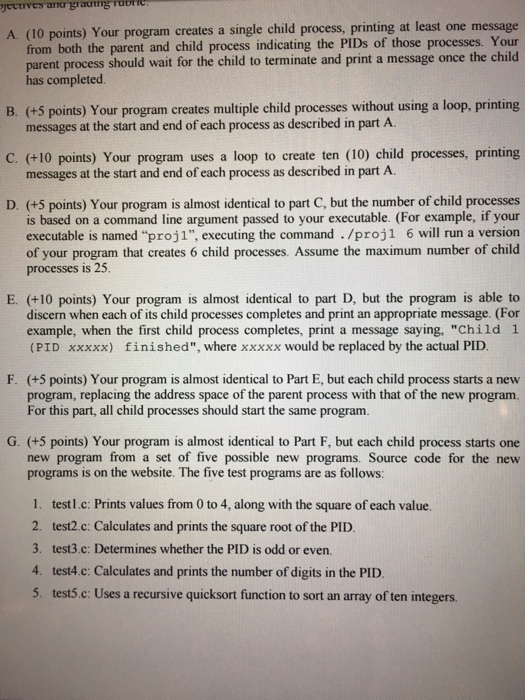
Your program creates a single child process, printing at least one message from both the parent and child process indicating the FIDs of those processes Your parent process should wait for the child to terminate and print a message once the child has completed Your program creates multiple child processes without using a loop, printing messages at the start and end of each process as described in part A. Your program uses a loop to create ten (10) child processes, printing messages at the start and end of each process as described in part A Your program is almost identical to part C, but the number of child processes is based on a command line argument passed to your executable (For example, if your executable is named "pro j 1". executing the command ./pro j 1 6 will run a version of your program that creates 6 child processes Assume the maximum number of child processes is 25. Your program is almost identical to part D, but the program is able to discern when each of its child processes completes and print an appropriate message (For example, when the first child process completes, print a message saying, "Child 1 (PID xxxxx) finished", where xxxxx would be replaced by the actual PID Your program is almost identical to Part F., but each child process starts a new program, replacing the address space of the parent process with that of the new program For this part, all child processes should start the same program
Step by Step Solution
There are 3 Steps involved in it

Get step-by-step solutions from verified subject matter experts
 Study Help