







Question: Your solution for lab #4 will be to create a C program which will accept a number of fixed verb names of your choosing. These
Your solution for lab #4 will be to create a C program which will accept a number of fixed verb names of your choosing. These will be replacements for variations of normal bash commands. Your program is to recognize the verb requested and create a process to run the equivalent bash command. To create the process you MUST use the fork() function and have the parent process wait() for it to complete.
Within the child process you MUST use one of the exec??() family of system calls to execute the required bash verb with your selected parameters. You are not allowed to call aliases or functions defined in your .bashrc (ask me why!).
As an example, in my version I have created a verb called "jobtree". When I run my code and type in "jobtree" at the prompt, it will produce the equivalent to the shell command:
ps -o user:32,pid,stime,tty,cmd -U jacques --forest
When I run jobtree in my shell, the C code will run the bash ps command followed by 5 parameters: "-o", " user:32,pid,stime,tty,cmd", "-U", "jacques", "--forest".
I strongly suggest that you get your commands working/tested in bash before you port them into your shell. It will help with debugging issues when things don't work later on.
Don't forget to add in an extra command to exit your shell and return to the bash shell. As an example I would add an extra verb like "logout" which would "exit" my C code and return to the original bash process. Of course, logout shouldn't trigger a fork() as this would just create an extra process and not just exit.
Ensure that you wait() for every child created by fork() or you will be creating zombie processes. Which, I will have to clean up. They waste system resources so, be vigilant. Do a "ps -ef | grep -e $USER" before you log out and make sure you aren't leaving any zombies behind.
For this exercise, you are required to create your own verb equivalents. You are required to use normal bash commands with parameters. Once you have selected 3 or 4 commands (not counting logout or help), then use exec() function call to execute the code.
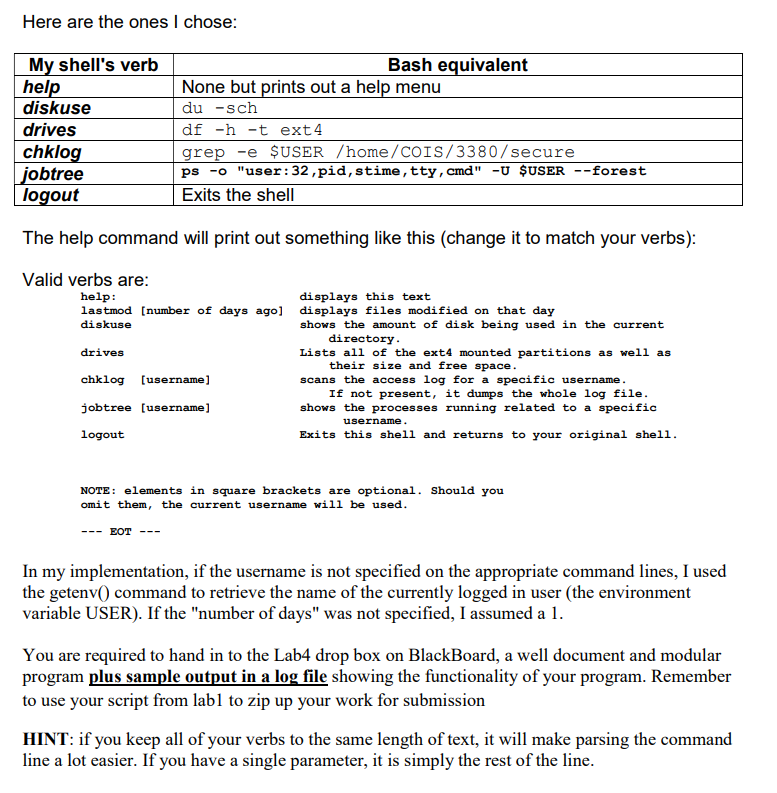
Here are the ones I chose: The help command will print out something like this (change it to match your verbs): Vi NOTE: elements in square brackets are optional. Should you omit them, the current username will be used. EOT In my implementation, if the username is not specified on the appropriate command lines, I used the getenv() command to retrieve the name of the currently logged in user (the environment variable USER). If the "number of days" was not specified, I assumed a 1. You are required to hand in to the Lab4 drop box on BlackBoard, a well document and modular program plus sample output in a log file showing the functionality of your program. Remember to use your script from labl to zip up your work for submission HINT: if you keep all of your verbs to the same length of text, it will make parsing the command line a lot easier. If you have a single parameter, it is simply the rest of the line
Step by Step Solution
There are 3 Steps involved in it

Get step-by-step solutions from verified subject matter experts
 Study Help