







Question: Your task is to develop classes to model a world involving Citizens and Traders, where Citizens are able to exchange gems for Goods including
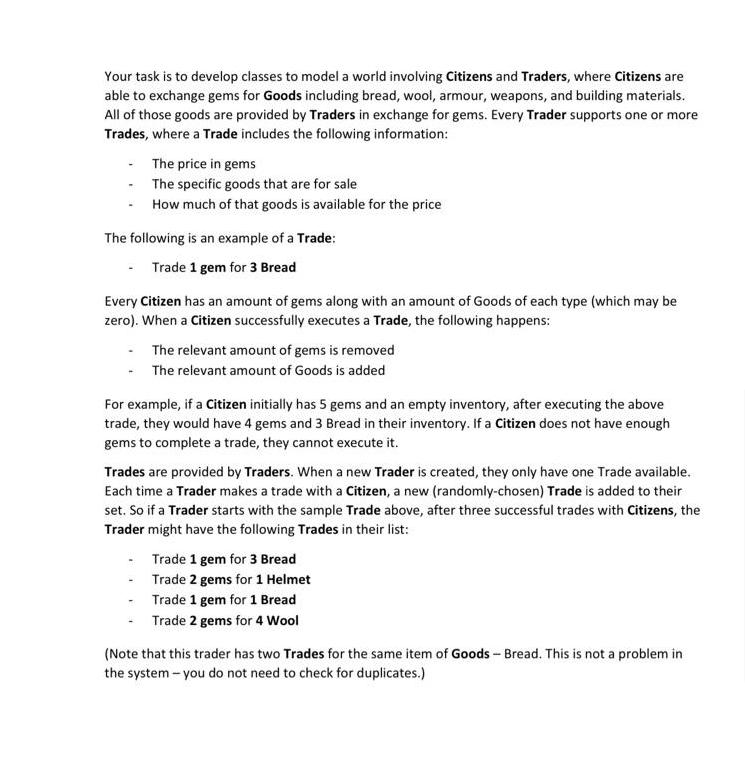
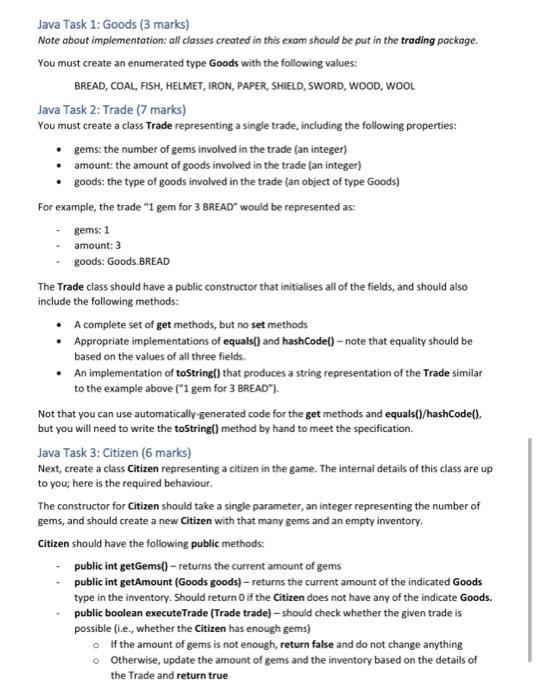
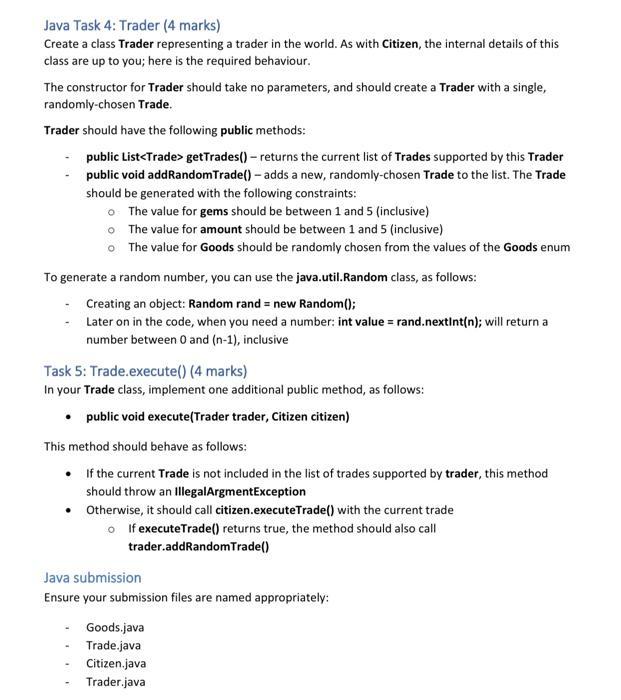
Your task is to develop classes to model a world involving Citizens and Traders, where Citizens are able to exchange gems for Goods including bread, wool, armour, weapons, and building materials. All of those goods are provided by Traders in exchange for gems. Every Trader supports one or more Trades, where a Trade includes the following information: - The price in gems The specific goods that are for sale How much of that goods is available for the price The following is an example of a Trade: - Trade 1 gem for 3 Bread Every Citizen has an amount of gems along with an amount of Goods of each type (which may be zero). When a Citizen successfully executes a Trade, the following happens: -The relevant amount of gems is removed - The relevant amount of Goods is added For example, if a Citizen initially has 5 gems and an empty inventory, after executing the above trade, they would have 4 gems and 3 Bread in their inventory. If a Citizen does not have enough gems to complete a trade, they cannot execute it. Trades are provided by Traders. When a new Trader is created, they only have one Trade available. Each time a Trader makes a trade with a Citizen, a new (randomly-chosen) Trade is added to their set. So if a Trader starts with the sample Trade above, after three successful trades with Citizens, the Trader might have the following Trades in their list: - Trade 1 gem for 3 Bread Trade 2 gems for 1 Helmet Trade 1 gem for 1 Bread Trade 2 gems for 4 Wool (Note that this trader has two Trades for the same item of Goods - Bread. This is not a problem in the system-you do not need to check for duplicates.) Java Task 1: Goods (3 marks) Note about implementation: all classes created in this exam should be put in the trading package. You must create an enumerated type Goods with the following values: BREAD, COAL, FISH, HELMET, IRON, PAPER, SHIELD, SWORD, WOOD, WOOL Java Task 2: Trade (7 marks) You must create a class Trade representing a single trade, including the following properties: gems: the number of gems involved in the trade (an integer) amount: the amount of goods involved in the trade (an integer) goods: the type of goods involved in the trade (an object of type Goods) For example, the trade "1 gem for 3 BREAD" would be represented as: gems: 1 amount: 3 goods: Goods.BREAD The Trade class should have a public constructor that initialises all of the fields, and should also include the following methods: A complete set of get methods, but no set methods Appropriate implementations of equals() and hashCode()-note that equality should be based on the values of all three fields. An implementation of toString() that produces a string representation of the Trade similar to the example above ("1 gem for 3 BREAD"). Not that you can use automatically-generated code for the get methods and equals()/hashCode(), but you will need to write the toString() method by hand to meet the specification. Java Task 3: Citizen (6 marks) Next, create a class Citizen representing a citizen in the game. The internal details of this class are up to you; here is the required behaviour. The constructor for Citizen should take a single parameter, an integer representing the number of gems, and should create a new Citizen with that many gems and an empty inventory. Citizen should have the following public methods: public int getGems()-returns the current amount of gems public int getAmount (Goods goods) - returns the current amount of the indicated Goods type in the inventory. Should return 0 if the Citizen does not have any of the indicate Goods. public boolean executeTrade (Trade trade) - should check whether the given trade is possible (i.e., whether the Citizen has enough gems) o If the amount of gems is not enough, return false and do not change anything Otherwise, update the amount of gems and the inventory based on the details of the Trade and return true o Java Task 4: Trader (4 marks) Create a class Trader representing a trader in the world. As with Citizen, the internal details of this class are up to you; here is the required behaviour. The constructor for Trader should take no parameters, and should create a Trader with a single, randomly-chosen Trade. Trader should have the following public methods: public List getTrades () - returns the current list of Trades supported by this Trader public void addRandomTrade() - adds a new, randomly-chosen Trade to the list. The Trade should be generated with the following constraints: o The value for gems should be between 1 and 5 (inclusive) o The value for amount should be between 1 and 5 (inclusive) o The value for Goods should be randomly chosen from the values of the Goods enum To generate a random number, you can use the java.util.Random class, as follows: Creating an object: Random rand = new Random(); Later on in the code, when you need a number: int value = rand.nextInt(n); will return a number between 0 and (n-1), inclusive Task 5: Trade.execute() (4 marks) In your Trade class, implement one additional public method, as follows: public void execute(Trader trader, Citizen citizen) This method should behave as follows: If the current Trade is not included in the list of trades supported by trader, this method should throw an IllegalArgmentException Otherwise, it should call citizen.executeTrade() with the current trade o If executeTrade() returns true, the method should also call trader.addRandom Trade() Java submission Ensure your submission files are named appropriately: Goods.java Trade.java Citizen.java Trader.java
Step by Step Solution
3.40 Rating (153 Votes )
There are 3 Steps involved in it
Here are the Java classes to model the world involving Citizens Traders Goods and Trades java packag... View full answer

Get step-by-step solutions from verified subject matter experts
 Study Help