





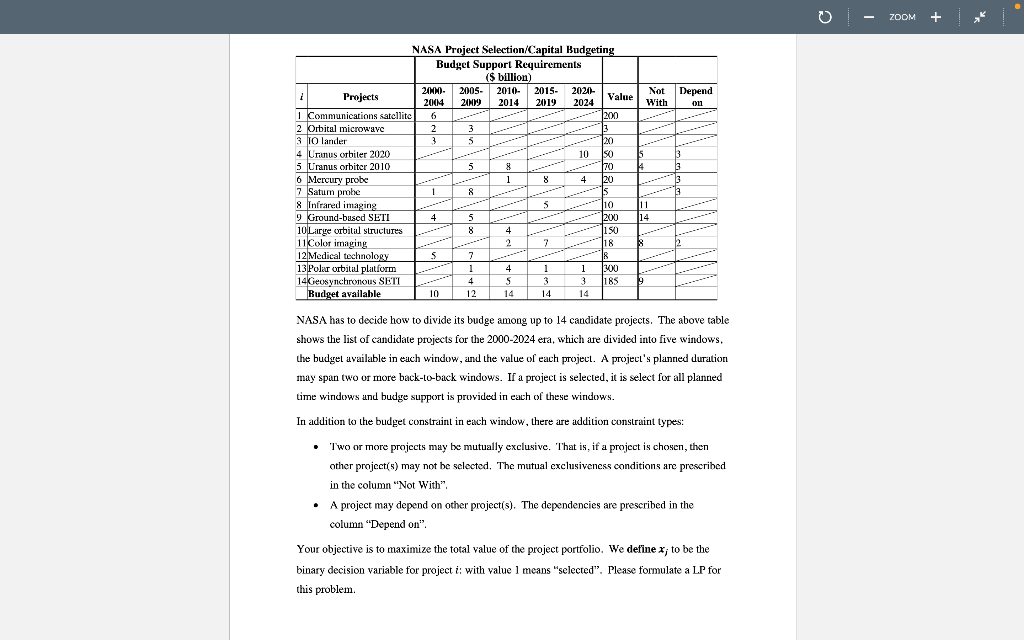
Question: ZOOM Not With Depend on 2024 Value . .. 10 15 P 4 5 8 NASA Project Selection/Capital Budgeting Budget Support Requirements ($ billion) 20)
ZOOM Not With Depend on 2024 Value . .. 10 15 P 4

ZOOM Not With Depend on 2024 Value . .. 10 15 P 4 5 8 NASA Project Selection/Capital Budgeting Budget Support Requirements ($ billion) 20) 1 Projects 2005- 2010- 2015. 2020- 2004 2119 2014 2019 I Communications satellite 6 200 2 Orbital microwave 2 3 3 3 TO lander 3 20 4 Uranus orbiter 2020 so 5 Uranus orbiter 2010 170 6 Mercury probe 20 7 Satum probe IS 8 Infrared imaging 10 9 Ground-based SETI 4 5 200 10 Large orbilad structures 8 4 150 11 Color imaging 2 18 12 Medical technology S 18 13 Polar orbitu platform 1 4 1 1 400 14 Geosynchronous SETI 4 5 3 3 185 Budget available 10 12 14 14 14 1 8 4 3 3 13 1 8 s 111 14 2 12 S 7 NASA has to decide how to divide its budge among up to 14 candidate projects. The above table shows the list of candidate projects for the 2000-2024 era, which are divided into five windows, the budget available in each window, and the value of each project. A project's planned duration may span two or more back-to-back windows. If a project is selected, it is select for all planned time windows and budge support is provided in each of these windows. In addition to the budget constraint in each window, there are addition constraint types: Two or more projects may be mutually exclusive. That is, if a project is chosen, then other project(s) may not be selected. The mutual exclusiveness conditions are prescribed in the column "Not With". A project may depend on other project(s). The dependencies are prescribed in the column "Depend on". Your objective is to maximize the total value of the project portfolio. We define x; to be the binary decision variable for project i: with value 1 means "selected". Please formulate a LP for this problem, ZOOM Not With Depend on 2024 Value . .. 10 15 P 4 5 8 NASA Project Selection/Capital Budgeting Budget Support Requirements ($ billion) 20) 1 Projects 2005- 2010- 2015. 2020- 2004 2119 2014 2019 I Communications satellite 6 200 2 Orbital microwave 2 3 3 3 TO lander 3 20 4 Uranus orbiter 2020 so 5 Uranus orbiter 2010 170 6 Mercury probe 20 7 Satum probe IS 8 Infrared imaging 10 9 Ground-based SETI 4 5 200 10 Large orbilad structures 8 4 150 11 Color imaging 2 18 12 Medical technology S 18 13 Polar orbitu platform 1 4 1 1 400 14 Geosynchronous SETI 4 5 3 3 185 Budget available 10 12 14 14 14 1 8 4 3 3 13 1 8 s 111 14 2 12 S 7 NASA has to decide how to divide its budge among up to 14 candidate projects. The above table shows the list of candidate projects for the 2000-2024 era, which are divided into five windows, the budget available in each window, and the value of each project. A project's planned duration may span two or more back-to-back windows. If a project is selected, it is select for all planned time windows and budge support is provided in each of these windows. In addition to the budget constraint in each window, there are addition constraint types: Two or more projects may be mutually exclusive. That is, if a project is chosen, then other project(s) may not be selected. The mutual exclusiveness conditions are prescribed in the column "Not With". A project may depend on other project(s). The dependencies are prescribed in the column "Depend on". Your objective is to maximize the total value of the project portfolio. We define x; to be the binary decision variable for project i: with value 1 means "selected". Please formulate a LP for this

Step by Step Solution

There are 3 Steps involved in it

1 Expert Approved Answer
Step: 1 Unlock blur-text-image

Question Has Been Solved by an Expert!

Get step-by-step solutions from verified subject matter experts

Step: 2 Unlock
Step: 3 Unlock

Students Have Also Explored These Related General Management Questions!