New Semester
Started
Get
50% OFF
Study Help!
--h --m --s
Claim Now
Question Answers
Textbooks
Find textbooks, questions and answers
Oops, something went wrong!
Change your search query and then try again
S
Books
FREE
Study Help
Expert Questions
Accounting
General Management
Mathematics
Finance
Organizational Behaviour
Law
Physics
Operating System
Management Leadership
Sociology
Programming
Marketing
Database
Computer Network
Economics
Textbooks Solutions
Accounting
Managerial Accounting
Management Leadership
Cost Accounting
Statistics
Business Law
Corporate Finance
Finance
Economics
Auditing
Tutors
Online Tutors
Find a Tutor
Hire a Tutor
Become a Tutor
AI Tutor
AI Study Planner
NEW
Sell Books
Search
Search
Sign In
Register
study help
sciences
nuclear physics
Physics Of Nuclear Reactors 1st Edition P Mohanakishnan - Solutions
The events (1) loss of offsite power, (2) Coolant pumps, (3) Steam water system, and (4) Transients] contribute to core damage frequency (CDF). Given a core damage event, calculate the probability that it was not initiated by loss of offsite power. The frequencies per year for respective events
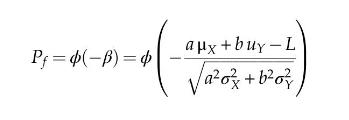
Suppose that the strength of a material is a linear function of two variables \(X\) and \(Y\), as \(S=a X+b Y\). The variables \(X\) and \(Y\) are normally distributed with mean \(\mu_{X}\) and \(\mu_{Y}\) and standard deviation \(\sigma_{X}\) and \(\sigma_{Y}\). Failure is said to occur if
Consider a \(\mathrm{BF}_{3}\) neutron detector of length \(20 \mathrm{~cm}\). Find its efficiency for thermal \((0.025 \mathrm{eV})\) and fast \((1 \mathrm{MeV})\) neutrons. Assume the fill gas pressure to be (a) \(0.5 \mathrm{~atm}\) and (b) \(1 \mathrm{~atm}\).
Using the Maxwell distribution for neutron flux given in Eq. (10.4), establish the relation between average energy and peak energy. Also, find the value of temperature that would correspond to a peak energy value of \(0.625 \mathrm{eV}\). (E): E (KT)2 ES (10.4)
Using the value of constants, \(A=1.058 \times 10^{3}, B=1.0363\), and \(C=2.29\), in Eq. (10.6), obtain the plot of Watt spectrum for neutron induced fission in \({ }^{235} \mathrm{U}\). N(E)=Ae=BE sinh(VCE) (10.6)
Find the saturation activity induced in gold foil irradiated in a thermal neutron flux of \(1.0 \times 10^{9} \mathrm{n} / \mathrm{cm}^{2} / \mathrm{s}\), given that the activation cross section for \({ }^{197} \mathrm{Au}\) in thermal spectrum is \(98.5 \mathrm{~b}\).
Assume a copper foil to be irradiated in a thermal neutron flux of \(1.0 \times 10^{9} \mathrm{n} / \mathrm{cm}^{2} / \mathrm{s}\). Using activation cross section for \({ }^{63} \mathrm{Cu}\) as \(4.41 \mathrm{~b}\) and for \({ }^{65} \mathrm{Cu}\) as \(1.8 \mathrm{~b}\), find the ratio of
Assuming detector efficiency of \(2 \%\), find the counts recorded by the detector for a gold foil irradiated in a thermal flux of \(1.0 \times 10^{9} \mathrm{n} / \mathrm{cm}^{2} / \mathrm{s}\) for \(1 \mathrm{~h}\). Assume that the cooling time is \(20 \mathrm{~h}\). Flux perturbation factor can
On insertion of a certain positive reactivity into a critical reactor (fueled with \({ }^{235} \mathrm{U}\) ), power was found to double every \(600 \mathrm{~s}\). Find the associated reactor period and hence the amount of reactivity added. Assume neutron generation time to be \(1 \mathrm{~ms}\)
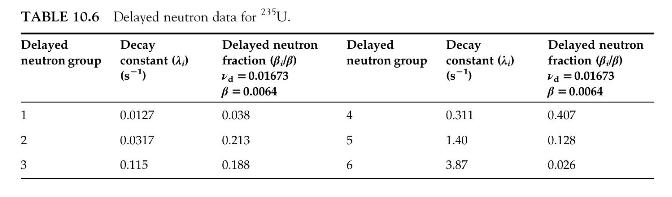
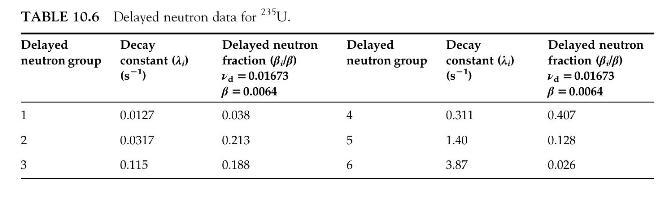
A positive reactivity was added to a critical reactor operating at a certain steady power level. The reactor power increased by \(20 \%\) in \(100 \mathrm{~s}\). Use the delayed neutron data given in Table 10.6 and find the amount of reactivity inserted. TABLE 10.6 Delayed neutron data for 235U.
A critical reactor is operating at power of \(100 \mathrm{~W}\) and a certain amount of instantaneous negative reactivity is added into the core. Immediately after reactivity addition, the power level drops to \(10 \mathrm{~W}\). Using the total delayed neutron fraction of 0.0076 , estimate the
A critical reactor is operating at \(100 \mathrm{~W}\) power and \(90 \mathrm{mK}\) of instantaneous negative reactivity is added into the core. Find the power level immediately after the reactivity addition. Use the total delayed neutron fraction value of 0.0076 .
In a certain subcritical measurement, the detector counts observed between two successive reactivity insertion stages were \(3450 \mathrm{cps}\) and \(4675 \mathrm{cps}\). Find the level of subcriticality.
(a) In experimental reactors, the control rod worth is measured using the change in geometric buckling. Assuming that only the leakage or geometrical buckling changes in such an experiment, derive an expression for its reactivity worth as a function of this buckling.(b) A spherical reactor using a
Calculate and compare the ranges of alpha of energy \(4.5 \mathrm{MeV}\) and beta particle of energy \(0.6 \mathrm{MeV}\) in polyethylene and acrylic glass. Use Bragg-Kleeman relation in the case of alpha and an appropriate empirical formula for beta particle.
For a gamma photon of energy \(1.5 \mathrm{MeV}\), calculate the maximum and minimum energy loss as a result of Compton scattering.
The mass attenuation coefficients for gamma radiation of energy \(5 \mathrm{MeV}\) in sodium, iron, and lead are \(2.753 \mathrm{E}-02,3.146 \mathrm{E}-02\), and \(4.272 \mathrm{E}-02 \mathrm{~g} / \mathrm{cm}^{2}\), respectively. Find the corresponding half value, fifth value, and tenth value
Assume that \(5 \mathrm{MeV}\) gamma (in the form of a narrow beam) is incident on a composite medium of \(2 \mathrm{~cm}\) sodium, \(0.5 \mathrm{~cm}\) of lead, and some unknown thickness of Iron medium. If the uncollided gamma intensity on the other side of the composite shield is \(1 / 150\) th
Consider that a monoenergetic point source of gamma radiation \((800 \mathrm{keV})\) with strength of \(10^{5}\) gammas \(/ \mathrm{s}\) is located at a point in air. At a distance of \(5 \mathrm{~cm}\), a composite shield of lead (thickness \(0.5 \mathrm{~cm}\) ) and iron (thickness \(2.5
If the half value layer for iron is \(1.7 \mathrm{~cm}\) for \(1.332 \mathrm{MeV}\) photons and the exposure rate from a source is \(1000 \mathrm{mR} / \mathrm{h}\), calculate (a) \(\mu\left(\mathrm{cm}^{-1}ight)\), (b) the thickness of iron required to reduce the exposure rate to \(100 \mathrm{mR}
Compute the following reaction rates \(/ \mathrm{cm}^{3} / \mathrm{s}\) :a. B-10(n, \(\alpha) \mathrm{Li}-7\) in the material Boron Carbide \(\mathrm{B}_{4} \mathrm{C}\) of density \(2.3 \mathrm{~g} / \mathrm{cc}\) : Take the cross-section to be \(500 \mathrm{~b}\), flux as \(10^{15} \mathrm{n} /
Consider a line source of length \(50 \mathrm{~cm}\) and with strength of \(10^{4}\) gammas \(/ \mathrm{cm} / \mathrm{s}\) and surrounded by vacuum. It emits two gammas of energy 200 and \(1250 \mathrm{keV}\) with intensities \(30 \%\) and \(70 \%\). Find the gamma flux at two points, one which is
A cesium source in the form of a disc of radius \(3 \mathrm{~cm}\) has a uniform activity of strength \(2 \mathrm{mCi} / \mathrm{cm}^{2}\). What is the dose at a point \(\mathrm{P}, 10 \mathrm{~cm}\) from the disc along the central axial direction. Take the dose conversion coefficient to be
A point source of photons of energy \(1.0 \mathrm{MeV}\) is giving a dose of \(10 \mathrm{mR} / \mathrm{h}\) at a dose point \(P\). How much thickness of lead (density \(11 \mathrm{~g} / \mathrm{cc}\) ) is to be provided in between source and dose point \(\mathrm{P}\) if the dose rate has to be
Calculate the dpa that iron experiences when iron is exposed to a \(1 \mathrm{MeV}\) neutron flux of \(5 \times 10^{15} / \mathrm{cm}^{2} / \mathrm{s}\) for a period of 2 years. Take the damage cross-section to be \(100 \mathrm{~b}\).
What are the new features of Gen III/ \(\mathrm{III}^{+}\)reactors relative to the Gen I and Gen II reactors?
What are the features that foster to innovate over Gen \(\mathrm{III} / \mathrm{III}^{+}\)reactors and what new goals are specified for Gen IV reactors?
The challenges arising in designing the reactor with core outlet temperature of the order of \(1273 \mathrm{~K}\) ?
What are the common and unique features of six types of Gen IV reactors?
The fuel invented to withstand high temperature in HTRs and its special characteristics?
Explain the configurations in vogue in the design of HTRs.
Advantages of heavy metal-cooled fast reactors and helium gas-cooled fast reactors over sodium-cooled fast reactors?
Advantages and challenges in developing the molten salt reactors?
Challenges in the design of super critical water reactors?
What are the objectives of developing HTRs and MSR in India?
List the reactor physics design challenges in Gen IV reactors?
List the major incentives in developing SMRs.
The goals to be achieved by SMR design?
The applications of nonelectric power generation in nuclear reactors in different types of industry?
Major change in the design of light and heavy water reactors to achieve design characteristics of SMRs.
Explain inherent safety and passive safety in the reactors.
How the cost, safety, waste generation, and proliferation of resistance of SMRs can be compared with large-sized reactors.
List the design features that are affected by the "size" and the "design" of the SMRs?
What is Breeder and Burn (B\&B) concept?
The genesis of TWRs and the mechanism that establishes the TWRs?
The parameters that characterize the TWRs?
What are the necessary conditions for development of TWRs, SWRs, CANDLE, and UCB SWRs?
What way the TWRs are different than the SWRs?
What are the reactor physics requirements for sustainability of TWRs?
What is the strategy of fuel utilization in a CANDLE reactor?
What are the advantages of CANDLE reactors?
Major challenges in developing B\&B concept based reactors?
Showing 100 - 200
of 152
1
2
Step by Step Answers

 Get 50% OFF
Claim Now
Get 50% OFF
Claim Now