







Question: A multiple recycle-loop problem, formulated by Cavett2 and shown in Figure 10.36, has been used to test tearing, sequencing, and convergence procedures. The flowsheet is
A multiple recycle-loop problem, formulated by Cavett2 and shown in Figure 10.36, has been used to test tearing, sequencing, and convergence procedures. The flowsheet is the equivalent of a four-theoretical-stage, near-isothermal distillation (rather than the conventional near-isobaric type), for which a patent by Gunther3 exists. The flowsheet does not include necessary mixers, compressors, pumps, valves, or heat exchangers to make it a practical system. For the specifications shown in Figure 10.36, determine the component flow rates for all streams in the process.
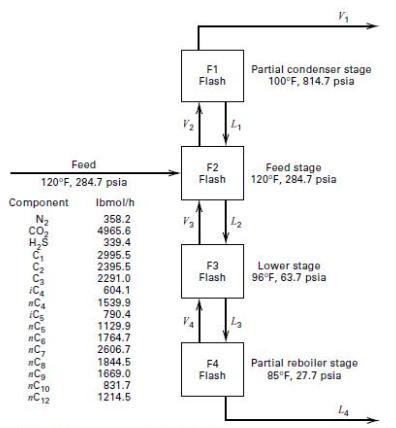
Feed 120F, 284.7 psia Component Ibmol/h 358.2 N CO 4965.6 339.4 2995.5 2395.5 C3 CA nC4 C nC5 nC6 nC7 nCB nCg C10 nC12 2291.0 604.1 1539.9 790.4 1129.9 1764.7 2606.7 1844.5 1669.0 831.7 1214.5 V3 V4 F1 Flash F2 Flash F3 Flash F4 Flash Figure 10.36 Data for Exercise 10.35. 41 12 L V Partial condenser stage. 100F, 814.7 psia Feed stage 120F, 284.7 psia Lower stage 96F, 63.7 psia Partial reboiler stage 85F, 27.7 psia La
Step by Step Solution
3.41 Rating (160 Votes )
There are 3 Steps involved in it
Solution The problem is to determine the flows for A B and C in the process For this problem ... View full answer

Get step-by-step solutions from verified subject matter experts
 Study Help