







Question: A Young's interference experiment is performed in the geometry shown in Fig. 5-14p. The pinholes are circular and have finite diameter (delta) and spacing (s).
A Young's interference experiment is performed in the geometry shown in Fig. 5-14p. The pinholes are circular and have finite diameter \(\delta\) and spacing \(s\). The source has bandwidth \(\Delta v\) and mean frequency \(\bar{v} . f\) is the focal length of the lens. The following two effects cause the fringes to be attenuated away from the optical axis:
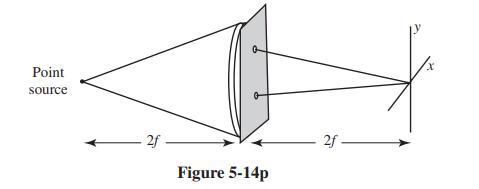
(a) The finite size of the pinholes,
(b) The finite bandwidth of the source.
Given \(\delta, s\), and \(f\), how small must the fractional bandwidth \(\Delta v / \bar{v}\) be to assure that effect
(a) dominates over effect (b)?
Point source 2f Figure 5-14p 2f-
Step by Step Solution
3.29 Rating (155 Votes )
There are 3 Steps involved in it
In the Youngs interference experiment shown in Figure 514p the interference fringes are attenuated a... View full answer

Get step-by-step solutions from verified subject matter experts
 Study Help